Motion Graphics in Advertising
We open this guide by defining what this format means for modern brand creative. Short, animated video pieces combine text, icons, shapes, sound, and data to say more in seconds than static posts can in minutes.
Our focus is practical: how these motion-driven visuals earn attention, boost recall, and improve click-through rates across paid ads, social feeds, websites, email, and internal comms.
We set clear expectations for teams. Great work builds awareness, educates customers, and supports conversion while staying consistent with design and brand voice.
Throughout this guide we use real examples — from major product launches to explainer clips — to show what success looks like in the market today.
Below the image, we preview the outcomes we will measure: engagement, shares, recall, and downstream conversions. That keeps our recommendations performance-focused and actionable.
Why Motion Graphics Matter in Today’s Attention Economy
In a world of fast scrolling, the opening seconds define whether viewers stay or swipe away.
We have to capture attention quickly on social media and mobile. Marketing data shows the first three seconds are the true battleground. Users scan feeds fast; a Microsoft-cited study pegs digital attention at about eight seconds. Twitter/X reported a 62% rise in video views from 2019 to 2020, which proves short clips earn more reach.
That reality changes creative choices. We favor bigger, readable text and quick value delivery. Simple motion hooks guide the eye without crowding the message. These tactics boost engagement and help our content stand out in a crowded media mix.
- Win the first three seconds with a clear visual hook that can grab attention.
- Design for rapid scanning: bold on-screen text, fast pacing, clear offer.
- Use short clips to increase shareability—they feel alive and invite taps or reposts.
What Motion Graphics Are and What They Aren’t
Let’s define the short, message-driven work we use to explain products and ideas. Motion graphics are animated designs that put readable text, clean icons, and simple shapes at the center of a clip.
We build these video pieces from core elements: typography, charts, transitions, and iconography that carry meaning fast. That focus keeps the message clear and reduces production time versus story-led approaches.

A plain-English definition
At their core, these videos combine text and moving visual cues to explain a single idea. We rely on timing, scale, and layout to make the point within seconds.
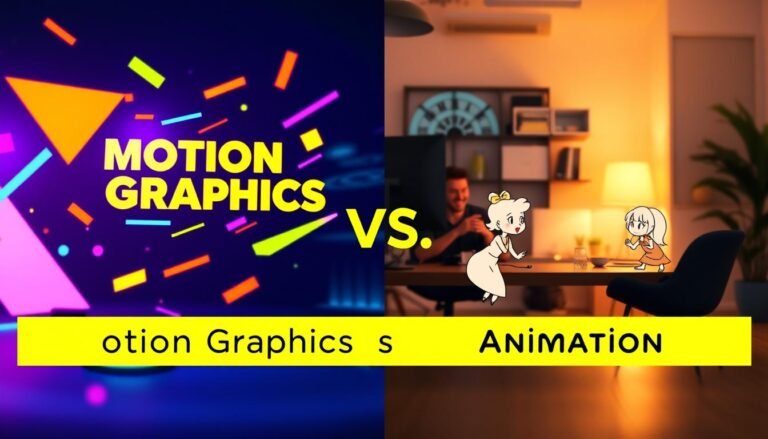
Motion graphics vs. animation
Animation often centers on narrative, characters, and world-building. By contrast, our approach stays messaging-first. We choose animations only when story or character adds clear value.
Where motion design sits across formats
Motion design spans 2D, 3D, and mixed media. We pair live-action footage with overlays when we need realism plus clarity.
- Building blocks: typography, icons, shapes, charts, transitions.
- Not a character-led film: fewer plot beats, lower complexity.
- Best use: short video that explains, prompts action, or clarifies data.
Motion Graphics in Advertising: Core Benefits Backed by Performance Data
Effective short-form video ties creative choices directly to metrics that matter for marketers. We use clear benchmarks to show why moving visuals work for awareness, sharing, and sales.
Higher recall
Viewers remember about 95% of a message from video versus 10% from plain text. That gap explains why we prioritize clips that state one idea clearly.
More engagement and shares
Motion effects create stopping power in fast feeds when the movement supports comprehension. Motion-centric creative can drive up to 1,200% more shares, which amplifies reach with the same media spend.
More conversions and ROI
Clear explanations and emotional pacing help convert. Studies show conversion lifts up to 80% and 82% of people say video convinces them to buy.
Marketers report strong ROI: 87% say video delivers a solid return and teams can generate roughly 66% more qualified leads year-over-year when they use video effectively.
- Retention: 95% vs 10% (video vs text)
- Sharing lift: up to 1,200% more shares
- Conversion gains: as much as +80%; 82% buyer influence stat
| Outcome | Benchmark | Practical impact |
|---|---|---|
| Recall | 95% vs 10% | Fewer repeated impressions needed |
| Shares | +1,200% | Organic reach multiplier |
| Leads & ROI | +66% leads; 87% report ROI | Better funnel efficiency |
We translate these metrics into tactics: design movement that clarifies information, place short clips where viewers scan, and test variants to protect conversions. Next, we look at where these formats perform best across channels.
Where Motion Graphic Ads Perform Best Across Channels
We map where short video assets earn the most attention and how to adapt creative for each placement.
Paid media on Facebook, Instagram, and Amazon consistently outperforms static creative. Tests show motion ads can drive about 1.5x more clicks than still images. For campaign planners, that lift justifies modest production and A/B tests early in a flight.
Social media formats
For feed, Stories, and short-form platforms, open strong. The first frames must state the value even with sound off. We favor bold text, clear CTAs, and single-idea clips that work across aspect ratios.
Website headers and landing pages
Adding subtle motion to headers can invite exploration and push users deeper on a page. Small looping video or animated overlays guide the eye toward offers and product features without slowing load time.

Launch, internal, and email use cases
Launch campaigns benefit because short clips communicate product value fast with simple metaphors and clear text. Internal company comms use moving visuals to make training and updates easier to watch and remember.
Email marketing also performs well. Lightweight motion—GIFs or a short video—can lift click-through rates by roughly 200–300% where deliverability allows. We recommend testing compressed formats first.
| Channel | Why it works | Practical tip |
|---|---|---|
| Paid media | Higher click volume vs static | Test 1–2 motion variants per creative |
| Social media | Fast scanning, muted starts | Lead with text and contrast |
| Website & email | Drives exploration and CTR lift | Use short loops; optimize file size |
Across channels we keep a single brand motion system that scales. Reuse assets and timing so our content stays consistent while fitting each placement.
Types of Motion Graphics Brands Use to Tell Stories
Brands use a range of short animated formats to turn complex ideas into simple stories. We categorize formats so teams pick the right tool for the job and avoid one-size-fits-all creative.
Explainer video formats for product and services
We use explainer video for product demos and for marketing services. These clips focus on one clear benefit and handle top objections fast.
Instructional and UX animation for onboarding
Small UX animation guides users through flows. These reduce friction and shorten time to value during setup or product tours.
Animated logos, titles, and branded stingers
Animated logos and titles add polish across campaigns. They create consistent brand beats that help recognition over time.
Interactive infographics and data visualizations
Interactive visuals make numbers easier to scan. We use animated charts when credibility and clarity matter most.
GIFs, micro-animations, and lightweight clips
GIFs and micro-animations drive quick engagement. They work where full videos would slow production or load times.
Animated presentations for stakeholders
For sales and internal storytelling, animated presentations keep pacing and hierarchy tight. These help teams share a clear argument without long meetings.
| Format | Primary use | Key element | Best for |
|---|---|---|---|
| Explainer video | Feature & benefit demos | Clear script and CTA | Product pages, landing pages |
| UX animation | Onboarding & flows | Step-by-step visuals | In-app tutorials |
| Interactive infographic | Data-driven storytelling | Animated charts | Reports, thought leadership |
| GIFs / micro clips | Social engagement | Short loops | Emails, feeds, ads |
What Makes a High-Performing Motion Graphics Ad
We build top-performing ads by prioritizing legible text, guided visuals, and tight pacing from frame one. Our craft choices help the viewer read, understand, and act within the first few seconds.
Kinetic typography that makes text the hero
Kinetic typography keeps the core message readable on small screens. We scale type, shorten lines, and animate only to support comprehension.
Iconography, shapes, and transitions that guide the eye
Simple icons and clear shapes create hierarchy. Clean transitions lead attention from headline to offer without causing confusion.
Sound design, music, and voiceover that boost clarity
We use subtle effects and short musical cues to mark beats. Voiceover is spare and timed to reinforce the on-screen text for sound-on and sound-off viewers.
On-brand color, style, and layout systems that scale
Consistent color rules, type scales, and spacing let us produce many ad variants fast. A shared style reduces review cycles and keeps campaigns coherent.
Pacing for short ads: how to say more in 15–30 seconds
We map each second to a single idea: hook, value, proof, CTA. That rhythm keeps 15–30 second ads clear without feeling rushed.
- Legibility on mobile: test at native sizes.
- Safe zones: keep CTAs away from UI overlays.
- Consistent easing: match transitions across cuts.

Building a Motion Graphics Strategy That Fits Our Brand
Start by naming a single objective so our creative solves one problem well. We choose awareness, education, or conversion as the primary target and measure against that goal.
Choosing one primary goal
We pick one goal per campaign. That keeps the message tight and the creative clear. It also makes testing and reporting faster.
Matching message complexity to approach
Simple claims use short, punchy clips. Complex topics get step-by-step visuals and longer cuts. We match tempo and assets to the message we must convey.
Product vs services storytelling
Product work tends to show features and quick demos. Services need conceptual storytelling that maps problem to solution. We pick formats that fit each case.
Planning formats and variations
Plan aspect ratios, lengths, and templates up front. Build variations for YouTube, Stories, and banners so we avoid last-minute fixes.
Repeatable motion system
We create templates, modular scenes, and brand rules. This reduces time per asset and keeps our brand consistent across media.
| Primary Goal | Approach | Best Formats | Quick Tip |
|---|---|---|---|
| Awareness | Bold hook, short message | 6–15s feeds, Stories | Lead with contrast |
| Education | Step-by-step visuals | 30–60s explainer, landing pages | Use clear labels |
| Conversion | Proof and CTA | 15–30s ads, email clips | Keep CTA visible |
How We Create Motion Graphics Ads From Brief to Final Deliverables
Our process turns strategy into deliverables by sequencing discovery, scripting, design, animation, sound, and delivery. We set clear checkpoints so the company knows which inputs reduce revisions and which choices drive performance.
Discovery: audience, positioning, and objectives
We start by defining the audience and campaign objectives. This aligns the company on outcomes and keeps creative decisions tied to measurable goals.
Script and storyboard: structuring information for clarity
Scripts compress complex information into a clear sequence. Storyboards show timing and visual beats so the team proofs meaning before assets are made.
Design: custom assets, typography, and branded visuals
Design creates reusable assets and type systems that scale across cuts. Our approach keeps brand rules simple and consistent for fast approvals.
Animation: bringing graphics to life with polished motion design
Animation adds rhythm, easing, and hierarchy. We use motion design to guide attention and make each frame readable on small screens.
Sound and finishing: music, effects, and final pacing
We pick music and effects that support pacing without overpowering text. Final checks confirm legibility, accessibility, and correct deliverable specs.
Delivery: platform-optimized exports
We export videos for feeds, Stories, and display with proper codecs, sizes, and captions. The delivery step includes tools and handoffs so media runs as intended.
| Phase | Focus | Output |
|---|---|---|
| Discovery | Audience & objectives | Brief & creative brief |
| Production | Design & animation | Master files & variants |
| Finish | Sound & delivery | Platform-ready videos |
Motion Graphics Examples That Show What “Great” Looks Like
Seeing real executions helps teams benchmark what clear, fast storytelling looks like. Below we highlight compact case studies and pull practical takeaways you can reuse.
Product launches that blend live action with 2D/3D
Google’s Gemini-era launch pairs live footage with layered 2D/3D overlays. The result balances realism and clarity for product proof points.
Brand history and rebrand videos driven by typography and transitions
Netflix’s anniversary film and Intel’s identity pieces rely on kinetic type and clean transitions to tell a brand story without complex plots.
Explainer videos that simplify services and processes
Slack’s explainer approach uses visual metaphors to reduce perceived complexity and make services easier to act on.
Six-second micro-ads that communicate a single point
Ultra-short clips, like inDrive’s savings spot, prove a one-idea ad can win attention and lift recall when executed with a sharp visual hook.
| Example Type | Key Takeaway | Best Use |
|---|---|---|
| Launch (live+CG) | Pace overlays for clarity | Product reveal |
| Rebrand | Typography carries identity | Brand film |
| Explainer | Visual metaphors cut complexity | Services pages |
| Micro-ad | One point, one hook | Feed ads |
Measuring Success and Optimizing Motion Ads Over Time
We track creative performance against clear business targets so teams can act fast.
Key metrics to track across paid media, social placements, and websites
We measure outcomes by objective. For awareness, we use view-through rates and recall proxies. For education, we track completion rates and saves. For conversion campaigns, CTR and CVR are primary signals.
Creative testing: hooks, text, visuals, and animation intensity
Our testing approach focuses on the first frames. We swap hooks, on-screen text, and visuals to see what stops viewers fastest. We also vary animation intensity to balance clarity and appeal.
Scaling what works with templates, localization, and workflows
When a variant wins, we standardize it into templates. Localization adjusts language, claims, and imagery for regions. This way we keep brand consistency while scaling fast across media.
- Benchmarks: 49% revenue lift from multi-channel campaigns; 200–300% CTR lift in email where applicable.
- Prioritize quick cycles: test, learn, and iterate rather than waiting for a single big launch.
| Objective | Primary Metric | Scale Action |
|---|---|---|
| Awareness | View-through / Recall | Roll hooks into templates |
| Education | Completion / Saves | Standardize pacing and labels |
| Conversion | CTR / CVR | Localize CTA and offers |
Our repeatable loop is simple: test, learn, standardize, scale. Over time this approach turns short tests into lasting gains and measurable ROI.
Bringing Our Brand Story to Life With Motion—Next Steps
We close with clear next steps to bring our brand story to life through short, focused video work. The core promise is simple: clearer communication, stronger recall, and scalable creative across channels.
Start by auditing current ads and content, choose one campaign objective, and map priority placements. Build a small, repeatable design system—type, color, transitions, and modular scenes—so our brand appears consistent everywhere.
Follow a tight roadmap: brief → storyboard → design → motion → sound → delivery, with named owners and checkpoints. Launch fast, measure results, and iterate on hooks, pacing, and message clarity.
This is not a trend but a lasting capability we can invest in to make our brand feel active and recognized in a crowded world.