How Much Does Motion Graphics Cost for Business
We wrote this guide so US teams could budget real work with clear expectations. By “motion graphics” we meant animated branding, explainer clips, and UI sequences that combine illustration, text, and sound. Pricing varied because production needs and design choices changed the scope.
In 2025 a typical 60-second video averaged $3,130, and real projects ranged from $1,000 to $16,000. That anchor helped buyers compare offers from freelancers, studios, and agencies without guessing.
We emphasized that runtime alone did not set final pricing. Design detail, animation complexity, review cycles, and delivery format drove the final cost. Our goal was practical: help teams pick the best value, not just the cheapest option.
Read on to get benchmarks, the main cost drivers, 2D versus 3D tradeoffs, common hidden fees, and negotiation tips that protected quality and kept projects on budget for US companies.
Why Motion Graphics Pricing Feels All Over the Map
Pricing for animated content often looks inconsistent because deliverables vary widely in scope and skill.
In business settings the term can mean anything from simple logo animation to full creative production with script, storyboard, and voiceover. That range changes teams, hours, and tools.
Common use cases that shift scope
Ads, explainers, onboarding clips, UI demos, and site animations each demand different scene counts and versions. More scenes and stakeholder reviews raise project time and price.
- Typical quote inclusions: discovery, scripting support, storyboard, design, animation, sound mix, and exports.
- Often optional: VO casting, advanced sound, 3D modeling, and priority delivery.
- Business constraints like compliance or many approvers add review cycles and fees.
Why two quotes differ so much
Two vendors may list a 60-second deliverable but mean different final files and standards. One may animate supplied assets; another creates custom illustrations and multiple cutdowns. That explains 5–10x gaps.
| Category | Typical Deliverables | Price Impact |
|---|---|---|
| Template-driven | Provided assets, basic animation, single export | Low |
| Full creative | Concept, script, storyboard, custom design, sound | High |
| UI & product demos | Screen captures, micro-interactions, multiple versions | Medium–High |
| 3D-enhanced | Modeling, lighting, render passes | Very High |
We use the rest of this guide to create an apples-to-apples framework so teams can compare providers and avoid under-scoping.
Motion Graphics Cost Benchmarks for 2025 Budgets
These 2025 figures show realistic price bands you can use to plan video spend. We pulled headline numbers so teams can compare quotes without guessing.
Headline averages and ranges
| Deliverable | Average | Range |
|---|---|---|
| 60-second explainer | $3,130 | $1,000–$16,000 |
| 2D (per minute) | $— | $4,000–$8,500 per minute |
| 3D (per minute) | $— | $5,000–$9,500 per minute |
| Logo / UI assets | $— | $300–$1,000 |
What the ranges assume
- Lower bands reflect basic-to-decent production and limited revisions.
- Upper bands include premium creative, custom design, and extra iterations.
- Short-form assets often cost more per second due to fixed setup work.
Remember: these pricing benchmarks are starting points. Use them to set budgets, then ask vendors about deliverables, style, and expected quality before you accept a quote.
How Much Does Motion Graphics Cost for Business Across Common Project Types
Different project types drive wildly different budgets, so we map common categories to realistic price bands.
Explainer videos for products and services
Explainer work usually needs more pre-production: script, storyboard, and voice coordination. That creates a higher fixed base price.
Simple explainers start in the low thousands. Complex scenes, custom characters, or 3D visuals push pricing into higher ranges and add review rounds.
Brand awareness and paid social content
Brand and paid ads focus on speed, multiple cutdowns, and performance testing. Typical business-friendly packages landed near $1,500–$3,000.
Deliverables often include 15/30 second versions and caption files. Faster turnarounds raise fees.
UX and UI animation demos
UX demos blend product accuracy with storytelling. Teams expect precise timing, multiple iterations, and exports for platforms.
These projects sit in a medium range: more costly than simple loops, less than full creative explainers unless complex interaction design is required.
Animated titles, typography, and looping assets
Titles and short loops are cost-effective building blocks. They reuse across campaigns and lower marginal spend per asset.
We often recommend these when the goal is awareness or quick activation rather than deep education.
| Project type | Typical range | Key drivers |
|---|---|---|
| Explainer video | $1,000–$9,000+ | Scenes, VO, custom design |
| Brand / paid social | $1,500–$3,000 | Cutdowns, speed, testing |
| 3D product visuals | $7,500–$9,000 | Modeling, lighting, renders |
Match purchase decisions to intent: choose explainers for education, brand clips for reach, UX demos for product clarity, and loops for repeatable assets.
The Biggest Cost Drivers We See in Motion Graphics Projects
A small list of factors explains most of the price differences we see across projects.
Video dynamics: scenes, actions, and pacing
We define complexity as how many distinct scenes, actions, and message beats we fit into the runtime. More scenes mean more setup, more assets, and more review cycles.
Character count and performance needs
Characters raise labor. Rigging, lip sync, and acting beats add hours and rounds of feedback. Multiple characters multiply coordination and approvals.
Scene complexity and camera movement
Camera moves and transitions lengthen render and edit time. In 3D, lighting and reflections further increase production effort.
Level of detail and design quality expectations
Higher design standards require extra assets, tighter QA, and more iterations to match brand guidelines.
Subject complexity in 3D product visuals
Complex geometry or materials like metal and glass demand modeling, texture, and render passes. That raises both schedule and cost.
- Reduce scenes and repeated elements to save hours.
- Simplify character actions or use static assets when possible.
- Limit unique environments and complex camera moves.
| Driver | Typical impact | Buyer lever |
|---|---|---|
| Scenes & pacing | Low→High time | Trim beats |
| Characters | Moderate→High labor | Reduce count |
| 3D subject detail | High production effort | Use stock models |
Length, Runtime, and the Myth of “Per-Second” Pricing
Per-second pricing sounds neat, but it rarely reflects the fixed work that sets quality. Buyers who ask for a simple rate often miss the non-runtime tasks that take most of the hours and decisions.
Why short clips can cost more per second
Compressing a product story into under 30 seconds often requires extra script and concept iterations. We tighten beats, trim words, and test variations to make the message land fast.
That focused work raises the price per second because discovery and shaping time do not shrink proportionally.
Which pre-production steps stay the same
About 50–70% of the effort—discovery, creative direction, style development, and storyboard planning—remains similar whether the runtime is 15 or 30 seconds.
- Discovery and brief alignment
- Styleframes and creative direction
- Script shaping and storyboard planning
- Initial asset creation and voice auditions
We recommend pricing by deliverables and complexity, then optimizing runtime after story approval. Contractually, treat runtime changes as change orders unless the quote explicitly includes flexible rounds.
2D vs. 3D Motion Graphics: What You Pay for and When It’s Worth It
Choosing between layered illustration and full 3D sets changes timelines, tooling, and final value. We see clear price bands: roughly $4,000–$8,500 per minute for 2D and $5,000–$9,500 per minute for rendered work.
Why 3D takes more time and tools
Three-dimensional projects require modeling, texturing, lighting, and long render passes. Specialized software and skilled technical artists increase hourly rates.
Each change can force rerenders, which lengthen schedules and raise risk. That explains the higher per-minute range.
When extra realism pays off
We recommend 3D when the subject is a physical product, prototype, or complex surface. Detailed renders help buyers and engineers see features clearly.
Conversely, simple SaaS explainers rarely need full renders. Flat animation often communicates faster and costs less.
- 2D: illustration systems, motion language, faster turnarounds.
- 3D: modeling, pipelines, heavier renders, higher technical risk.
- Hybrid: 2D base with limited 3D hero shots to lift perceived value without a full 3D budget.
| Approach | Typical minute range | Best use |
|---|---|---|
| 2D | $4,000–$8,500 | Explainers, fast turnarounds |
| 3D | $5,000–$9,500 | Product demos, prototypes |
| Hybrid | Mid-range | Brand lift with controlled budget |
Choose the style that improves clarity and conversions. That focus protects ROI more than picking the flashiest option.
Custom Design vs. Templates and Stock Assets
Choosing between bespoke art and off-the-shelf templates changes both budget and brand impact. We weigh trade-offs so teams pick the right path for each campaign or internal need.
What custom illustration buys you
Custom illustration and styleframes give consistent visual language across channels. They create unique brand markers and make assets reusable in later projects.
We recommend custom work when public perception, launch campaigns, or core brand identity are at stake.
When templates are acceptable
Templates speed delivery and cut hours. They work well for internal training, quick updates, and low-stakes social posts where uniqueness is not required.
Stock 3D as a smart compromise
Buying a stock 3D model (often ~$50) and customizing animation can save modeling time without lowering perceived quality. That approach is ideal when realism is needed but budgets are tight.
- Invest in custom when brand equity is on the line.
- Use templates for speed and limited distribution.
- Verify portfolios to spot true custom work versus dressed-up templates.
- Confirm licensing and modification rights before purchase.
| Approach | Typical use | Pros / Cons |
|---|---|---|
| Custom illustration | Public campaigns, launches | High brand fit / Higher price |
| Templates | Internal clips, quick posts | Fast and cheap / Less unique |
| Stock 3D | Product demos needing realism | Lower modeling time / Licensing check required |
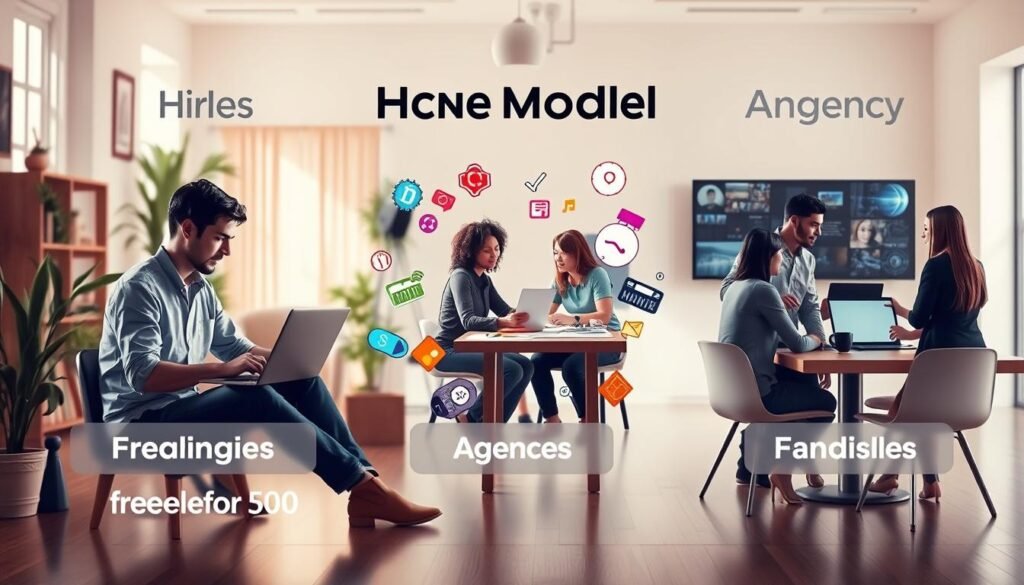
Who You Hire Changes the Price: Freelancer, Studio, or Agency
Choosing who executes a video often shifts the price more than runtime or effects. We break the common hiring models into clear tradeoffs so teams can pick the right path for a given risk level and timeline.
Freelancer rates and quality expectations
Independent creators can start near $50 per hour for decent quality. At that level, expect solid execution but limited roles. One person often handles design, animation, and delivery.
Vetting is vital. We check portfolios, role credits on past pieces, and repeatable style before awarding work.
Why studio teams reduce risk
Studios staff multiple roles: creative direction, illustrator, animator, and project manager. That provides predictable workflows and backup capacity when deadlines matter.
Tradeoffs and procurement tips
Freelancers lower overhead; studios and agencies package process, review gates, and QA. Agencies add strategy and campaign support but increase fees.
- Define deliverables and revision rounds up front.
- Require styleframes and a timeline with milestones.
- Match hiring level to campaign risk: use agencies for launches, studios for steady production, freelancers for small updates.
| Model | Typical rate | Strengths | When to pick |
|---|---|---|---|
| Freelancer | $50+/hr | Low cost, fast hire | Small updates, tight budgets |
| Studio | Mid-range project fees | Consistent output, layered roles | Business-critical videos |
| Agency | Higher project or retainer | Strategy + production | Campaigns and launches |
Geography and the Real Cost Gap for Similar Quality
Location affects more than price; it shapes timelines, communication, and final polish. We mapped regional averages to show where dollars go and why similar briefs produce different bids.
Regional benchmarks for a 60-second deliverable: US teams averaged $6,460, European teams $4,170, and Asian teams $1,880. Labor markets, cost of living, and sales overhead explain most of the gap.
- Check communication cadence and sample timelines before committing.
- Request revision policy and proof of consistent delivery on past projects.
- Mitigate risk with paid test tasks, milestone billing, and clear acceptance criteria.
- Account for time zone delays; slow feedback can extend schedules and raise total spend.
| Region | Average (60s) | Typical trade-offs |
|---|---|---|
| United States | $6,460 | Faster client alignment, higher overhead, premium rates |
| Europe | $4,170 | Balanced quality and price, varied English fluency, moderate timelines |
| Asia | $1,880 | Lower hourly rates, potential timezone friction, variable process maturity |
Keep launches and regulated work local. Use offshore partners for volume work or assets where strict branding or compliance is not critical.
Pricing Models You’ll Be Quoted: Project-Based vs. Monthly Subscription
Your choice between one-off quotes and retainers decides how quickly requests move from idea to deliverable. We map the trade-offs so teams pick the model that matches volume, timing, and consistency needs.
When a project-based quote is the better buy
Project pricing fits a single, defined deliverable. Use it for one major explainer, a product launch, or a campaign with fixed scope.
Expect clear milestones and a capped price. If revisions and scope are locked, this often minimizes risk and simplifies procurement.
When a monthly retainer wins on value
Retainers shine when you need steady output: weekly ad variants, regular social clips, or recurring UI demos.
Ongoing access to a dedicated team reduces per-asset time and keeps style consistent across assets.
Typical subscription ranges and what to confirm
- Common retainer bands: $3,500–$8,500 per month for a dedicated small team.
- Confirm turnaround times, queue limits, and revision rules before signing.
- Avoid vague “unlimited” promises without operational detail; they often hide bottlenecks.
| Decision Factor | Best fit | Recommendation |
|---|---|---|
| Volume | High (>4 pieces/month) | Retainer |
| Urgency | Fast, ad-hoc | Retainer with SLA or premium project fee |
| One-off deliverable | Single explainer or launch | Project-based quote |
Hidden and Add-On Costs That Change Your Final Invoice
Revision and licensing line items are the usual surprises that shift a neat quote into a larger invoice.
Revision rounds and how they can consume budget
Revisions typically used up to ~12% of a production budget in our data. That number grows when approvals are slow or feedback is vague.
We separate a revision (tweaks inside an agreed scene) from a scope change (new scenes or rewritten script). Vendors bill scope changes as extras, and that often explains final increases.
Late-stage changes and major spikes
Late-stage changes pushed budgets about ~30% higher in sampled projects. Adding scenes, swapping styles, or reworking voice delivery near delivery triggers rework and renders that cost real time.
Voiceover, sound, and licensing
Voiceover ranges vary from ~$50 to $1,000+. We found a quality sweet spot near $250–$450 for pro reads with clear usage terms. Licensing can be annual or per-use.
Stock music is cheaper than custom work, but cheap tracks can create legal or brand risk. Ask about music rights, sound design fees, and any software or third-party asset licenses up front.
- Common add-ons we saw: VO, music, sound design, and asset licenses.
- Demand transparent line items for software and template or 3D model licenses.
| Add-on | Typical range | Buyer tip |
|---|---|---|
| Voiceover | $50–$1,000+ | Budget $250–$450 and confirm usage rights |
| Music & sound | $0–$1,200+ | Prefer licensed stock with clear platform rights |
| Software / third-party assets | $0–$500+ | Require disclosure of license type and transferability |
What a “Good Quote” Looks Like: How We Compare Apples to Apples
Good proposals make it simple to compare offerings without guessing what’s included. We look for clear line items, explicit usage terms, and a named approval process that limits surprises.

Deliverables checklist
A strong quote lists deliverables by stage: discovery, storyboard, styleframes, animation, sound, and final exports. Each item should include file formats, resolution targets, and who owns source files.
Usage rights and licensing
Ask for plain-language usage rights. We request perpetual, worldwide usage when possible and separate paid media or broadcast terms. If a vendor proposes time-limited or platform-specific licenses, flag it and request written examples.
Timeline, review gates, and revisions
Quotes should map milestones and review gates and name approvers at each step. Define a “revision” as edits within an agreed scene or artboard. Anything that adds scenes, rewrites scripts, or changes style is a scope change and should be priced separately.
- Look for QA proof: brand checks, typography, audio levels, and delivery spec notes.
- Red flags: missing exports, vague timelines, or bundled licensing with no terms.
| Item | What to expect | Buyer action |
|---|---|---|
| Storyboard | Scene-by-scene shots and timing | Approve before animation |
| Styleframes | Color, typography, hero art | Lock visuals early |
| Revisions | Number of rounds and scope limits | Require clear definition |
| Usage | License length and channels | Get perpetual wording when needed |
Budgeting Smart: Where to Spend for Quality and Where to Simplify
A practical budget focuses on clarity, not chasing every visual trend. We start by protecting the script and story; those buy the most viewer attention and cut down revision time.
Separating must-haves from nice-to-haves
We prioritize core scenes, clear on-screen text, and a brand-safe palette first. Those elements make the message readable across platforms.
Choosing style and complexity that supports the message
We pick a style that speeds comprehension. Avoid adding 3D or fancy effects unless they improve understanding.
Planning multiple cutdowns and endings
Plan cutdowns and alternate CTAs up front. Including them in the scope saves add-on fees and improves funnel performance.
Building reusable assets
Invest in a simple design system: icon sets, type scale, and transitions. Reusable assets reduce time and cost on follow-up projects.
| Spend Area | Priority | Expected Impact |
|---|---|---|
| Script & storyboard | High | Fewer revisions; clearer conversions |
| Design system / styleframes | High | Consistent brand, faster future work |
| Cutdown packages & CTAs | Medium | Better ad performance; fewer change orders |
| Advanced 3D or heavy VFX | Low (unless required) | High cost; limited incremental clarity |
Negotiation Strategies That Protect Quality (Instead of Just Chasing Discounts)
When price talks get tense, we recommend trading added deliverables rather than asking for blunt discounts. That approach keeps the creative hours that drive quality intact.
Trade money for deliverables
Ask for subtitles, cutdowns, alternate CTAs, or extra exports instead of dropping price. Those items add distribution value and are cheaper than losing a design pass or audio mix.
Right-size scope ethically
If a quote is above budget, propose specific scope reductions. Reduce scene count, simplify character actions, reuse backgrounds, or replace some 3D shots with 2D callouts.
- Protect the script and storyboard as non-negotiable.
- Keep design consistency and audio quality untouched.
- Share budget limits and offer clear option tiers in your counteroffer.
| Negotiation lever | What it changes | Buyer outcome |
|---|---|---|
| Extra deliverables | More exports, cutdowns, subtitles | Higher distribution value with same quality |
| Scope trim | Fewer scenes, simpler rigs | Lower price, preserved core story |
| Style swap | Convert select 3D shots to 2D | Cost savings with limited visual impact |
Confirm any counteroffer in writing. List what changed, who approves, and the revised timeline. We find that clear trade-offs protect outcomes and improve ROI more than a shallow discount.
Timeline Expectations: How Long Motion Graphics Production Typically Takes
Turnaround time depends more on approvals than on raw animation hours. We outline realistic production timeline windows so teams can plan internal reviews and launch dates.
Fast-turn simple assets vs. multi-week explainers
Simple logo or UI assets often finish in 1–2 weeks. These deliveries include basic design, a single revision round, and final exports.
Full explainers with script, storyboard, voiceover, and several review gates typically take 4–6+ weeks. Complex scenes or 3D lifts can stretch schedules further.
How feedback speed impacts schedule and cost
Slow feedback adds days or weeks and raises the chance of scope changes. Rushed timelines force overtime or extra staff and increase final invoices.
- Typical workflow: discovery → script/storyboard → styleframes → animation → sound → exports.
- Set one named decision-maker and a review cadence to avoid bottlenecks.
- Include legal, compliance, and brand approvals in your internal calendar.
| Deliverable | Typical timeline | Notes |
|---|---|---|
| Logo / UI asset | 1–2 weeks | Fast, limited revisions |
| Standard explainer | 4–6+ weeks | Includes VO and multiple approvals |
| 3D-enhanced explainer | 6+ weeks | Rendering and technical reviews extend time |
Making the Business Case: ROI and Performance Benefits of Motion Graphics
We measured creative spend by the outcomes it produced, not by runtime or effects alone.
When teams matched video type to a clear goal, results were easier to track. Engagement rose when a clip fit the audience and channel. Conversion paths tightened when CTAs and story beats aligned.

Where video improved engagement and conversions
Explainers increased product understanding and cut demo time. Awareness clips lifted reach and click-throughs. Short cutdowns boosted activation by testing CTAs fast. Support clips reduced tickets and sped onboarding.
Match type to funnel goal
- Awareness: broad reach and impressions.
- Education: clear features and next steps.
- Activation: focused CTAs and variants for testing.
- Support: concise how-tos that reduce support load.
| Video type | Funnel goal | Expected business outcome |
|---|---|---|
| Awareness clip | Top funnel | Higher reach; more ad impressions |
| Explainer | Education | Better product understanding; fewer demos |
| Cutdowns | Activation | Improved conversion rate via A/B tests |
| Support video | Post-sale | Lower ticket volume; faster onboarding |
We recommended repurposing a hero asset into platform-native pieces. That increased ROI without redoing the whole project.
Budget against impact: spend on clarity, CTA alignment, and versions that moved metrics. Simplify effects where they added little measurable value.
Choosing the Best Option for Your Company and Moving Forward Confidently
Start with the problem you need to solve, then align style, complexity, and timeline to a clear budget. Define the goal, pick the project type, choose 2D or 3D based on value, and set scene and version limits before work begins.
Keep these 2025 benchmarks handy: a 60‑second average ~$3,130 (range $1,000–$16,000); regional averages US ~$6,460, Europe ~$4,170, Asia ~$1,880; 2D ~$4,000–$8,500/min; 3D ~$5,000–$9,500/min; logo/UI $300–$1,000; retainers $3,500–$8,500/month; voiceover sweet spot $250–$450.
Quote readiness checklist: objective, audience, script status, brand rules, deliverables, platforms, and deadline. Vendor rubric: relevant portfolio, clear process, revision policy, licensing, and reliable delivery speed.
To cut spend without hurting results, trim scenes, reuse assets, limit characters, use stock 3D smartly, and plan cutdowns up front. Choose the path that protects the message, meets timelines, and supports reuse.
FAQ
What pricing factors cause such wide variation in motion graphics quotes?
What does “motion graphics” include in a business project?
Which common uses most affect scope and budget?
What should a professional production quote typically include?
What’s a realistic budget range for a 60-second video in 2025?
How much does 2D animation cost per minute?
What about 3D pricing per minute?
How much does a simple logo animation or UI motion cost?
What budget should we plan for explainer videos?
How much should we allocate for brand awareness and paid social content?
What are typical costs for UX and UI animation demos?
FAQ
What pricing factors cause such wide variation in motion graphics quotes?
Several variables drive price differences: project length, visual style, whether we use 2D or 3D, character animation, scene complexity, voiceover and sound design, licensing for music or assets, and the number of revision rounds. Team size and geographic location of the provider also shift rates significantly.
What does “motion graphics” include in a business project?
In a business context, motion graphics covers animated typography, logo reveals, explainer visuals, product rotations, UI micro-interactions, character-driven narratives, and branded social ads. It also includes pre-production (script, storyboard, styleframes), animation, sound design, and final exports.
Which common uses most affect scope and budget?
Explainer videos, product demos with 3D visuals, character-led storytelling, and multi-platform ad cutdowns increase scope. Simple logo animations, short social clips, and basic UI motion remain lower cost.
What should a professional production quote typically include?
A clear quote lists deliverables (script, storyboard, styleframes, full animation, formats), timeline, number of revision rounds, usage rights, milestones and payment schedule, and any third-party costs like voiceover, music licensing, or stock assets.
What’s a realistic budget range for a 60-second video in 2025?
For 60 seconds, budgets commonly span from a few thousand dollars for template-based or freelance work to ,000–,000+ for high-end agency or studio productions with bespoke design, characters, or 3D. Quality and complexity determine where a project lands.
How much does 2D animation cost per minute?
2D rates vary widely. Simple, low-detail 2D can be a few thousand dollars per finished minute. Midrange custom 2D projects often fall between ,000–,000 per minute depending on design and revisions.
What about 3D pricing per minute?
3D increases time and tooling costs. Basic 3D product animations start in the mid-thousands per minute, while full 3D scenes with lighting, materials, and complex camera work typically range from ,000 to 0,000+ per finished minute.
How much does a simple logo animation or UI motion cost?
Simple logo reveals or UI micro-animations can cost from a few hundred to several thousand dollars depending on customization, iterations, and export needs for multiple platforms.
What budget should we plan for explainer videos?
Explainers vary by style. Lightweight, template-based explainers can be under ,000. Bespoke 2D explainers with professional voiceover and sound design often sit in the ,000–,000 range. Character-driven or 3D explainers will cost more.
How much should we allocate for brand awareness and paid social content?
Paid social often favors shorter cutdowns and multiple aspect ratios. Budget for the initial hero video and additional cutdowns; a modest campaign might start at ,000–,000, while a full creative package with numerous variants can exceed ,000.
What are typical costs for UX and UI animation demos?
UI demos and interaction prototypes are usually less resource-heavy but need precision. Expect
FAQ
What pricing factors cause such wide variation in motion graphics quotes?
Several variables drive price differences: project length, visual style, whether we use 2D or 3D, character animation, scene complexity, voiceover and sound design, licensing for music or assets, and the number of revision rounds. Team size and geographic location of the provider also shift rates significantly.
What does “motion graphics” include in a business project?
In a business context, motion graphics covers animated typography, logo reveals, explainer visuals, product rotations, UI micro-interactions, character-driven narratives, and branded social ads. It also includes pre-production (script, storyboard, styleframes), animation, sound design, and final exports.
Which common uses most affect scope and budget?
Explainer videos, product demos with 3D visuals, character-led storytelling, and multi-platform ad cutdowns increase scope. Simple logo animations, short social clips, and basic UI motion remain lower cost.
What should a professional production quote typically include?
A clear quote lists deliverables (script, storyboard, styleframes, full animation, formats), timeline, number of revision rounds, usage rights, milestones and payment schedule, and any third-party costs like voiceover, music licensing, or stock assets.
What’s a realistic budget range for a 60-second video in 2025?
For 60 seconds, budgets commonly span from a few thousand dollars for template-based or freelance work to $30,000–$80,000+ for high-end agency or studio productions with bespoke design, characters, or 3D. Quality and complexity determine where a project lands.
How much does 2D animation cost per minute?
2D rates vary widely. Simple, low-detail 2D can be a few thousand dollars per finished minute. Midrange custom 2D projects often fall between $8,000–$25,000 per minute depending on design and revisions.
What about 3D pricing per minute?
3D increases time and tooling costs. Basic 3D product animations start in the mid-thousands per minute, while full 3D scenes with lighting, materials, and complex camera work typically range from $20,000 to $100,000+ per finished minute.
How much does a simple logo animation or UI motion cost?
Simple logo reveals or UI micro-animations can cost from a few hundred to several thousand dollars depending on customization, iterations, and export needs for multiple platforms.
What budget should we plan for explainer videos?
Explainers vary by style. Lightweight, template-based explainers can be under $5,000. Bespoke 2D explainers with professional voiceover and sound design often sit in the $8,000–$30,000 range. Character-driven or 3D explainers will cost more.
How much should we allocate for brand awareness and paid social content?
Paid social often favors shorter cutdowns and multiple aspect ratios. Budget for the initial hero video and additional cutdowns; a modest campaign might start at $5,000–$15,000, while a full creative package with numerous variants can exceed $25,000.
What are typical costs for UX and UI animation demos?
UI demos and interaction prototypes are usually less resource-heavy but need precision. Expect $1,500–$10,000 depending on length, fidelity, and whether we build clickable prototypes in addition to motion exports.
How are animated titles, typography, and looping assets priced?
Short animated titles and looping assets are cost-efficient. Pricing can range from a few hundred dollars for templates to several thousand for custom type treatment and multiple formats.
Which project elements drive the biggest cost increases?
Key drivers include the number of scenes and cuts, character animation and rigging, complex camera moves, photoreal 3D rendering, and high-detail design. Each factor multiplies time for artists, review cycles, and rendering resources.
How does character count affect budgets?
Each character adds rigging, design, and animation time. A single, reusable character is manageable; multiple distinct characters or nuanced performances significantly increase cost and schedule.
How does scene complexity and camera movement impact price?
Multi-layered scenes and dynamic camera work require more animation and compositing time. They also increase render times in 3D, which leads to higher costs for both artists and infrastructure.
How does subject complexity in 3D product visuals change pricing?
Complex materials, precision modeling, and interactive product demos require more hours for modeling, texturing, lighting, and photoreal rendering. That specialized work pushes budgets higher than simpler 3D assets.
Why can short videos cost more per second than longer ones?
Fixed pre-production tasks—concepting, scripting, design—take similar effort whether a video is 15 or 60 seconds. With shorter runtimes, those fixed costs are spread over fewer seconds, raising the per-second rate.
Which pre-production steps remain constant regardless of length?
Concept development, scriptwriting, storyboarding, styleframes, and casting voiceover typically require similar time and creative input no matter the final runtime.
Why does 3D cost more than 2D?
3D typically needs modeling, UVs, texturing, rigging, lighting, and rendering. Those stages require specialized software, longer compute times, and often more senior artists, which increases cost and timelines.
When does 3D deliver measurable business value?
Use 3D for realistic product demos, interactive configurators, or when we need accurate material, lighting, and perspective that 2D can’t convey. If brand impact or conversion benefits depend on realism, 3D is worth the investment.
What does custom design buy compared to templates?
Custom illustration and bespoke motion ensure brand consistency, unique creative positioning, and assets we can reuse. Templates speed production and lower cost but often look generic and limit differentiation.
When are templates acceptable for business use?
Templates work well for internal training, quick social posts, or proof-of-concept content where time and budget matter more than brand originality.
Can stock 3D models reduce cost without sacrificing quality?
Yes. High-quality stock objects can cut modeling time. We still need to adjust materials and lighting for brand fit, but stock assets often offer a good balance of cost and visual quality.
How do freelancer, studio, and agency hires compare on price and risk?
Freelancers can be cost-effective for limited-scope work. Studios offer consistent pipelines and QA for complex projects. Agencies provide strategy, larger teams, and cross-channel production but usually cost more. Tradeoffs include speed, reliability, and creative breadth.
What should we expect in geographic price differences?
US and Western Europe rates tend to be higher, while Eastern Europe and parts of Asia offer lower hourly costs. Quality can be comparable; the key is vetting portfolios, workflows, and communication standards.
How can we evaluate offshore providers without under-scoping?
Request detailed breakdowns of deliverables, ask for process documentation, review past work, and include milestone payments tied to clear reviews. Insist on native-language scripts or professional copywriting where messaging matters.
When is project-based pricing preferable?
Project pricing works best for one-off deliverables with a defined scope and timeline. It provides clarity on total spend and simplifies procurement for single campaigns.
When should we consider a monthly subscription or retainer?
Retainers suit companies needing regular video output, multiple cutdowns, or ongoing motion support. Monthly plans can lower per-video cost and speed delivery through dedicated teams.
What typical subscription ranges exist for a dedicated motion team?
Retainers vary widely. Small packages with limited turnaround may start a few thousand dollars per month. Comprehensive teams handling frequent, high-quality assets often cost $10,000–$30,000+ monthly.
How do revision rounds affect final invoices?
Revisions consume time. Quotes usually include a set number of rounds; additional rounds are billed hourly or as flat fees. Clear review gates and consolidated feedback help control costs.
What late-stage changes trigger major cost spikes?
Rewriting the script, replacing voiceover after animation, adding new scenes, or switching from 2D to 3D late in production can multiply costs because these changes require rework across multiple stages.
What are typical voiceover pricing ranges?
Professional voiceover rates depend on talent, language, and usage rights. For business use, expect $200–$1,500 for a short read; celebrity or agency-represented talent costs more. Bundled packages often include editing and files.
How should we budget for sound design and music licensing?
Custom sound design adds several hundred to several thousand dollars. Royalty-free tracks cost less, while bespoke compositions or sync licenses for commercial use can be $1,000–$10,000+ depending on the track and rights.
Do software and third-party licenses add to the bill?
Yes. Plugins, render farm time, stock asset purchases, and software seat fees can be itemized. Studios often include these as separate line items or fold them into the overall quote.
What does a “good quote” look like when comparing vendors?
A solid quote is itemized and clear: deliverables, file formats, revisions included, timeline, payment milestones, usage rights, and exclusion items. It allows apples-to-apples comparison across bids.
What usage rights and licensing terms should businesses request?
Request explicit broadcast and digital usage rights, any territorial limits, duration of use, and whether rights are exclusive. Clarifying these avoids unexpected licensing fees later.
How should timelines and review gates be defined?
Define milestones for script approval, storyboard and styleframe sign-off, first animation pass, and final delivery. Specify review window lengths and what constitutes a revision to prevent delays and scope creep.
How do we separate must-haves from nice-to-haves when budgeting?
Rank goals by impact: message clarity, brand alignment, and conversion are must-haves. Extra visual flourishes, alternate endings, or nonessential cutdowns can be deferred to later phases.
How do we choose a style and complexity that supports our message?
Match the visual approach to audience and channel. Simple, bold animation works for social ads; detailed 3D helps product demos. Prioritize clarity of message over unnecessary detail.
Should we plan multiple cutdowns and endings for funnels?
Yes. Planning cutdowns up front saves rework. Building alternate CTAs and aspect ratios during the initial production is more cost-effective than creating them after the hero edit.
How can we build reusable assets to save future costs?
Invest in modular elements: character rigs, branded motion systems, icon sets, and templates. Reusable assets shorten future production time and reduce per-asset cost.
How can we negotiate without sacrificing quality?
Trade scope for deliverables—ask for fewer scenes, fewer revisions, or smaller resolution exports to lower price. Alternatively, request added deliverables (subtitles, cutdowns) in exchange for higher fees to maximize value.
How do we right-size scope if a quote comes in over budget?
Prioritize message-critical scenes, reduce character count, simplify design treatments, or switch some elements to templates or stock assets. Phasing the project into MVP and later enhancements also helps.
How long does production typically take?
Timelines depend on complexity. Simple assets can be delivered in a few days to two weeks. Midrange explainers often take 4–8 weeks. Complex 3D or character projects may take several months.
How does client feedback speed affect schedule and cost?
Slow or disorganized feedback extends timelines and can increase cost if it leads to rework. Timely, consolidated feedback speeds delivery and keeps projects on budget.
What ROI benefits can motion graphics deliver?
Motion increases engagement, retention, and conversion compared to static content. Explainers reduce support costs, product demos boost purchase confidence, and social videos improve ad performance when paired with strong targeting.
How do we match video type to business goals?
Use awareness-focused short ads for reach, explainers for education and onboarding, and product demos for purchase intent. Aligning format with funnel stage maximizes ROI.
How should we choose a provider and move forward confidently?
Evaluate portfolios for relevant work, request detailed scopes and references, set clear milestones and usage rights, and start with a small pilot if uncertain. That approach reduces risk and clarifies expectations.
,500–,000 depending on length, fidelity, and whether we build clickable prototypes in addition to motion exports.
How are animated titles, typography, and looping assets priced?
Short animated titles and looping assets are cost-efficient. Pricing can range from a few hundred dollars for templates to several thousand for custom type treatment and multiple formats.
Which project elements drive the biggest cost increases?
Key drivers include the number of scenes and cuts, character animation and rigging, complex camera moves, photoreal 3D rendering, and high-detail design. Each factor multiplies time for artists, review cycles, and rendering resources.
How does character count affect budgets?
Each character adds rigging, design, and animation time. A single, reusable character is manageable; multiple distinct characters or nuanced performances significantly increase cost and schedule.
How does scene complexity and camera movement impact price?
Multi-layered scenes and dynamic camera work require more animation and compositing time. They also increase render times in 3D, which leads to higher costs for both artists and infrastructure.
How does subject complexity in 3D product visuals change pricing?
Complex materials, precision modeling, and interactive product demos require more hours for modeling, texturing, lighting, and photoreal rendering. That specialized work pushes budgets higher than simpler 3D assets.
Why can short videos cost more per second than longer ones?
Fixed pre-production tasks—concepting, scripting, design—take similar effort whether a video is 15 or 60 seconds. With shorter runtimes, those fixed costs are spread over fewer seconds, raising the per-second rate.
Which pre-production steps remain constant regardless of length?
Concept development, scriptwriting, storyboarding, styleframes, and casting voiceover typically require similar time and creative input no matter the final runtime.
Why does 3D cost more than 2D?
3D typically needs modeling, UVs, texturing, rigging, lighting, and rendering. Those stages require specialized software, longer compute times, and often more senior artists, which increases cost and timelines.
When does 3D deliver measurable business value?
Use 3D for realistic product demos, interactive configurators, or when we need accurate material, lighting, and perspective that 2D can’t convey. If brand impact or conversion benefits depend on realism, 3D is worth the investment.
What does custom design buy compared to templates?
Custom illustration and bespoke motion ensure brand consistency, unique creative positioning, and assets we can reuse. Templates speed production and lower cost but often look generic and limit differentiation.
When are templates acceptable for business use?
Templates work well for internal training, quick social posts, or proof-of-concept content where time and budget matter more than brand originality.
Can stock 3D models reduce cost without sacrificing quality?
Yes. High-quality stock objects can cut modeling time. We still need to adjust materials and lighting for brand fit, but stock assets often offer a good balance of cost and visual quality.
How do freelancer, studio, and agency hires compare on price and risk?
Freelancers can be cost-effective for limited-scope work. Studios offer consistent pipelines and QA for complex projects. Agencies provide strategy, larger teams, and cross-channel production but usually cost more. Tradeoffs include speed, reliability, and creative breadth.
What should we expect in geographic price differences?
US and Western Europe rates tend to be higher, while Eastern Europe and parts of Asia offer lower hourly costs. Quality can be comparable; the key is vetting portfolios, workflows, and communication standards.
How can we evaluate offshore providers without under-scoping?
Request detailed breakdowns of deliverables, ask for process documentation, review past work, and include milestone payments tied to clear reviews. Insist on native-language scripts or professional copywriting where messaging matters.
When is project-based pricing preferable?
Project pricing works best for one-off deliverables with a defined scope and timeline. It provides clarity on total spend and simplifies procurement for single campaigns.
When should we consider a monthly subscription or retainer?
Retainers suit companies needing regular video output, multiple cutdowns, or ongoing motion support. Monthly plans can lower per-video cost and speed delivery through dedicated teams.
What typical subscription ranges exist for a dedicated motion team?
Retainers vary widely. Small packages with limited turnaround may start a few thousand dollars per month. Comprehensive teams handling frequent, high-quality assets often cost ,000–,000+ monthly.
How do revision rounds affect final invoices?
Revisions consume time. Quotes usually include a set number of rounds; additional rounds are billed hourly or as flat fees. Clear review gates and consolidated feedback help control costs.
What late-stage changes trigger major cost spikes?
Rewriting the script, replacing voiceover after animation, adding new scenes, or switching from 2D to 3D late in production can multiply costs because these changes require rework across multiple stages.
What are typical voiceover pricing ranges?
Professional voiceover rates depend on talent, language, and usage rights. For business use, expect 0–
FAQ
What pricing factors cause such wide variation in motion graphics quotes?
Several variables drive price differences: project length, visual style, whether we use 2D or 3D, character animation, scene complexity, voiceover and sound design, licensing for music or assets, and the number of revision rounds. Team size and geographic location of the provider also shift rates significantly.
What does “motion graphics” include in a business project?
In a business context, motion graphics covers animated typography, logo reveals, explainer visuals, product rotations, UI micro-interactions, character-driven narratives, and branded social ads. It also includes pre-production (script, storyboard, styleframes), animation, sound design, and final exports.
Which common uses most affect scope and budget?
Explainer videos, product demos with 3D visuals, character-led storytelling, and multi-platform ad cutdowns increase scope. Simple logo animations, short social clips, and basic UI motion remain lower cost.
What should a professional production quote typically include?
A clear quote lists deliverables (script, storyboard, styleframes, full animation, formats), timeline, number of revision rounds, usage rights, milestones and payment schedule, and any third-party costs like voiceover, music licensing, or stock assets.
What’s a realistic budget range for a 60-second video in 2025?
For 60 seconds, budgets commonly span from a few thousand dollars for template-based or freelance work to $30,000–$80,000+ for high-end agency or studio productions with bespoke design, characters, or 3D. Quality and complexity determine where a project lands.
How much does 2D animation cost per minute?
2D rates vary widely. Simple, low-detail 2D can be a few thousand dollars per finished minute. Midrange custom 2D projects often fall between $8,000–$25,000 per minute depending on design and revisions.
What about 3D pricing per minute?
3D increases time and tooling costs. Basic 3D product animations start in the mid-thousands per minute, while full 3D scenes with lighting, materials, and complex camera work typically range from $20,000 to $100,000+ per finished minute.
How much does a simple logo animation or UI motion cost?
Simple logo reveals or UI micro-animations can cost from a few hundred to several thousand dollars depending on customization, iterations, and export needs for multiple platforms.
What budget should we plan for explainer videos?
Explainers vary by style. Lightweight, template-based explainers can be under $5,000. Bespoke 2D explainers with professional voiceover and sound design often sit in the $8,000–$30,000 range. Character-driven or 3D explainers will cost more.
How much should we allocate for brand awareness and paid social content?
Paid social often favors shorter cutdowns and multiple aspect ratios. Budget for the initial hero video and additional cutdowns; a modest campaign might start at $5,000–$15,000, while a full creative package with numerous variants can exceed $25,000.
What are typical costs for UX and UI animation demos?
UI demos and interaction prototypes are usually less resource-heavy but need precision. Expect $1,500–$10,000 depending on length, fidelity, and whether we build clickable prototypes in addition to motion exports.
How are animated titles, typography, and looping assets priced?
Short animated titles and looping assets are cost-efficient. Pricing can range from a few hundred dollars for templates to several thousand for custom type treatment and multiple formats.
Which project elements drive the biggest cost increases?
Key drivers include the number of scenes and cuts, character animation and rigging, complex camera moves, photoreal 3D rendering, and high-detail design. Each factor multiplies time for artists, review cycles, and rendering resources.
How does character count affect budgets?
Each character adds rigging, design, and animation time. A single, reusable character is manageable; multiple distinct characters or nuanced performances significantly increase cost and schedule.
How does scene complexity and camera movement impact price?
Multi-layered scenes and dynamic camera work require more animation and compositing time. They also increase render times in 3D, which leads to higher costs for both artists and infrastructure.
How does subject complexity in 3D product visuals change pricing?
Complex materials, precision modeling, and interactive product demos require more hours for modeling, texturing, lighting, and photoreal rendering. That specialized work pushes budgets higher than simpler 3D assets.
Why can short videos cost more per second than longer ones?
Fixed pre-production tasks—concepting, scripting, design—take similar effort whether a video is 15 or 60 seconds. With shorter runtimes, those fixed costs are spread over fewer seconds, raising the per-second rate.
Which pre-production steps remain constant regardless of length?
Concept development, scriptwriting, storyboarding, styleframes, and casting voiceover typically require similar time and creative input no matter the final runtime.
Why does 3D cost more than 2D?
3D typically needs modeling, UVs, texturing, rigging, lighting, and rendering. Those stages require specialized software, longer compute times, and often more senior artists, which increases cost and timelines.
When does 3D deliver measurable business value?
Use 3D for realistic product demos, interactive configurators, or when we need accurate material, lighting, and perspective that 2D can’t convey. If brand impact or conversion benefits depend on realism, 3D is worth the investment.
What does custom design buy compared to templates?
Custom illustration and bespoke motion ensure brand consistency, unique creative positioning, and assets we can reuse. Templates speed production and lower cost but often look generic and limit differentiation.
When are templates acceptable for business use?
Templates work well for internal training, quick social posts, or proof-of-concept content where time and budget matter more than brand originality.
Can stock 3D models reduce cost without sacrificing quality?
Yes. High-quality stock objects can cut modeling time. We still need to adjust materials and lighting for brand fit, but stock assets often offer a good balance of cost and visual quality.
How do freelancer, studio, and agency hires compare on price and risk?
Freelancers can be cost-effective for limited-scope work. Studios offer consistent pipelines and QA for complex projects. Agencies provide strategy, larger teams, and cross-channel production but usually cost more. Tradeoffs include speed, reliability, and creative breadth.
What should we expect in geographic price differences?
US and Western Europe rates tend to be higher, while Eastern Europe and parts of Asia offer lower hourly costs. Quality can be comparable; the key is vetting portfolios, workflows, and communication standards.
How can we evaluate offshore providers without under-scoping?
Request detailed breakdowns of deliverables, ask for process documentation, review past work, and include milestone payments tied to clear reviews. Insist on native-language scripts or professional copywriting where messaging matters.
When is project-based pricing preferable?
Project pricing works best for one-off deliverables with a defined scope and timeline. It provides clarity on total spend and simplifies procurement for single campaigns.
When should we consider a monthly subscription or retainer?
Retainers suit companies needing regular video output, multiple cutdowns, or ongoing motion support. Monthly plans can lower per-video cost and speed delivery through dedicated teams.
What typical subscription ranges exist for a dedicated motion team?
Retainers vary widely. Small packages with limited turnaround may start a few thousand dollars per month. Comprehensive teams handling frequent, high-quality assets often cost $10,000–$30,000+ monthly.
How do revision rounds affect final invoices?
Revisions consume time. Quotes usually include a set number of rounds; additional rounds are billed hourly or as flat fees. Clear review gates and consolidated feedback help control costs.
What late-stage changes trigger major cost spikes?
Rewriting the script, replacing voiceover after animation, adding new scenes, or switching from 2D to 3D late in production can multiply costs because these changes require rework across multiple stages.
What are typical voiceover pricing ranges?
Professional voiceover rates depend on talent, language, and usage rights. For business use, expect $200–$1,500 for a short read; celebrity or agency-represented talent costs more. Bundled packages often include editing and files.
How should we budget for sound design and music licensing?
Custom sound design adds several hundred to several thousand dollars. Royalty-free tracks cost less, while bespoke compositions or sync licenses for commercial use can be $1,000–$10,000+ depending on the track and rights.
Do software and third-party licenses add to the bill?
Yes. Plugins, render farm time, stock asset purchases, and software seat fees can be itemized. Studios often include these as separate line items or fold them into the overall quote.
What does a “good quote” look like when comparing vendors?
A solid quote is itemized and clear: deliverables, file formats, revisions included, timeline, payment milestones, usage rights, and exclusion items. It allows apples-to-apples comparison across bids.
What usage rights and licensing terms should businesses request?
Request explicit broadcast and digital usage rights, any territorial limits, duration of use, and whether rights are exclusive. Clarifying these avoids unexpected licensing fees later.
How should timelines and review gates be defined?
Define milestones for script approval, storyboard and styleframe sign-off, first animation pass, and final delivery. Specify review window lengths and what constitutes a revision to prevent delays and scope creep.
How do we separate must-haves from nice-to-haves when budgeting?
Rank goals by impact: message clarity, brand alignment, and conversion are must-haves. Extra visual flourishes, alternate endings, or nonessential cutdowns can be deferred to later phases.
How do we choose a style and complexity that supports our message?
Match the visual approach to audience and channel. Simple, bold animation works for social ads; detailed 3D helps product demos. Prioritize clarity of message over unnecessary detail.
Should we plan multiple cutdowns and endings for funnels?
Yes. Planning cutdowns up front saves rework. Building alternate CTAs and aspect ratios during the initial production is more cost-effective than creating them after the hero edit.
How can we build reusable assets to save future costs?
Invest in modular elements: character rigs, branded motion systems, icon sets, and templates. Reusable assets shorten future production time and reduce per-asset cost.
How can we negotiate without sacrificing quality?
Trade scope for deliverables—ask for fewer scenes, fewer revisions, or smaller resolution exports to lower price. Alternatively, request added deliverables (subtitles, cutdowns) in exchange for higher fees to maximize value.
How do we right-size scope if a quote comes in over budget?
Prioritize message-critical scenes, reduce character count, simplify design treatments, or switch some elements to templates or stock assets. Phasing the project into MVP and later enhancements also helps.
How long does production typically take?
Timelines depend on complexity. Simple assets can be delivered in a few days to two weeks. Midrange explainers often take 4–8 weeks. Complex 3D or character projects may take several months.
How does client feedback speed affect schedule and cost?
Slow or disorganized feedback extends timelines and can increase cost if it leads to rework. Timely, consolidated feedback speeds delivery and keeps projects on budget.
What ROI benefits can motion graphics deliver?
Motion increases engagement, retention, and conversion compared to static content. Explainers reduce support costs, product demos boost purchase confidence, and social videos improve ad performance when paired with strong targeting.
How do we match video type to business goals?
Use awareness-focused short ads for reach, explainers for education and onboarding, and product demos for purchase intent. Aligning format with funnel stage maximizes ROI.
How should we choose a provider and move forward confidently?
Evaluate portfolios for relevant work, request detailed scopes and references, set clear milestones and usage rights, and start with a small pilot if uncertain. That approach reduces risk and clarifies expectations.
,500 for a short read; celebrity or agency-represented talent costs more. Bundled packages often include editing and files.
How should we budget for sound design and music licensing?
Custom sound design adds several hundred to several thousand dollars. Royalty-free tracks cost less, while bespoke compositions or sync licenses for commercial use can be
FAQ
What pricing factors cause such wide variation in motion graphics quotes?
Several variables drive price differences: project length, visual style, whether we use 2D or 3D, character animation, scene complexity, voiceover and sound design, licensing for music or assets, and the number of revision rounds. Team size and geographic location of the provider also shift rates significantly.
What does “motion graphics” include in a business project?
In a business context, motion graphics covers animated typography, logo reveals, explainer visuals, product rotations, UI micro-interactions, character-driven narratives, and branded social ads. It also includes pre-production (script, storyboard, styleframes), animation, sound design, and final exports.
Which common uses most affect scope and budget?
Explainer videos, product demos with 3D visuals, character-led storytelling, and multi-platform ad cutdowns increase scope. Simple logo animations, short social clips, and basic UI motion remain lower cost.
What should a professional production quote typically include?
A clear quote lists deliverables (script, storyboard, styleframes, full animation, formats), timeline, number of revision rounds, usage rights, milestones and payment schedule, and any third-party costs like voiceover, music licensing, or stock assets.
What’s a realistic budget range for a 60-second video in 2025?
For 60 seconds, budgets commonly span from a few thousand dollars for template-based or freelance work to $30,000–$80,000+ for high-end agency or studio productions with bespoke design, characters, or 3D. Quality and complexity determine where a project lands.
How much does 2D animation cost per minute?
2D rates vary widely. Simple, low-detail 2D can be a few thousand dollars per finished minute. Midrange custom 2D projects often fall between $8,000–$25,000 per minute depending on design and revisions.
What about 3D pricing per minute?
3D increases time and tooling costs. Basic 3D product animations start in the mid-thousands per minute, while full 3D scenes with lighting, materials, and complex camera work typically range from $20,000 to $100,000+ per finished minute.
How much does a simple logo animation or UI motion cost?
Simple logo reveals or UI micro-animations can cost from a few hundred to several thousand dollars depending on customization, iterations, and export needs for multiple platforms.
What budget should we plan for explainer videos?
Explainers vary by style. Lightweight, template-based explainers can be under $5,000. Bespoke 2D explainers with professional voiceover and sound design often sit in the $8,000–$30,000 range. Character-driven or 3D explainers will cost more.
How much should we allocate for brand awareness and paid social content?
Paid social often favors shorter cutdowns and multiple aspect ratios. Budget for the initial hero video and additional cutdowns; a modest campaign might start at $5,000–$15,000, while a full creative package with numerous variants can exceed $25,000.
What are typical costs for UX and UI animation demos?
UI demos and interaction prototypes are usually less resource-heavy but need precision. Expect $1,500–$10,000 depending on length, fidelity, and whether we build clickable prototypes in addition to motion exports.
How are animated titles, typography, and looping assets priced?
Short animated titles and looping assets are cost-efficient. Pricing can range from a few hundred dollars for templates to several thousand for custom type treatment and multiple formats.
Which project elements drive the biggest cost increases?
Key drivers include the number of scenes and cuts, character animation and rigging, complex camera moves, photoreal 3D rendering, and high-detail design. Each factor multiplies time for artists, review cycles, and rendering resources.
How does character count affect budgets?
Each character adds rigging, design, and animation time. A single, reusable character is manageable; multiple distinct characters or nuanced performances significantly increase cost and schedule.
How does scene complexity and camera movement impact price?
Multi-layered scenes and dynamic camera work require more animation and compositing time. They also increase render times in 3D, which leads to higher costs for both artists and infrastructure.
How does subject complexity in 3D product visuals change pricing?
Complex materials, precision modeling, and interactive product demos require more hours for modeling, texturing, lighting, and photoreal rendering. That specialized work pushes budgets higher than simpler 3D assets.
Why can short videos cost more per second than longer ones?
Fixed pre-production tasks—concepting, scripting, design—take similar effort whether a video is 15 or 60 seconds. With shorter runtimes, those fixed costs are spread over fewer seconds, raising the per-second rate.
Which pre-production steps remain constant regardless of length?
Concept development, scriptwriting, storyboarding, styleframes, and casting voiceover typically require similar time and creative input no matter the final runtime.
Why does 3D cost more than 2D?
3D typically needs modeling, UVs, texturing, rigging, lighting, and rendering. Those stages require specialized software, longer compute times, and often more senior artists, which increases cost and timelines.
When does 3D deliver measurable business value?
Use 3D for realistic product demos, interactive configurators, or when we need accurate material, lighting, and perspective that 2D can’t convey. If brand impact or conversion benefits depend on realism, 3D is worth the investment.
What does custom design buy compared to templates?
Custom illustration and bespoke motion ensure brand consistency, unique creative positioning, and assets we can reuse. Templates speed production and lower cost but often look generic and limit differentiation.
When are templates acceptable for business use?
Templates work well for internal training, quick social posts, or proof-of-concept content where time and budget matter more than brand originality.
Can stock 3D models reduce cost without sacrificing quality?
Yes. High-quality stock objects can cut modeling time. We still need to adjust materials and lighting for brand fit, but stock assets often offer a good balance of cost and visual quality.
How do freelancer, studio, and agency hires compare on price and risk?
Freelancers can be cost-effective for limited-scope work. Studios offer consistent pipelines and QA for complex projects. Agencies provide strategy, larger teams, and cross-channel production but usually cost more. Tradeoffs include speed, reliability, and creative breadth.
What should we expect in geographic price differences?
US and Western Europe rates tend to be higher, while Eastern Europe and parts of Asia offer lower hourly costs. Quality can be comparable; the key is vetting portfolios, workflows, and communication standards.
How can we evaluate offshore providers without under-scoping?
Request detailed breakdowns of deliverables, ask for process documentation, review past work, and include milestone payments tied to clear reviews. Insist on native-language scripts or professional copywriting where messaging matters.
When is project-based pricing preferable?
Project pricing works best for one-off deliverables with a defined scope and timeline. It provides clarity on total spend and simplifies procurement for single campaigns.
When should we consider a monthly subscription or retainer?
Retainers suit companies needing regular video output, multiple cutdowns, or ongoing motion support. Monthly plans can lower per-video cost and speed delivery through dedicated teams.
What typical subscription ranges exist for a dedicated motion team?
Retainers vary widely. Small packages with limited turnaround may start a few thousand dollars per month. Comprehensive teams handling frequent, high-quality assets often cost $10,000–$30,000+ monthly.
How do revision rounds affect final invoices?
Revisions consume time. Quotes usually include a set number of rounds; additional rounds are billed hourly or as flat fees. Clear review gates and consolidated feedback help control costs.
What late-stage changes trigger major cost spikes?
Rewriting the script, replacing voiceover after animation, adding new scenes, or switching from 2D to 3D late in production can multiply costs because these changes require rework across multiple stages.
What are typical voiceover pricing ranges?
Professional voiceover rates depend on talent, language, and usage rights. For business use, expect $200–$1,500 for a short read; celebrity or agency-represented talent costs more. Bundled packages often include editing and files.
How should we budget for sound design and music licensing?
Custom sound design adds several hundred to several thousand dollars. Royalty-free tracks cost less, while bespoke compositions or sync licenses for commercial use can be $1,000–$10,000+ depending on the track and rights.
Do software and third-party licenses add to the bill?
Yes. Plugins, render farm time, stock asset purchases, and software seat fees can be itemized. Studios often include these as separate line items or fold them into the overall quote.
What does a “good quote” look like when comparing vendors?
A solid quote is itemized and clear: deliverables, file formats, revisions included, timeline, payment milestones, usage rights, and exclusion items. It allows apples-to-apples comparison across bids.
What usage rights and licensing terms should businesses request?
Request explicit broadcast and digital usage rights, any territorial limits, duration of use, and whether rights are exclusive. Clarifying these avoids unexpected licensing fees later.
How should timelines and review gates be defined?
Define milestones for script approval, storyboard and styleframe sign-off, first animation pass, and final delivery. Specify review window lengths and what constitutes a revision to prevent delays and scope creep.
How do we separate must-haves from nice-to-haves when budgeting?
Rank goals by impact: message clarity, brand alignment, and conversion are must-haves. Extra visual flourishes, alternate endings, or nonessential cutdowns can be deferred to later phases.
How do we choose a style and complexity that supports our message?
Match the visual approach to audience and channel. Simple, bold animation works for social ads; detailed 3D helps product demos. Prioritize clarity of message over unnecessary detail.
Should we plan multiple cutdowns and endings for funnels?
Yes. Planning cutdowns up front saves rework. Building alternate CTAs and aspect ratios during the initial production is more cost-effective than creating them after the hero edit.
How can we build reusable assets to save future costs?
Invest in modular elements: character rigs, branded motion systems, icon sets, and templates. Reusable assets shorten future production time and reduce per-asset cost.
How can we negotiate without sacrificing quality?
Trade scope for deliverables—ask for fewer scenes, fewer revisions, or smaller resolution exports to lower price. Alternatively, request added deliverables (subtitles, cutdowns) in exchange for higher fees to maximize value.
How do we right-size scope if a quote comes in over budget?
Prioritize message-critical scenes, reduce character count, simplify design treatments, or switch some elements to templates or stock assets. Phasing the project into MVP and later enhancements also helps.
How long does production typically take?
Timelines depend on complexity. Simple assets can be delivered in a few days to two weeks. Midrange explainers often take 4–8 weeks. Complex 3D or character projects may take several months.
How does client feedback speed affect schedule and cost?
Slow or disorganized feedback extends timelines and can increase cost if it leads to rework. Timely, consolidated feedback speeds delivery and keeps projects on budget.
What ROI benefits can motion graphics deliver?
Motion increases engagement, retention, and conversion compared to static content. Explainers reduce support costs, product demos boost purchase confidence, and social videos improve ad performance when paired with strong targeting.
How do we match video type to business goals?
Use awareness-focused short ads for reach, explainers for education and onboarding, and product demos for purchase intent. Aligning format with funnel stage maximizes ROI.
How should we choose a provider and move forward confidently?
Evaluate portfolios for relevant work, request detailed scopes and references, set clear milestones and usage rights, and start with a small pilot if uncertain. That approach reduces risk and clarifies expectations.
,000–,000+ depending on the track and rights.
Do software and third-party licenses add to the bill?
Yes. Plugins, render farm time, stock asset purchases, and software seat fees can be itemized. Studios often include these as separate line items or fold them into the overall quote.
What does a “good quote” look like when comparing vendors?
A solid quote is itemized and clear: deliverables, file formats, revisions included, timeline, payment milestones, usage rights, and exclusion items. It allows apples-to-apples comparison across bids.
What usage rights and licensing terms should businesses request?
Request explicit broadcast and digital usage rights, any territorial limits, duration of use, and whether rights are exclusive. Clarifying these avoids unexpected licensing fees later.
How should timelines and review gates be defined?
Define milestones for script approval, storyboard and styleframe sign-off, first animation pass, and final delivery. Specify review window lengths and what constitutes a revision to prevent delays and scope creep.
How do we separate must-haves from nice-to-haves when budgeting?
Rank goals by impact: message clarity, brand alignment, and conversion are must-haves. Extra visual flourishes, alternate endings, or nonessential cutdowns can be deferred to later phases.
How do we choose a style and complexity that supports our message?
Match the visual approach to audience and channel. Simple, bold animation works for social ads; detailed 3D helps product demos. Prioritize clarity of message over unnecessary detail.
Should we plan multiple cutdowns and endings for funnels?
Yes. Planning cutdowns up front saves rework. Building alternate CTAs and aspect ratios during the initial production is more cost-effective than creating them after the hero edit.
How can we build reusable assets to save future costs?
Invest in modular elements: character rigs, branded motion systems, icon sets, and templates. Reusable assets shorten future production time and reduce per-asset cost.
How can we negotiate without sacrificing quality?
Trade scope for deliverables—ask for fewer scenes, fewer revisions, or smaller resolution exports to lower price. Alternatively, request added deliverables (subtitles, cutdowns) in exchange for higher fees to maximize value.
How do we right-size scope if a quote comes in over budget?
Prioritize message-critical scenes, reduce character count, simplify design treatments, or switch some elements to templates or stock assets. Phasing the project into MVP and later enhancements also helps.
How long does production typically take?
Timelines depend on complexity. Simple assets can be delivered in a few days to two weeks. Midrange explainers often take 4–8 weeks. Complex 3D or character projects may take several months.
How does client feedback speed affect schedule and cost?
Slow or disorganized feedback extends timelines and can increase cost if it leads to rework. Timely, consolidated feedback speeds delivery and keeps projects on budget.
What ROI benefits can motion graphics deliver?
Motion increases engagement, retention, and conversion compared to static content. Explainers reduce support costs, product demos boost purchase confidence, and social videos improve ad performance when paired with strong targeting.
How do we match video type to business goals?
Use awareness-focused short ads for reach, explainers for education and onboarding, and product demos for purchase intent. Aligning format with funnel stage maximizes ROI.
How should we choose a provider and move forward confidently?
Evaluate portfolios for relevant work, request detailed scopes and references, set clear milestones and usage rights, and start with a small pilot if uncertain. That approach reduces risk and clarifies expectations.
FAQ
What pricing factors cause such wide variation in motion graphics quotes?
Several variables drive price differences: project length, visual style, whether we use 2D or 3D, character animation, scene complexity, voiceover and sound design, licensing for music or assets, and the number of revision rounds. Team size and geographic location of the provider also shift rates significantly.
What does “motion graphics” include in a business project?
In a business context, motion graphics covers animated typography, logo reveals, explainer visuals, product rotations, UI micro-interactions, character-driven narratives, and branded social ads. It also includes pre-production (script, storyboard, styleframes), animation, sound design, and final exports.
Which common uses most affect scope and budget?
Explainer videos, product demos with 3D visuals, character-led storytelling, and multi-platform ad cutdowns increase scope. Simple logo animations, short social clips, and basic UI motion remain lower cost.
What should a professional production quote typically include?
A clear quote lists deliverables (script, storyboard, styleframes, full animation, formats), timeline, number of revision rounds, usage rights, milestones and payment schedule, and any third-party costs like voiceover, music licensing, or stock assets.
What’s a realistic budget range for a 60-second video in 2025?
For 60 seconds, budgets commonly span from a few thousand dollars for template-based or freelance work to ,000–,000+ for high-end agency or studio productions with bespoke design, characters, or 3D. Quality and complexity determine where a project lands.
How much does 2D animation cost per minute?
2D rates vary widely. Simple, low-detail 2D can be a few thousand dollars per finished minute. Midrange custom 2D projects often fall between ,000–,000 per minute depending on design and revisions.
What about 3D pricing per minute?
3D increases time and tooling costs. Basic 3D product animations start in the mid-thousands per minute, while full 3D scenes with lighting, materials, and complex camera work typically range from ,000 to 0,000+ per finished minute.
How much does a simple logo animation or UI motion cost?
Simple logo reveals or UI micro-animations can cost from a few hundred to several thousand dollars depending on customization, iterations, and export needs for multiple platforms.
What budget should we plan for explainer videos?
Explainers vary by style. Lightweight, template-based explainers can be under ,000. Bespoke 2D explainers with professional voiceover and sound design often sit in the ,000–,000 range. Character-driven or 3D explainers will cost more.
How much should we allocate for brand awareness and paid social content?
Paid social often favors shorter cutdowns and multiple aspect ratios. Budget for the initial hero video and additional cutdowns; a modest campaign might start at ,000–,000, while a full creative package with numerous variants can exceed ,000.
What are typical costs for UX and UI animation demos?
UI demos and interaction prototypes are usually less resource-heavy but need precision. Expect
FAQ
What pricing factors cause such wide variation in motion graphics quotes?
Several variables drive price differences: project length, visual style, whether we use 2D or 3D, character animation, scene complexity, voiceover and sound design, licensing for music or assets, and the number of revision rounds. Team size and geographic location of the provider also shift rates significantly.
What does “motion graphics” include in a business project?
In a business context, motion graphics covers animated typography, logo reveals, explainer visuals, product rotations, UI micro-interactions, character-driven narratives, and branded social ads. It also includes pre-production (script, storyboard, styleframes), animation, sound design, and final exports.
Which common uses most affect scope and budget?
Explainer videos, product demos with 3D visuals, character-led storytelling, and multi-platform ad cutdowns increase scope. Simple logo animations, short social clips, and basic UI motion remain lower cost.
What should a professional production quote typically include?
A clear quote lists deliverables (script, storyboard, styleframes, full animation, formats), timeline, number of revision rounds, usage rights, milestones and payment schedule, and any third-party costs like voiceover, music licensing, or stock assets.
What’s a realistic budget range for a 60-second video in 2025?
For 60 seconds, budgets commonly span from a few thousand dollars for template-based or freelance work to $30,000–$80,000+ for high-end agency or studio productions with bespoke design, characters, or 3D. Quality and complexity determine where a project lands.
How much does 2D animation cost per minute?
2D rates vary widely. Simple, low-detail 2D can be a few thousand dollars per finished minute. Midrange custom 2D projects often fall between $8,000–$25,000 per minute depending on design and revisions.
What about 3D pricing per minute?
3D increases time and tooling costs. Basic 3D product animations start in the mid-thousands per minute, while full 3D scenes with lighting, materials, and complex camera work typically range from $20,000 to $100,000+ per finished minute.
How much does a simple logo animation or UI motion cost?
Simple logo reveals or UI micro-animations can cost from a few hundred to several thousand dollars depending on customization, iterations, and export needs for multiple platforms.
What budget should we plan for explainer videos?
Explainers vary by style. Lightweight, template-based explainers can be under $5,000. Bespoke 2D explainers with professional voiceover and sound design often sit in the $8,000–$30,000 range. Character-driven or 3D explainers will cost more.
How much should we allocate for brand awareness and paid social content?
Paid social often favors shorter cutdowns and multiple aspect ratios. Budget for the initial hero video and additional cutdowns; a modest campaign might start at $5,000–$15,000, while a full creative package with numerous variants can exceed $25,000.
What are typical costs for UX and UI animation demos?
UI demos and interaction prototypes are usually less resource-heavy but need precision. Expect $1,500–$10,000 depending on length, fidelity, and whether we build clickable prototypes in addition to motion exports.
How are animated titles, typography, and looping assets priced?
Short animated titles and looping assets are cost-efficient. Pricing can range from a few hundred dollars for templates to several thousand for custom type treatment and multiple formats.
Which project elements drive the biggest cost increases?
Key drivers include the number of scenes and cuts, character animation and rigging, complex camera moves, photoreal 3D rendering, and high-detail design. Each factor multiplies time for artists, review cycles, and rendering resources.
How does character count affect budgets?
Each character adds rigging, design, and animation time. A single, reusable character is manageable; multiple distinct characters or nuanced performances significantly increase cost and schedule.
How does scene complexity and camera movement impact price?
Multi-layered scenes and dynamic camera work require more animation and compositing time. They also increase render times in 3D, which leads to higher costs for both artists and infrastructure.
How does subject complexity in 3D product visuals change pricing?
Complex materials, precision modeling, and interactive product demos require more hours for modeling, texturing, lighting, and photoreal rendering. That specialized work pushes budgets higher than simpler 3D assets.
Why can short videos cost more per second than longer ones?
Fixed pre-production tasks—concepting, scripting, design—take similar effort whether a video is 15 or 60 seconds. With shorter runtimes, those fixed costs are spread over fewer seconds, raising the per-second rate.
Which pre-production steps remain constant regardless of length?
Concept development, scriptwriting, storyboarding, styleframes, and casting voiceover typically require similar time and creative input no matter the final runtime.
Why does 3D cost more than 2D?
3D typically needs modeling, UVs, texturing, rigging, lighting, and rendering. Those stages require specialized software, longer compute times, and often more senior artists, which increases cost and timelines.
When does 3D deliver measurable business value?
Use 3D for realistic product demos, interactive configurators, or when we need accurate material, lighting, and perspective that 2D can’t convey. If brand impact or conversion benefits depend on realism, 3D is worth the investment.
What does custom design buy compared to templates?
Custom illustration and bespoke motion ensure brand consistency, unique creative positioning, and assets we can reuse. Templates speed production and lower cost but often look generic and limit differentiation.
When are templates acceptable for business use?
Templates work well for internal training, quick social posts, or proof-of-concept content where time and budget matter more than brand originality.
Can stock 3D models reduce cost without sacrificing quality?
Yes. High-quality stock objects can cut modeling time. We still need to adjust materials and lighting for brand fit, but stock assets often offer a good balance of cost and visual quality.
How do freelancer, studio, and agency hires compare on price and risk?
Freelancers can be cost-effective for limited-scope work. Studios offer consistent pipelines and QA for complex projects. Agencies provide strategy, larger teams, and cross-channel production but usually cost more. Tradeoffs include speed, reliability, and creative breadth.
What should we expect in geographic price differences?
US and Western Europe rates tend to be higher, while Eastern Europe and parts of Asia offer lower hourly costs. Quality can be comparable; the key is vetting portfolios, workflows, and communication standards.
How can we evaluate offshore providers without under-scoping?
Request detailed breakdowns of deliverables, ask for process documentation, review past work, and include milestone payments tied to clear reviews. Insist on native-language scripts or professional copywriting where messaging matters.
When is project-based pricing preferable?
Project pricing works best for one-off deliverables with a defined scope and timeline. It provides clarity on total spend and simplifies procurement for single campaigns.
When should we consider a monthly subscription or retainer?
Retainers suit companies needing regular video output, multiple cutdowns, or ongoing motion support. Monthly plans can lower per-video cost and speed delivery through dedicated teams.
What typical subscription ranges exist for a dedicated motion team?
Retainers vary widely. Small packages with limited turnaround may start a few thousand dollars per month. Comprehensive teams handling frequent, high-quality assets often cost $10,000–$30,000+ monthly.
How do revision rounds affect final invoices?
Revisions consume time. Quotes usually include a set number of rounds; additional rounds are billed hourly or as flat fees. Clear review gates and consolidated feedback help control costs.
What late-stage changes trigger major cost spikes?
Rewriting the script, replacing voiceover after animation, adding new scenes, or switching from 2D to 3D late in production can multiply costs because these changes require rework across multiple stages.
What are typical voiceover pricing ranges?
Professional voiceover rates depend on talent, language, and usage rights. For business use, expect $200–$1,500 for a short read; celebrity or agency-represented talent costs more. Bundled packages often include editing and files.
How should we budget for sound design and music licensing?
Custom sound design adds several hundred to several thousand dollars. Royalty-free tracks cost less, while bespoke compositions or sync licenses for commercial use can be $1,000–$10,000+ depending on the track and rights.
Do software and third-party licenses add to the bill?
Yes. Plugins, render farm time, stock asset purchases, and software seat fees can be itemized. Studios often include these as separate line items or fold them into the overall quote.
What does a “good quote” look like when comparing vendors?
A solid quote is itemized and clear: deliverables, file formats, revisions included, timeline, payment milestones, usage rights, and exclusion items. It allows apples-to-apples comparison across bids.
What usage rights and licensing terms should businesses request?
Request explicit broadcast and digital usage rights, any territorial limits, duration of use, and whether rights are exclusive. Clarifying these avoids unexpected licensing fees later.
How should timelines and review gates be defined?
Define milestones for script approval, storyboard and styleframe sign-off, first animation pass, and final delivery. Specify review window lengths and what constitutes a revision to prevent delays and scope creep.
How do we separate must-haves from nice-to-haves when budgeting?
Rank goals by impact: message clarity, brand alignment, and conversion are must-haves. Extra visual flourishes, alternate endings, or nonessential cutdowns can be deferred to later phases.
How do we choose a style and complexity that supports our message?
Match the visual approach to audience and channel. Simple, bold animation works for social ads; detailed 3D helps product demos. Prioritize clarity of message over unnecessary detail.
Should we plan multiple cutdowns and endings for funnels?
Yes. Planning cutdowns up front saves rework. Building alternate CTAs and aspect ratios during the initial production is more cost-effective than creating them after the hero edit.
How can we build reusable assets to save future costs?
Invest in modular elements: character rigs, branded motion systems, icon sets, and templates. Reusable assets shorten future production time and reduce per-asset cost.
How can we negotiate without sacrificing quality?
Trade scope for deliverables—ask for fewer scenes, fewer revisions, or smaller resolution exports to lower price. Alternatively, request added deliverables (subtitles, cutdowns) in exchange for higher fees to maximize value.
How do we right-size scope if a quote comes in over budget?
Prioritize message-critical scenes, reduce character count, simplify design treatments, or switch some elements to templates or stock assets. Phasing the project into MVP and later enhancements also helps.
How long does production typically take?
Timelines depend on complexity. Simple assets can be delivered in a few days to two weeks. Midrange explainers often take 4–8 weeks. Complex 3D or character projects may take several months.
How does client feedback speed affect schedule and cost?
Slow or disorganized feedback extends timelines and can increase cost if it leads to rework. Timely, consolidated feedback speeds delivery and keeps projects on budget.
What ROI benefits can motion graphics deliver?
Motion increases engagement, retention, and conversion compared to static content. Explainers reduce support costs, product demos boost purchase confidence, and social videos improve ad performance when paired with strong targeting.
How do we match video type to business goals?
Use awareness-focused short ads for reach, explainers for education and onboarding, and product demos for purchase intent. Aligning format with funnel stage maximizes ROI.
How should we choose a provider and move forward confidently?
Evaluate portfolios for relevant work, request detailed scopes and references, set clear milestones and usage rights, and start with a small pilot if uncertain. That approach reduces risk and clarifies expectations.
,500–,000 depending on length, fidelity, and whether we build clickable prototypes in addition to motion exports.
How are animated titles, typography, and looping assets priced?
Short animated titles and looping assets are cost-efficient. Pricing can range from a few hundred dollars for templates to several thousand for custom type treatment and multiple formats.
Which project elements drive the biggest cost increases?
Key drivers include the number of scenes and cuts, character animation and rigging, complex camera moves, photoreal 3D rendering, and high-detail design. Each factor multiplies time for artists, review cycles, and rendering resources.
How does character count affect budgets?
Each character adds rigging, design, and animation time. A single, reusable character is manageable; multiple distinct characters or nuanced performances significantly increase cost and schedule.
How does scene complexity and camera movement impact price?
Multi-layered scenes and dynamic camera work require more animation and compositing time. They also increase render times in 3D, which leads to higher costs for both artists and infrastructure.
How does subject complexity in 3D product visuals change pricing?
Complex materials, precision modeling, and interactive product demos require more hours for modeling, texturing, lighting, and photoreal rendering. That specialized work pushes budgets higher than simpler 3D assets.
Why can short videos cost more per second than longer ones?
Fixed pre-production tasks—concepting, scripting, design—take similar effort whether a video is 15 or 60 seconds. With shorter runtimes, those fixed costs are spread over fewer seconds, raising the per-second rate.
Which pre-production steps remain constant regardless of length?
Concept development, scriptwriting, storyboarding, styleframes, and casting voiceover typically require similar time and creative input no matter the final runtime.
Why does 3D cost more than 2D?
3D typically needs modeling, UVs, texturing, rigging, lighting, and rendering. Those stages require specialized software, longer compute times, and often more senior artists, which increases cost and timelines.
When does 3D deliver measurable business value?
Use 3D for realistic product demos, interactive configurators, or when we need accurate material, lighting, and perspective that 2D can’t convey. If brand impact or conversion benefits depend on realism, 3D is worth the investment.
What does custom design buy compared to templates?
Custom illustration and bespoke motion ensure brand consistency, unique creative positioning, and assets we can reuse. Templates speed production and lower cost but often look generic and limit differentiation.
When are templates acceptable for business use?
Templates work well for internal training, quick social posts, or proof-of-concept content where time and budget matter more than brand originality.
Can stock 3D models reduce cost without sacrificing quality?
Yes. High-quality stock objects can cut modeling time. We still need to adjust materials and lighting for brand fit, but stock assets often offer a good balance of cost and visual quality.
How do freelancer, studio, and agency hires compare on price and risk?
Freelancers can be cost-effective for limited-scope work. Studios offer consistent pipelines and QA for complex projects. Agencies provide strategy, larger teams, and cross-channel production but usually cost more. Tradeoffs include speed, reliability, and creative breadth.
What should we expect in geographic price differences?
US and Western Europe rates tend to be higher, while Eastern Europe and parts of Asia offer lower hourly costs. Quality can be comparable; the key is vetting portfolios, workflows, and communication standards.
How can we evaluate offshore providers without under-scoping?
Request detailed breakdowns of deliverables, ask for process documentation, review past work, and include milestone payments tied to clear reviews. Insist on native-language scripts or professional copywriting where messaging matters.
When is project-based pricing preferable?
Project pricing works best for one-off deliverables with a defined scope and timeline. It provides clarity on total spend and simplifies procurement for single campaigns.
When should we consider a monthly subscription or retainer?
Retainers suit companies needing regular video output, multiple cutdowns, or ongoing motion support. Monthly plans can lower per-video cost and speed delivery through dedicated teams.
What typical subscription ranges exist for a dedicated motion team?
Retainers vary widely. Small packages with limited turnaround may start a few thousand dollars per month. Comprehensive teams handling frequent, high-quality assets often cost ,000–,000+ monthly.
How do revision rounds affect final invoices?
Revisions consume time. Quotes usually include a set number of rounds; additional rounds are billed hourly or as flat fees. Clear review gates and consolidated feedback help control costs.
What late-stage changes trigger major cost spikes?
Rewriting the script, replacing voiceover after animation, adding new scenes, or switching from 2D to 3D late in production can multiply costs because these changes require rework across multiple stages.
What are typical voiceover pricing ranges?
Professional voiceover rates depend on talent, language, and usage rights. For business use, expect 0–
FAQ
What pricing factors cause such wide variation in motion graphics quotes?
Several variables drive price differences: project length, visual style, whether we use 2D or 3D, character animation, scene complexity, voiceover and sound design, licensing for music or assets, and the number of revision rounds. Team size and geographic location of the provider also shift rates significantly.
What does “motion graphics” include in a business project?
In a business context, motion graphics covers animated typography, logo reveals, explainer visuals, product rotations, UI micro-interactions, character-driven narratives, and branded social ads. It also includes pre-production (script, storyboard, styleframes), animation, sound design, and final exports.
Which common uses most affect scope and budget?
Explainer videos, product demos with 3D visuals, character-led storytelling, and multi-platform ad cutdowns increase scope. Simple logo animations, short social clips, and basic UI motion remain lower cost.
What should a professional production quote typically include?
A clear quote lists deliverables (script, storyboard, styleframes, full animation, formats), timeline, number of revision rounds, usage rights, milestones and payment schedule, and any third-party costs like voiceover, music licensing, or stock assets.
What’s a realistic budget range for a 60-second video in 2025?
For 60 seconds, budgets commonly span from a few thousand dollars for template-based or freelance work to $30,000–$80,000+ for high-end agency or studio productions with bespoke design, characters, or 3D. Quality and complexity determine where a project lands.
How much does 2D animation cost per minute?
2D rates vary widely. Simple, low-detail 2D can be a few thousand dollars per finished minute. Midrange custom 2D projects often fall between $8,000–$25,000 per minute depending on design and revisions.
What about 3D pricing per minute?
3D increases time and tooling costs. Basic 3D product animations start in the mid-thousands per minute, while full 3D scenes with lighting, materials, and complex camera work typically range from $20,000 to $100,000+ per finished minute.
How much does a simple logo animation or UI motion cost?
Simple logo reveals or UI micro-animations can cost from a few hundred to several thousand dollars depending on customization, iterations, and export needs for multiple platforms.
What budget should we plan for explainer videos?
Explainers vary by style. Lightweight, template-based explainers can be under $5,000. Bespoke 2D explainers with professional voiceover and sound design often sit in the $8,000–$30,000 range. Character-driven or 3D explainers will cost more.
How much should we allocate for brand awareness and paid social content?
Paid social often favors shorter cutdowns and multiple aspect ratios. Budget for the initial hero video and additional cutdowns; a modest campaign might start at $5,000–$15,000, while a full creative package with numerous variants can exceed $25,000.
What are typical costs for UX and UI animation demos?
UI demos and interaction prototypes are usually less resource-heavy but need precision. Expect $1,500–$10,000 depending on length, fidelity, and whether we build clickable prototypes in addition to motion exports.
How are animated titles, typography, and looping assets priced?
Short animated titles and looping assets are cost-efficient. Pricing can range from a few hundred dollars for templates to several thousand for custom type treatment and multiple formats.
Which project elements drive the biggest cost increases?
Key drivers include the number of scenes and cuts, character animation and rigging, complex camera moves, photoreal 3D rendering, and high-detail design. Each factor multiplies time for artists, review cycles, and rendering resources.
How does character count affect budgets?
Each character adds rigging, design, and animation time. A single, reusable character is manageable; multiple distinct characters or nuanced performances significantly increase cost and schedule.
How does scene complexity and camera movement impact price?
Multi-layered scenes and dynamic camera work require more animation and compositing time. They also increase render times in 3D, which leads to higher costs for both artists and infrastructure.
How does subject complexity in 3D product visuals change pricing?
Complex materials, precision modeling, and interactive product demos require more hours for modeling, texturing, lighting, and photoreal rendering. That specialized work pushes budgets higher than simpler 3D assets.
Why can short videos cost more per second than longer ones?
Fixed pre-production tasks—concepting, scripting, design—take similar effort whether a video is 15 or 60 seconds. With shorter runtimes, those fixed costs are spread over fewer seconds, raising the per-second rate.
Which pre-production steps remain constant regardless of length?
Concept development, scriptwriting, storyboarding, styleframes, and casting voiceover typically require similar time and creative input no matter the final runtime.
Why does 3D cost more than 2D?
3D typically needs modeling, UVs, texturing, rigging, lighting, and rendering. Those stages require specialized software, longer compute times, and often more senior artists, which increases cost and timelines.
When does 3D deliver measurable business value?
Use 3D for realistic product demos, interactive configurators, or when we need accurate material, lighting, and perspective that 2D can’t convey. If brand impact or conversion benefits depend on realism, 3D is worth the investment.
What does custom design buy compared to templates?
Custom illustration and bespoke motion ensure brand consistency, unique creative positioning, and assets we can reuse. Templates speed production and lower cost but often look generic and limit differentiation.
When are templates acceptable for business use?
Templates work well for internal training, quick social posts, or proof-of-concept content where time and budget matter more than brand originality.
Can stock 3D models reduce cost without sacrificing quality?
Yes. High-quality stock objects can cut modeling time. We still need to adjust materials and lighting for brand fit, but stock assets often offer a good balance of cost and visual quality.
How do freelancer, studio, and agency hires compare on price and risk?
Freelancers can be cost-effective for limited-scope work. Studios offer consistent pipelines and QA for complex projects. Agencies provide strategy, larger teams, and cross-channel production but usually cost more. Tradeoffs include speed, reliability, and creative breadth.
What should we expect in geographic price differences?
US and Western Europe rates tend to be higher, while Eastern Europe and parts of Asia offer lower hourly costs. Quality can be comparable; the key is vetting portfolios, workflows, and communication standards.
How can we evaluate offshore providers without under-scoping?
Request detailed breakdowns of deliverables, ask for process documentation, review past work, and include milestone payments tied to clear reviews. Insist on native-language scripts or professional copywriting where messaging matters.
When is project-based pricing preferable?
Project pricing works best for one-off deliverables with a defined scope and timeline. It provides clarity on total spend and simplifies procurement for single campaigns.
When should we consider a monthly subscription or retainer?
Retainers suit companies needing regular video output, multiple cutdowns, or ongoing motion support. Monthly plans can lower per-video cost and speed delivery through dedicated teams.
What typical subscription ranges exist for a dedicated motion team?
Retainers vary widely. Small packages with limited turnaround may start a few thousand dollars per month. Comprehensive teams handling frequent, high-quality assets often cost $10,000–$30,000+ monthly.
How do revision rounds affect final invoices?
Revisions consume time. Quotes usually include a set number of rounds; additional rounds are billed hourly or as flat fees. Clear review gates and consolidated feedback help control costs.
What late-stage changes trigger major cost spikes?
Rewriting the script, replacing voiceover after animation, adding new scenes, or switching from 2D to 3D late in production can multiply costs because these changes require rework across multiple stages.
What are typical voiceover pricing ranges?
Professional voiceover rates depend on talent, language, and usage rights. For business use, expect $200–$1,500 for a short read; celebrity or agency-represented talent costs more. Bundled packages often include editing and files.
How should we budget for sound design and music licensing?
Custom sound design adds several hundred to several thousand dollars. Royalty-free tracks cost less, while bespoke compositions or sync licenses for commercial use can be $1,000–$10,000+ depending on the track and rights.
Do software and third-party licenses add to the bill?
Yes. Plugins, render farm time, stock asset purchases, and software seat fees can be itemized. Studios often include these as separate line items or fold them into the overall quote.
What does a “good quote” look like when comparing vendors?
A solid quote is itemized and clear: deliverables, file formats, revisions included, timeline, payment milestones, usage rights, and exclusion items. It allows apples-to-apples comparison across bids.
What usage rights and licensing terms should businesses request?
Request explicit broadcast and digital usage rights, any territorial limits, duration of use, and whether rights are exclusive. Clarifying these avoids unexpected licensing fees later.
How should timelines and review gates be defined?
Define milestones for script approval, storyboard and styleframe sign-off, first animation pass, and final delivery. Specify review window lengths and what constitutes a revision to prevent delays and scope creep.
How do we separate must-haves from nice-to-haves when budgeting?
Rank goals by impact: message clarity, brand alignment, and conversion are must-haves. Extra visual flourishes, alternate endings, or nonessential cutdowns can be deferred to later phases.
How do we choose a style and complexity that supports our message?
Match the visual approach to audience and channel. Simple, bold animation works for social ads; detailed 3D helps product demos. Prioritize clarity of message over unnecessary detail.
Should we plan multiple cutdowns and endings for funnels?
Yes. Planning cutdowns up front saves rework. Building alternate CTAs and aspect ratios during the initial production is more cost-effective than creating them after the hero edit.
How can we build reusable assets to save future costs?
Invest in modular elements: character rigs, branded motion systems, icon sets, and templates. Reusable assets shorten future production time and reduce per-asset cost.
How can we negotiate without sacrificing quality?
Trade scope for deliverables—ask for fewer scenes, fewer revisions, or smaller resolution exports to lower price. Alternatively, request added deliverables (subtitles, cutdowns) in exchange for higher fees to maximize value.
How do we right-size scope if a quote comes in over budget?
Prioritize message-critical scenes, reduce character count, simplify design treatments, or switch some elements to templates or stock assets. Phasing the project into MVP and later enhancements also helps.
How long does production typically take?
Timelines depend on complexity. Simple assets can be delivered in a few days to two weeks. Midrange explainers often take 4–8 weeks. Complex 3D or character projects may take several months.
How does client feedback speed affect schedule and cost?
Slow or disorganized feedback extends timelines and can increase cost if it leads to rework. Timely, consolidated feedback speeds delivery and keeps projects on budget.
What ROI benefits can motion graphics deliver?
Motion increases engagement, retention, and conversion compared to static content. Explainers reduce support costs, product demos boost purchase confidence, and social videos improve ad performance when paired with strong targeting.
How do we match video type to business goals?
Use awareness-focused short ads for reach, explainers for education and onboarding, and product demos for purchase intent. Aligning format with funnel stage maximizes ROI.
How should we choose a provider and move forward confidently?
Evaluate portfolios for relevant work, request detailed scopes and references, set clear milestones and usage rights, and start with a small pilot if uncertain. That approach reduces risk and clarifies expectations.
,500 for a short read; celebrity or agency-represented talent costs more. Bundled packages often include editing and files.
How should we budget for sound design and music licensing?
Custom sound design adds several hundred to several thousand dollars. Royalty-free tracks cost less, while bespoke compositions or sync licenses for commercial use can be
FAQ
What pricing factors cause such wide variation in motion graphics quotes?
Several variables drive price differences: project length, visual style, whether we use 2D or 3D, character animation, scene complexity, voiceover and sound design, licensing for music or assets, and the number of revision rounds. Team size and geographic location of the provider also shift rates significantly.
What does “motion graphics” include in a business project?
In a business context, motion graphics covers animated typography, logo reveals, explainer visuals, product rotations, UI micro-interactions, character-driven narratives, and branded social ads. It also includes pre-production (script, storyboard, styleframes), animation, sound design, and final exports.
Which common uses most affect scope and budget?
Explainer videos, product demos with 3D visuals, character-led storytelling, and multi-platform ad cutdowns increase scope. Simple logo animations, short social clips, and basic UI motion remain lower cost.
What should a professional production quote typically include?
A clear quote lists deliverables (script, storyboard, styleframes, full animation, formats), timeline, number of revision rounds, usage rights, milestones and payment schedule, and any third-party costs like voiceover, music licensing, or stock assets.
What’s a realistic budget range for a 60-second video in 2025?
For 60 seconds, budgets commonly span from a few thousand dollars for template-based or freelance work to $30,000–$80,000+ for high-end agency or studio productions with bespoke design, characters, or 3D. Quality and complexity determine where a project lands.
How much does 2D animation cost per minute?
2D rates vary widely. Simple, low-detail 2D can be a few thousand dollars per finished minute. Midrange custom 2D projects often fall between $8,000–$25,000 per minute depending on design and revisions.
What about 3D pricing per minute?
3D increases time and tooling costs. Basic 3D product animations start in the mid-thousands per minute, while full 3D scenes with lighting, materials, and complex camera work typically range from $20,000 to $100,000+ per finished minute.
How much does a simple logo animation or UI motion cost?
Simple logo reveals or UI micro-animations can cost from a few hundred to several thousand dollars depending on customization, iterations, and export needs for multiple platforms.
What budget should we plan for explainer videos?
Explainers vary by style. Lightweight, template-based explainers can be under $5,000. Bespoke 2D explainers with professional voiceover and sound design often sit in the $8,000–$30,000 range. Character-driven or 3D explainers will cost more.
How much should we allocate for brand awareness and paid social content?
Paid social often favors shorter cutdowns and multiple aspect ratios. Budget for the initial hero video and additional cutdowns; a modest campaign might start at $5,000–$15,000, while a full creative package with numerous variants can exceed $25,000.
What are typical costs for UX and UI animation demos?
UI demos and interaction prototypes are usually less resource-heavy but need precision. Expect $1,500–$10,000 depending on length, fidelity, and whether we build clickable prototypes in addition to motion exports.
How are animated titles, typography, and looping assets priced?
Short animated titles and looping assets are cost-efficient. Pricing can range from a few hundred dollars for templates to several thousand for custom type treatment and multiple formats.
Which project elements drive the biggest cost increases?
Key drivers include the number of scenes and cuts, character animation and rigging, complex camera moves, photoreal 3D rendering, and high-detail design. Each factor multiplies time for artists, review cycles, and rendering resources.
How does character count affect budgets?
Each character adds rigging, design, and animation time. A single, reusable character is manageable; multiple distinct characters or nuanced performances significantly increase cost and schedule.
How does scene complexity and camera movement impact price?
Multi-layered scenes and dynamic camera work require more animation and compositing time. They also increase render times in 3D, which leads to higher costs for both artists and infrastructure.
How does subject complexity in 3D product visuals change pricing?
Complex materials, precision modeling, and interactive product demos require more hours for modeling, texturing, lighting, and photoreal rendering. That specialized work pushes budgets higher than simpler 3D assets.
Why can short videos cost more per second than longer ones?
Fixed pre-production tasks—concepting, scripting, design—take similar effort whether a video is 15 or 60 seconds. With shorter runtimes, those fixed costs are spread over fewer seconds, raising the per-second rate.
Which pre-production steps remain constant regardless of length?
Concept development, scriptwriting, storyboarding, styleframes, and casting voiceover typically require similar time and creative input no matter the final runtime.
Why does 3D cost more than 2D?
3D typically needs modeling, UVs, texturing, rigging, lighting, and rendering. Those stages require specialized software, longer compute times, and often more senior artists, which increases cost and timelines.
When does 3D deliver measurable business value?
Use 3D for realistic product demos, interactive configurators, or when we need accurate material, lighting, and perspective that 2D can’t convey. If brand impact or conversion benefits depend on realism, 3D is worth the investment.
What does custom design buy compared to templates?
Custom illustration and bespoke motion ensure brand consistency, unique creative positioning, and assets we can reuse. Templates speed production and lower cost but often look generic and limit differentiation.
When are templates acceptable for business use?
Templates work well for internal training, quick social posts, or proof-of-concept content where time and budget matter more than brand originality.
Can stock 3D models reduce cost without sacrificing quality?
Yes. High-quality stock objects can cut modeling time. We still need to adjust materials and lighting for brand fit, but stock assets often offer a good balance of cost and visual quality.
How do freelancer, studio, and agency hires compare on price and risk?
Freelancers can be cost-effective for limited-scope work. Studios offer consistent pipelines and QA for complex projects. Agencies provide strategy, larger teams, and cross-channel production but usually cost more. Tradeoffs include speed, reliability, and creative breadth.
What should we expect in geographic price differences?
US and Western Europe rates tend to be higher, while Eastern Europe and parts of Asia offer lower hourly costs. Quality can be comparable; the key is vetting portfolios, workflows, and communication standards.
How can we evaluate offshore providers without under-scoping?
Request detailed breakdowns of deliverables, ask for process documentation, review past work, and include milestone payments tied to clear reviews. Insist on native-language scripts or professional copywriting where messaging matters.
When is project-based pricing preferable?
Project pricing works best for one-off deliverables with a defined scope and timeline. It provides clarity on total spend and simplifies procurement for single campaigns.
When should we consider a monthly subscription or retainer?
Retainers suit companies needing regular video output, multiple cutdowns, or ongoing motion support. Monthly plans can lower per-video cost and speed delivery through dedicated teams.
What typical subscription ranges exist for a dedicated motion team?
Retainers vary widely. Small packages with limited turnaround may start a few thousand dollars per month. Comprehensive teams handling frequent, high-quality assets often cost $10,000–$30,000+ monthly.
How do revision rounds affect final invoices?
Revisions consume time. Quotes usually include a set number of rounds; additional rounds are billed hourly or as flat fees. Clear review gates and consolidated feedback help control costs.
What late-stage changes trigger major cost spikes?
Rewriting the script, replacing voiceover after animation, adding new scenes, or switching from 2D to 3D late in production can multiply costs because these changes require rework across multiple stages.
What are typical voiceover pricing ranges?
Professional voiceover rates depend on talent, language, and usage rights. For business use, expect $200–$1,500 for a short read; celebrity or agency-represented talent costs more. Bundled packages often include editing and files.
How should we budget for sound design and music licensing?
Custom sound design adds several hundred to several thousand dollars. Royalty-free tracks cost less, while bespoke compositions or sync licenses for commercial use can be $1,000–$10,000+ depending on the track and rights.
Do software and third-party licenses add to the bill?
Yes. Plugins, render farm time, stock asset purchases, and software seat fees can be itemized. Studios often include these as separate line items or fold them into the overall quote.
What does a “good quote” look like when comparing vendors?
A solid quote is itemized and clear: deliverables, file formats, revisions included, timeline, payment milestones, usage rights, and exclusion items. It allows apples-to-apples comparison across bids.
What usage rights and licensing terms should businesses request?
Request explicit broadcast and digital usage rights, any territorial limits, duration of use, and whether rights are exclusive. Clarifying these avoids unexpected licensing fees later.
How should timelines and review gates be defined?
Define milestones for script approval, storyboard and styleframe sign-off, first animation pass, and final delivery. Specify review window lengths and what constitutes a revision to prevent delays and scope creep.
How do we separate must-haves from nice-to-haves when budgeting?
Rank goals by impact: message clarity, brand alignment, and conversion are must-haves. Extra visual flourishes, alternate endings, or nonessential cutdowns can be deferred to later phases.
How do we choose a style and complexity that supports our message?
Match the visual approach to audience and channel. Simple, bold animation works for social ads; detailed 3D helps product demos. Prioritize clarity of message over unnecessary detail.
Should we plan multiple cutdowns and endings for funnels?
Yes. Planning cutdowns up front saves rework. Building alternate CTAs and aspect ratios during the initial production is more cost-effective than creating them after the hero edit.
How can we build reusable assets to save future costs?
Invest in modular elements: character rigs, branded motion systems, icon sets, and templates. Reusable assets shorten future production time and reduce per-asset cost.
How can we negotiate without sacrificing quality?
Trade scope for deliverables—ask for fewer scenes, fewer revisions, or smaller resolution exports to lower price. Alternatively, request added deliverables (subtitles, cutdowns) in exchange for higher fees to maximize value.
How do we right-size scope if a quote comes in over budget?
Prioritize message-critical scenes, reduce character count, simplify design treatments, or switch some elements to templates or stock assets. Phasing the project into MVP and later enhancements also helps.
How long does production typically take?
Timelines depend on complexity. Simple assets can be delivered in a few days to two weeks. Midrange explainers often take 4–8 weeks. Complex 3D or character projects may take several months.
How does client feedback speed affect schedule and cost?
Slow or disorganized feedback extends timelines and can increase cost if it leads to rework. Timely, consolidated feedback speeds delivery and keeps projects on budget.
What ROI benefits can motion graphics deliver?
Motion increases engagement, retention, and conversion compared to static content. Explainers reduce support costs, product demos boost purchase confidence, and social videos improve ad performance when paired with strong targeting.
How do we match video type to business goals?
Use awareness-focused short ads for reach, explainers for education and onboarding, and product demos for purchase intent. Aligning format with funnel stage maximizes ROI.
How should we choose a provider and move forward confidently?
Evaluate portfolios for relevant work, request detailed scopes and references, set clear milestones and usage rights, and start with a small pilot if uncertain. That approach reduces risk and clarifies expectations.
,000–,000+ depending on the track and rights.
Do software and third-party licenses add to the bill?
Yes. Plugins, render farm time, stock asset purchases, and software seat fees can be itemized. Studios often include these as separate line items or fold them into the overall quote.
What does a “good quote” look like when comparing vendors?
A solid quote is itemized and clear: deliverables, file formats, revisions included, timeline, payment milestones, usage rights, and exclusion items. It allows apples-to-apples comparison across bids.
What usage rights and licensing terms should businesses request?
Request explicit broadcast and digital usage rights, any territorial limits, duration of use, and whether rights are exclusive. Clarifying these avoids unexpected licensing fees later.
How should timelines and review gates be defined?
Define milestones for script approval, storyboard and styleframe sign-off, first animation pass, and final delivery. Specify review window lengths and what constitutes a revision to prevent delays and scope creep.
How do we separate must-haves from nice-to-haves when budgeting?
Rank goals by impact: message clarity, brand alignment, and conversion are must-haves. Extra visual flourishes, alternate endings, or nonessential cutdowns can be deferred to later phases.
How do we choose a style and complexity that supports our message?
Match the visual approach to audience and channel. Simple, bold animation works for social ads; detailed 3D helps product demos. Prioritize clarity of message over unnecessary detail.
Should we plan multiple cutdowns and endings for funnels?
Yes. Planning cutdowns up front saves rework. Building alternate CTAs and aspect ratios during the initial production is more cost-effective than creating them after the hero edit.
How can we build reusable assets to save future costs?
Invest in modular elements: character rigs, branded motion systems, icon sets, and templates. Reusable assets shorten future production time and reduce per-asset cost.
How can we negotiate without sacrificing quality?
Trade scope for deliverables—ask for fewer scenes, fewer revisions, or smaller resolution exports to lower price. Alternatively, request added deliverables (subtitles, cutdowns) in exchange for higher fees to maximize value.
How do we right-size scope if a quote comes in over budget?
Prioritize message-critical scenes, reduce character count, simplify design treatments, or switch some elements to templates or stock assets. Phasing the project into MVP and later enhancements also helps.
How long does production typically take?
Timelines depend on complexity. Simple assets can be delivered in a few days to two weeks. Midrange explainers often take 4–8 weeks. Complex 3D or character projects may take several months.
How does client feedback speed affect schedule and cost?
Slow or disorganized feedback extends timelines and can increase cost if it leads to rework. Timely, consolidated feedback speeds delivery and keeps projects on budget.
What ROI benefits can motion graphics deliver?
Motion increases engagement, retention, and conversion compared to static content. Explainers reduce support costs, product demos boost purchase confidence, and social videos improve ad performance when paired with strong targeting.
How do we match video type to business goals?
Use awareness-focused short ads for reach, explainers for education and onboarding, and product demos for purchase intent. Aligning format with funnel stage maximizes ROI.
How should we choose a provider and move forward confidently?
Evaluate portfolios for relevant work, request detailed scopes and references, set clear milestones and usage rights, and start with a small pilot if uncertain. That approach reduces risk and clarifies expectations.
FAQ
What pricing factors cause such wide variation in motion graphics quotes?
Several variables drive price differences: project length, visual style, whether we use 2D or 3D, character animation, scene complexity, voiceover and sound design, licensing for music or assets, and the number of revision rounds. Team size and geographic location of the provider also shift rates significantly.
What does “motion graphics” include in a business project?
In a business context, motion graphics covers animated typography, logo reveals, explainer visuals, product rotations, UI micro-interactions, character-driven narratives, and branded social ads. It also includes pre-production (script, storyboard, styleframes), animation, sound design, and final exports.
Which common uses most affect scope and budget?
Explainer videos, product demos with 3D visuals, character-led storytelling, and multi-platform ad cutdowns increase scope. Simple logo animations, short social clips, and basic UI motion remain lower cost.
What should a professional production quote typically include?
A clear quote lists deliverables (script, storyboard, styleframes, full animation, formats), timeline, number of revision rounds, usage rights, milestones and payment schedule, and any third-party costs like voiceover, music licensing, or stock assets.
What’s a realistic budget range for a 60-second video in 2025?
For 60 seconds, budgets commonly span from a few thousand dollars for template-based or freelance work to ,000–,000+ for high-end agency or studio productions with bespoke design, characters, or 3D. Quality and complexity determine where a project lands.
How much does 2D animation cost per minute?
2D rates vary widely. Simple, low-detail 2D can be a few thousand dollars per finished minute. Midrange custom 2D projects often fall between ,000–,000 per minute depending on design and revisions.
What about 3D pricing per minute?
3D increases time and tooling costs. Basic 3D product animations start in the mid-thousands per minute, while full 3D scenes with lighting, materials, and complex camera work typically range from ,000 to 0,000+ per finished minute.
How much does a simple logo animation or UI motion cost?
Simple logo reveals or UI micro-animations can cost from a few hundred to several thousand dollars depending on customization, iterations, and export needs for multiple platforms.
What budget should we plan for explainer videos?
Explainers vary by style. Lightweight, template-based explainers can be under ,000. Bespoke 2D explainers with professional voiceover and sound design often sit in the ,000–,000 range. Character-driven or 3D explainers will cost more.
How much should we allocate for brand awareness and paid social content?
Paid social often favors shorter cutdowns and multiple aspect ratios. Budget for the initial hero video and additional cutdowns; a modest campaign might start at ,000–,000, while a full creative package with numerous variants can exceed ,000.
What are typical costs for UX and UI animation demos?
UI demos and interaction prototypes are usually less resource-heavy but need precision. Expect
FAQ
What pricing factors cause such wide variation in motion graphics quotes?
Several variables drive price differences: project length, visual style, whether we use 2D or 3D, character animation, scene complexity, voiceover and sound design, licensing for music or assets, and the number of revision rounds. Team size and geographic location of the provider also shift rates significantly.
What does “motion graphics” include in a business project?
In a business context, motion graphics covers animated typography, logo reveals, explainer visuals, product rotations, UI micro-interactions, character-driven narratives, and branded social ads. It also includes pre-production (script, storyboard, styleframes), animation, sound design, and final exports.
Which common uses most affect scope and budget?
Explainer videos, product demos with 3D visuals, character-led storytelling, and multi-platform ad cutdowns increase scope. Simple logo animations, short social clips, and basic UI motion remain lower cost.
What should a professional production quote typically include?
A clear quote lists deliverables (script, storyboard, styleframes, full animation, formats), timeline, number of revision rounds, usage rights, milestones and payment schedule, and any third-party costs like voiceover, music licensing, or stock assets.
What’s a realistic budget range for a 60-second video in 2025?
For 60 seconds, budgets commonly span from a few thousand dollars for template-based or freelance work to $30,000–$80,000+ for high-end agency or studio productions with bespoke design, characters, or 3D. Quality and complexity determine where a project lands.
How much does 2D animation cost per minute?
2D rates vary widely. Simple, low-detail 2D can be a few thousand dollars per finished minute. Midrange custom 2D projects often fall between $8,000–$25,000 per minute depending on design and revisions.
What about 3D pricing per minute?
3D increases time and tooling costs. Basic 3D product animations start in the mid-thousands per minute, while full 3D scenes with lighting, materials, and complex camera work typically range from $20,000 to $100,000+ per finished minute.
How much does a simple logo animation or UI motion cost?
Simple logo reveals or UI micro-animations can cost from a few hundred to several thousand dollars depending on customization, iterations, and export needs for multiple platforms.
What budget should we plan for explainer videos?
Explainers vary by style. Lightweight, template-based explainers can be under $5,000. Bespoke 2D explainers with professional voiceover and sound design often sit in the $8,000–$30,000 range. Character-driven or 3D explainers will cost more.
How much should we allocate for brand awareness and paid social content?
Paid social often favors shorter cutdowns and multiple aspect ratios. Budget for the initial hero video and additional cutdowns; a modest campaign might start at $5,000–$15,000, while a full creative package with numerous variants can exceed $25,000.
What are typical costs for UX and UI animation demos?
UI demos and interaction prototypes are usually less resource-heavy but need precision. Expect $1,500–$10,000 depending on length, fidelity, and whether we build clickable prototypes in addition to motion exports.
How are animated titles, typography, and looping assets priced?
Short animated titles and looping assets are cost-efficient. Pricing can range from a few hundred dollars for templates to several thousand for custom type treatment and multiple formats.
Which project elements drive the biggest cost increases?
Key drivers include the number of scenes and cuts, character animation and rigging, complex camera moves, photoreal 3D rendering, and high-detail design. Each factor multiplies time for artists, review cycles, and rendering resources.
How does character count affect budgets?
Each character adds rigging, design, and animation time. A single, reusable character is manageable; multiple distinct characters or nuanced performances significantly increase cost and schedule.
How does scene complexity and camera movement impact price?
Multi-layered scenes and dynamic camera work require more animation and compositing time. They also increase render times in 3D, which leads to higher costs for both artists and infrastructure.
How does subject complexity in 3D product visuals change pricing?
Complex materials, precision modeling, and interactive product demos require more hours for modeling, texturing, lighting, and photoreal rendering. That specialized work pushes budgets higher than simpler 3D assets.
Why can short videos cost more per second than longer ones?
Fixed pre-production tasks—concepting, scripting, design—take similar effort whether a video is 15 or 60 seconds. With shorter runtimes, those fixed costs are spread over fewer seconds, raising the per-second rate.
Which pre-production steps remain constant regardless of length?
Concept development, scriptwriting, storyboarding, styleframes, and casting voiceover typically require similar time and creative input no matter the final runtime.
Why does 3D cost more than 2D?
3D typically needs modeling, UVs, texturing, rigging, lighting, and rendering. Those stages require specialized software, longer compute times, and often more senior artists, which increases cost and timelines.
When does 3D deliver measurable business value?
Use 3D for realistic product demos, interactive configurators, or when we need accurate material, lighting, and perspective that 2D can’t convey. If brand impact or conversion benefits depend on realism, 3D is worth the investment.
What does custom design buy compared to templates?
Custom illustration and bespoke motion ensure brand consistency, unique creative positioning, and assets we can reuse. Templates speed production and lower cost but often look generic and limit differentiation.
When are templates acceptable for business use?
Templates work well for internal training, quick social posts, or proof-of-concept content where time and budget matter more than brand originality.
Can stock 3D models reduce cost without sacrificing quality?
Yes. High-quality stock objects can cut modeling time. We still need to adjust materials and lighting for brand fit, but stock assets often offer a good balance of cost and visual quality.
How do freelancer, studio, and agency hires compare on price and risk?
Freelancers can be cost-effective for limited-scope work. Studios offer consistent pipelines and QA for complex projects. Agencies provide strategy, larger teams, and cross-channel production but usually cost more. Tradeoffs include speed, reliability, and creative breadth.
What should we expect in geographic price differences?
US and Western Europe rates tend to be higher, while Eastern Europe and parts of Asia offer lower hourly costs. Quality can be comparable; the key is vetting portfolios, workflows, and communication standards.
How can we evaluate offshore providers without under-scoping?
Request detailed breakdowns of deliverables, ask for process documentation, review past work, and include milestone payments tied to clear reviews. Insist on native-language scripts or professional copywriting where messaging matters.
When is project-based pricing preferable?
Project pricing works best for one-off deliverables with a defined scope and timeline. It provides clarity on total spend and simplifies procurement for single campaigns.
When should we consider a monthly subscription or retainer?
Retainers suit companies needing regular video output, multiple cutdowns, or ongoing motion support. Monthly plans can lower per-video cost and speed delivery through dedicated teams.
What typical subscription ranges exist for a dedicated motion team?
Retainers vary widely. Small packages with limited turnaround may start a few thousand dollars per month. Comprehensive teams handling frequent, high-quality assets often cost $10,000–$30,000+ monthly.
How do revision rounds affect final invoices?
Revisions consume time. Quotes usually include a set number of rounds; additional rounds are billed hourly or as flat fees. Clear review gates and consolidated feedback help control costs.
What late-stage changes trigger major cost spikes?
Rewriting the script, replacing voiceover after animation, adding new scenes, or switching from 2D to 3D late in production can multiply costs because these changes require rework across multiple stages.
What are typical voiceover pricing ranges?
Professional voiceover rates depend on talent, language, and usage rights. For business use, expect $200–$1,500 for a short read; celebrity or agency-represented talent costs more. Bundled packages often include editing and files.
How should we budget for sound design and music licensing?
Custom sound design adds several hundred to several thousand dollars. Royalty-free tracks cost less, while bespoke compositions or sync licenses for commercial use can be $1,000–$10,000+ depending on the track and rights.
Do software and third-party licenses add to the bill?
Yes. Plugins, render farm time, stock asset purchases, and software seat fees can be itemized. Studios often include these as separate line items or fold them into the overall quote.
What does a “good quote” look like when comparing vendors?
A solid quote is itemized and clear: deliverables, file formats, revisions included, timeline, payment milestones, usage rights, and exclusion items. It allows apples-to-apples comparison across bids.
What usage rights and licensing terms should businesses request?
Request explicit broadcast and digital usage rights, any territorial limits, duration of use, and whether rights are exclusive. Clarifying these avoids unexpected licensing fees later.
How should timelines and review gates be defined?
Define milestones for script approval, storyboard and styleframe sign-off, first animation pass, and final delivery. Specify review window lengths and what constitutes a revision to prevent delays and scope creep.
How do we separate must-haves from nice-to-haves when budgeting?
Rank goals by impact: message clarity, brand alignment, and conversion are must-haves. Extra visual flourishes, alternate endings, or nonessential cutdowns can be deferred to later phases.
How do we choose a style and complexity that supports our message?
Match the visual approach to audience and channel. Simple, bold animation works for social ads; detailed 3D helps product demos. Prioritize clarity of message over unnecessary detail.
Should we plan multiple cutdowns and endings for funnels?
Yes. Planning cutdowns up front saves rework. Building alternate CTAs and aspect ratios during the initial production is more cost-effective than creating them after the hero edit.
How can we build reusable assets to save future costs?
Invest in modular elements: character rigs, branded motion systems, icon sets, and templates. Reusable assets shorten future production time and reduce per-asset cost.
How can we negotiate without sacrificing quality?
Trade scope for deliverables—ask for fewer scenes, fewer revisions, or smaller resolution exports to lower price. Alternatively, request added deliverables (subtitles, cutdowns) in exchange for higher fees to maximize value.
How do we right-size scope if a quote comes in over budget?
Prioritize message-critical scenes, reduce character count, simplify design treatments, or switch some elements to templates or stock assets. Phasing the project into MVP and later enhancements also helps.
How long does production typically take?
Timelines depend on complexity. Simple assets can be delivered in a few days to two weeks. Midrange explainers often take 4–8 weeks. Complex 3D or character projects may take several months.
How does client feedback speed affect schedule and cost?
Slow or disorganized feedback extends timelines and can increase cost if it leads to rework. Timely, consolidated feedback speeds delivery and keeps projects on budget.
What ROI benefits can motion graphics deliver?
Motion increases engagement, retention, and conversion compared to static content. Explainers reduce support costs, product demos boost purchase confidence, and social videos improve ad performance when paired with strong targeting.
How do we match video type to business goals?
Use awareness-focused short ads for reach, explainers for education and onboarding, and product demos for purchase intent. Aligning format with funnel stage maximizes ROI.
How should we choose a provider and move forward confidently?
Evaluate portfolios for relevant work, request detailed scopes and references, set clear milestones and usage rights, and start with a small pilot if uncertain. That approach reduces risk and clarifies expectations.
,500–,000 depending on length, fidelity, and whether we build clickable prototypes in addition to motion exports.
How are animated titles, typography, and looping assets priced?
Short animated titles and looping assets are cost-efficient. Pricing can range from a few hundred dollars for templates to several thousand for custom type treatment and multiple formats.
Which project elements drive the biggest cost increases?
Key drivers include the number of scenes and cuts, character animation and rigging, complex camera moves, photoreal 3D rendering, and high-detail design. Each factor multiplies time for artists, review cycles, and rendering resources.
How does character count affect budgets?
Each character adds rigging, design, and animation time. A single, reusable character is manageable; multiple distinct characters or nuanced performances significantly increase cost and schedule.
How does scene complexity and camera movement impact price?
Multi-layered scenes and dynamic camera work require more animation and compositing time. They also increase render times in 3D, which leads to higher costs for both artists and infrastructure.
How does subject complexity in 3D product visuals change pricing?
Complex materials, precision modeling, and interactive product demos require more hours for modeling, texturing, lighting, and photoreal rendering. That specialized work pushes budgets higher than simpler 3D assets.
Why can short videos cost more per second than longer ones?
Fixed pre-production tasks—concepting, scripting, design—take similar effort whether a video is 15 or 60 seconds. With shorter runtimes, those fixed costs are spread over fewer seconds, raising the per-second rate.
Which pre-production steps remain constant regardless of length?
Concept development, scriptwriting, storyboarding, styleframes, and casting voiceover typically require similar time and creative input no matter the final runtime.
Why does 3D cost more than 2D?
3D typically needs modeling, UVs, texturing, rigging, lighting, and rendering. Those stages require specialized software, longer compute times, and often more senior artists, which increases cost and timelines.
When does 3D deliver measurable business value?
Use 3D for realistic product demos, interactive configurators, or when we need accurate material, lighting, and perspective that 2D can’t convey. If brand impact or conversion benefits depend on realism, 3D is worth the investment.
What does custom design buy compared to templates?
Custom illustration and bespoke motion ensure brand consistency, unique creative positioning, and assets we can reuse. Templates speed production and lower cost but often look generic and limit differentiation.
When are templates acceptable for business use?
Templates work well for internal training, quick social posts, or proof-of-concept content where time and budget matter more than brand originality.
Can stock 3D models reduce cost without sacrificing quality?
Yes. High-quality stock objects can cut modeling time. We still need to adjust materials and lighting for brand fit, but stock assets often offer a good balance of cost and visual quality.
How do freelancer, studio, and agency hires compare on price and risk?
Freelancers can be cost-effective for limited-scope work. Studios offer consistent pipelines and QA for complex projects. Agencies provide strategy, larger teams, and cross-channel production but usually cost more. Tradeoffs include speed, reliability, and creative breadth.
What should we expect in geographic price differences?
US and Western Europe rates tend to be higher, while Eastern Europe and parts of Asia offer lower hourly costs. Quality can be comparable; the key is vetting portfolios, workflows, and communication standards.
How can we evaluate offshore providers without under-scoping?
Request detailed breakdowns of deliverables, ask for process documentation, review past work, and include milestone payments tied to clear reviews. Insist on native-language scripts or professional copywriting where messaging matters.
When is project-based pricing preferable?
Project pricing works best for one-off deliverables with a defined scope and timeline. It provides clarity on total spend and simplifies procurement for single campaigns.
When should we consider a monthly subscription or retainer?
Retainers suit companies needing regular video output, multiple cutdowns, or ongoing motion support. Monthly plans can lower per-video cost and speed delivery through dedicated teams.
What typical subscription ranges exist for a dedicated motion team?
Retainers vary widely. Small packages with limited turnaround may start a few thousand dollars per month. Comprehensive teams handling frequent, high-quality assets often cost ,000–,000+ monthly.
How do revision rounds affect final invoices?
Revisions consume time. Quotes usually include a set number of rounds; additional rounds are billed hourly or as flat fees. Clear review gates and consolidated feedback help control costs.
What late-stage changes trigger major cost spikes?
Rewriting the script, replacing voiceover after animation, adding new scenes, or switching from 2D to 3D late in production can multiply costs because these changes require rework across multiple stages.
What are typical voiceover pricing ranges?
Professional voiceover rates depend on talent, language, and usage rights. For business use, expect 0–
FAQ
What pricing factors cause such wide variation in motion graphics quotes?
Several variables drive price differences: project length, visual style, whether we use 2D or 3D, character animation, scene complexity, voiceover and sound design, licensing for music or assets, and the number of revision rounds. Team size and geographic location of the provider also shift rates significantly.
What does “motion graphics” include in a business project?
In a business context, motion graphics covers animated typography, logo reveals, explainer visuals, product rotations, UI micro-interactions, character-driven narratives, and branded social ads. It also includes pre-production (script, storyboard, styleframes), animation, sound design, and final exports.
Which common uses most affect scope and budget?
Explainer videos, product demos with 3D visuals, character-led storytelling, and multi-platform ad cutdowns increase scope. Simple logo animations, short social clips, and basic UI motion remain lower cost.
What should a professional production quote typically include?
A clear quote lists deliverables (script, storyboard, styleframes, full animation, formats), timeline, number of revision rounds, usage rights, milestones and payment schedule, and any third-party costs like voiceover, music licensing, or stock assets.
What’s a realistic budget range for a 60-second video in 2025?
For 60 seconds, budgets commonly span from a few thousand dollars for template-based or freelance work to $30,000–$80,000+ for high-end agency or studio productions with bespoke design, characters, or 3D. Quality and complexity determine where a project lands.
How much does 2D animation cost per minute?
2D rates vary widely. Simple, low-detail 2D can be a few thousand dollars per finished minute. Midrange custom 2D projects often fall between $8,000–$25,000 per minute depending on design and revisions.
What about 3D pricing per minute?
3D increases time and tooling costs. Basic 3D product animations start in the mid-thousands per minute, while full 3D scenes with lighting, materials, and complex camera work typically range from $20,000 to $100,000+ per finished minute.
How much does a simple logo animation or UI motion cost?
Simple logo reveals or UI micro-animations can cost from a few hundred to several thousand dollars depending on customization, iterations, and export needs for multiple platforms.
What budget should we plan for explainer videos?
Explainers vary by style. Lightweight, template-based explainers can be under $5,000. Bespoke 2D explainers with professional voiceover and sound design often sit in the $8,000–$30,000 range. Character-driven or 3D explainers will cost more.
How much should we allocate for brand awareness and paid social content?
Paid social often favors shorter cutdowns and multiple aspect ratios. Budget for the initial hero video and additional cutdowns; a modest campaign might start at $5,000–$15,000, while a full creative package with numerous variants can exceed $25,000.
What are typical costs for UX and UI animation demos?
UI demos and interaction prototypes are usually less resource-heavy but need precision. Expect $1,500–$10,000 depending on length, fidelity, and whether we build clickable prototypes in addition to motion exports.
How are animated titles, typography, and looping assets priced?
Short animated titles and looping assets are cost-efficient. Pricing can range from a few hundred dollars for templates to several thousand for custom type treatment and multiple formats.
Which project elements drive the biggest cost increases?
Key drivers include the number of scenes and cuts, character animation and rigging, complex camera moves, photoreal 3D rendering, and high-detail design. Each factor multiplies time for artists, review cycles, and rendering resources.
How does character count affect budgets?
Each character adds rigging, design, and animation time. A single, reusable character is manageable; multiple distinct characters or nuanced performances significantly increase cost and schedule.
How does scene complexity and camera movement impact price?
Multi-layered scenes and dynamic camera work require more animation and compositing time. They also increase render times in 3D, which leads to higher costs for both artists and infrastructure.
How does subject complexity in 3D product visuals change pricing?
Complex materials, precision modeling, and interactive product demos require more hours for modeling, texturing, lighting, and photoreal rendering. That specialized work pushes budgets higher than simpler 3D assets.
Why can short videos cost more per second than longer ones?
Fixed pre-production tasks—concepting, scripting, design—take similar effort whether a video is 15 or 60 seconds. With shorter runtimes, those fixed costs are spread over fewer seconds, raising the per-second rate.
Which pre-production steps remain constant regardless of length?
Concept development, scriptwriting, storyboarding, styleframes, and casting voiceover typically require similar time and creative input no matter the final runtime.
Why does 3D cost more than 2D?
3D typically needs modeling, UVs, texturing, rigging, lighting, and rendering. Those stages require specialized software, longer compute times, and often more senior artists, which increases cost and timelines.
When does 3D deliver measurable business value?
Use 3D for realistic product demos, interactive configurators, or when we need accurate material, lighting, and perspective that 2D can’t convey. If brand impact or conversion benefits depend on realism, 3D is worth the investment.
What does custom design buy compared to templates?
Custom illustration and bespoke motion ensure brand consistency, unique creative positioning, and assets we can reuse. Templates speed production and lower cost but often look generic and limit differentiation.
When are templates acceptable for business use?
Templates work well for internal training, quick social posts, or proof-of-concept content where time and budget matter more than brand originality.
Can stock 3D models reduce cost without sacrificing quality?
Yes. High-quality stock objects can cut modeling time. We still need to adjust materials and lighting for brand fit, but stock assets often offer a good balance of cost and visual quality.
How do freelancer, studio, and agency hires compare on price and risk?
Freelancers can be cost-effective for limited-scope work. Studios offer consistent pipelines and QA for complex projects. Agencies provide strategy, larger teams, and cross-channel production but usually cost more. Tradeoffs include speed, reliability, and creative breadth.
What should we expect in geographic price differences?
US and Western Europe rates tend to be higher, while Eastern Europe and parts of Asia offer lower hourly costs. Quality can be comparable; the key is vetting portfolios, workflows, and communication standards.
How can we evaluate offshore providers without under-scoping?
Request detailed breakdowns of deliverables, ask for process documentation, review past work, and include milestone payments tied to clear reviews. Insist on native-language scripts or professional copywriting where messaging matters.
When is project-based pricing preferable?
Project pricing works best for one-off deliverables with a defined scope and timeline. It provides clarity on total spend and simplifies procurement for single campaigns.
When should we consider a monthly subscription or retainer?
Retainers suit companies needing regular video output, multiple cutdowns, or ongoing motion support. Monthly plans can lower per-video cost and speed delivery through dedicated teams.
What typical subscription ranges exist for a dedicated motion team?
Retainers vary widely. Small packages with limited turnaround may start a few thousand dollars per month. Comprehensive teams handling frequent, high-quality assets often cost $10,000–$30,000+ monthly.
How do revision rounds affect final invoices?
Revisions consume time. Quotes usually include a set number of rounds; additional rounds are billed hourly or as flat fees. Clear review gates and consolidated feedback help control costs.
What late-stage changes trigger major cost spikes?
Rewriting the script, replacing voiceover after animation, adding new scenes, or switching from 2D to 3D late in production can multiply costs because these changes require rework across multiple stages.
What are typical voiceover pricing ranges?
Professional voiceover rates depend on talent, language, and usage rights. For business use, expect $200–$1,500 for a short read; celebrity or agency-represented talent costs more. Bundled packages often include editing and files.
How should we budget for sound design and music licensing?
Custom sound design adds several hundred to several thousand dollars. Royalty-free tracks cost less, while bespoke compositions or sync licenses for commercial use can be $1,000–$10,000+ depending on the track and rights.
Do software and third-party licenses add to the bill?
Yes. Plugins, render farm time, stock asset purchases, and software seat fees can be itemized. Studios often include these as separate line items or fold them into the overall quote.
What does a “good quote” look like when comparing vendors?
A solid quote is itemized and clear: deliverables, file formats, revisions included, timeline, payment milestones, usage rights, and exclusion items. It allows apples-to-apples comparison across bids.
What usage rights and licensing terms should businesses request?
Request explicit broadcast and digital usage rights, any territorial limits, duration of use, and whether rights are exclusive. Clarifying these avoids unexpected licensing fees later.
How should timelines and review gates be defined?
Define milestones for script approval, storyboard and styleframe sign-off, first animation pass, and final delivery. Specify review window lengths and what constitutes a revision to prevent delays and scope creep.
How do we separate must-haves from nice-to-haves when budgeting?
Rank goals by impact: message clarity, brand alignment, and conversion are must-haves. Extra visual flourishes, alternate endings, or nonessential cutdowns can be deferred to later phases.
How do we choose a style and complexity that supports our message?
Match the visual approach to audience and channel. Simple, bold animation works for social ads; detailed 3D helps product demos. Prioritize clarity of message over unnecessary detail.
Should we plan multiple cutdowns and endings for funnels?
Yes. Planning cutdowns up front saves rework. Building alternate CTAs and aspect ratios during the initial production is more cost-effective than creating them after the hero edit.
How can we build reusable assets to save future costs?
Invest in modular elements: character rigs, branded motion systems, icon sets, and templates. Reusable assets shorten future production time and reduce per-asset cost.
How can we negotiate without sacrificing quality?
Trade scope for deliverables—ask for fewer scenes, fewer revisions, or smaller resolution exports to lower price. Alternatively, request added deliverables (subtitles, cutdowns) in exchange for higher fees to maximize value.
How do we right-size scope if a quote comes in over budget?
Prioritize message-critical scenes, reduce character count, simplify design treatments, or switch some elements to templates or stock assets. Phasing the project into MVP and later enhancements also helps.
How long does production typically take?
Timelines depend on complexity. Simple assets can be delivered in a few days to two weeks. Midrange explainers often take 4–8 weeks. Complex 3D or character projects may take several months.
How does client feedback speed affect schedule and cost?
Slow or disorganized feedback extends timelines and can increase cost if it leads to rework. Timely, consolidated feedback speeds delivery and keeps projects on budget.
What ROI benefits can motion graphics deliver?
Motion increases engagement, retention, and conversion compared to static content. Explainers reduce support costs, product demos boost purchase confidence, and social videos improve ad performance when paired with strong targeting.
How do we match video type to business goals?
Use awareness-focused short ads for reach, explainers for education and onboarding, and product demos for purchase intent. Aligning format with funnel stage maximizes ROI.
How should we choose a provider and move forward confidently?
Evaluate portfolios for relevant work, request detailed scopes and references, set clear milestones and usage rights, and start with a small pilot if uncertain. That approach reduces risk and clarifies expectations.
,500 for a short read; celebrity or agency-represented talent costs more. Bundled packages often include editing and files.
How should we budget for sound design and music licensing?
Custom sound design adds several hundred to several thousand dollars. Royalty-free tracks cost less, while bespoke compositions or sync licenses for commercial use can be
FAQ
What pricing factors cause such wide variation in motion graphics quotes?
Several variables drive price differences: project length, visual style, whether we use 2D or 3D, character animation, scene complexity, voiceover and sound design, licensing for music or assets, and the number of revision rounds. Team size and geographic location of the provider also shift rates significantly.
What does “motion graphics” include in a business project?
In a business context, motion graphics covers animated typography, logo reveals, explainer visuals, product rotations, UI micro-interactions, character-driven narratives, and branded social ads. It also includes pre-production (script, storyboard, styleframes), animation, sound design, and final exports.
Which common uses most affect scope and budget?
Explainer videos, product demos with 3D visuals, character-led storytelling, and multi-platform ad cutdowns increase scope. Simple logo animations, short social clips, and basic UI motion remain lower cost.
What should a professional production quote typically include?
A clear quote lists deliverables (script, storyboard, styleframes, full animation, formats), timeline, number of revision rounds, usage rights, milestones and payment schedule, and any third-party costs like voiceover, music licensing, or stock assets.
What’s a realistic budget range for a 60-second video in 2025?
For 60 seconds, budgets commonly span from a few thousand dollars for template-based or freelance work to $30,000–$80,000+ for high-end agency or studio productions with bespoke design, characters, or 3D. Quality and complexity determine where a project lands.
How much does 2D animation cost per minute?
2D rates vary widely. Simple, low-detail 2D can be a few thousand dollars per finished minute. Midrange custom 2D projects often fall between $8,000–$25,000 per minute depending on design and revisions.
What about 3D pricing per minute?
3D increases time and tooling costs. Basic 3D product animations start in the mid-thousands per minute, while full 3D scenes with lighting, materials, and complex camera work typically range from $20,000 to $100,000+ per finished minute.
How much does a simple logo animation or UI motion cost?
Simple logo reveals or UI micro-animations can cost from a few hundred to several thousand dollars depending on customization, iterations, and export needs for multiple platforms.
What budget should we plan for explainer videos?
Explainers vary by style. Lightweight, template-based explainers can be under $5,000. Bespoke 2D explainers with professional voiceover and sound design often sit in the $8,000–$30,000 range. Character-driven or 3D explainers will cost more.
How much should we allocate for brand awareness and paid social content?
Paid social often favors shorter cutdowns and multiple aspect ratios. Budget for the initial hero video and additional cutdowns; a modest campaign might start at $5,000–$15,000, while a full creative package with numerous variants can exceed $25,000.
What are typical costs for UX and UI animation demos?
UI demos and interaction prototypes are usually less resource-heavy but need precision. Expect $1,500–$10,000 depending on length, fidelity, and whether we build clickable prototypes in addition to motion exports.
How are animated titles, typography, and looping assets priced?
Short animated titles and looping assets are cost-efficient. Pricing can range from a few hundred dollars for templates to several thousand for custom type treatment and multiple formats.
Which project elements drive the biggest cost increases?
Key drivers include the number of scenes and cuts, character animation and rigging, complex camera moves, photoreal 3D rendering, and high-detail design. Each factor multiplies time for artists, review cycles, and rendering resources.
How does character count affect budgets?
Each character adds rigging, design, and animation time. A single, reusable character is manageable; multiple distinct characters or nuanced performances significantly increase cost and schedule.
How does scene complexity and camera movement impact price?
Multi-layered scenes and dynamic camera work require more animation and compositing time. They also increase render times in 3D, which leads to higher costs for both artists and infrastructure.
How does subject complexity in 3D product visuals change pricing?
Complex materials, precision modeling, and interactive product demos require more hours for modeling, texturing, lighting, and photoreal rendering. That specialized work pushes budgets higher than simpler 3D assets.
Why can short videos cost more per second than longer ones?
Fixed pre-production tasks—concepting, scripting, design—take similar effort whether a video is 15 or 60 seconds. With shorter runtimes, those fixed costs are spread over fewer seconds, raising the per-second rate.
Which pre-production steps remain constant regardless of length?
Concept development, scriptwriting, storyboarding, styleframes, and casting voiceover typically require similar time and creative input no matter the final runtime.
Why does 3D cost more than 2D?
3D typically needs modeling, UVs, texturing, rigging, lighting, and rendering. Those stages require specialized software, longer compute times, and often more senior artists, which increases cost and timelines.
When does 3D deliver measurable business value?
Use 3D for realistic product demos, interactive configurators, or when we need accurate material, lighting, and perspective that 2D can’t convey. If brand impact or conversion benefits depend on realism, 3D is worth the investment.
What does custom design buy compared to templates?
Custom illustration and bespoke motion ensure brand consistency, unique creative positioning, and assets we can reuse. Templates speed production and lower cost but often look generic and limit differentiation.
When are templates acceptable for business use?
Templates work well for internal training, quick social posts, or proof-of-concept content where time and budget matter more than brand originality.
Can stock 3D models reduce cost without sacrificing quality?
Yes. High-quality stock objects can cut modeling time. We still need to adjust materials and lighting for brand fit, but stock assets often offer a good balance of cost and visual quality.
How do freelancer, studio, and agency hires compare on price and risk?
Freelancers can be cost-effective for limited-scope work. Studios offer consistent pipelines and QA for complex projects. Agencies provide strategy, larger teams, and cross-channel production but usually cost more. Tradeoffs include speed, reliability, and creative breadth.
What should we expect in geographic price differences?
US and Western Europe rates tend to be higher, while Eastern Europe and parts of Asia offer lower hourly costs. Quality can be comparable; the key is vetting portfolios, workflows, and communication standards.
How can we evaluate offshore providers without under-scoping?
Request detailed breakdowns of deliverables, ask for process documentation, review past work, and include milestone payments tied to clear reviews. Insist on native-language scripts or professional copywriting where messaging matters.
When is project-based pricing preferable?
Project pricing works best for one-off deliverables with a defined scope and timeline. It provides clarity on total spend and simplifies procurement for single campaigns.
When should we consider a monthly subscription or retainer?
Retainers suit companies needing regular video output, multiple cutdowns, or ongoing motion support. Monthly plans can lower per-video cost and speed delivery through dedicated teams.
What typical subscription ranges exist for a dedicated motion team?
Retainers vary widely. Small packages with limited turnaround may start a few thousand dollars per month. Comprehensive teams handling frequent, high-quality assets often cost $10,000–$30,000+ monthly.
How do revision rounds affect final invoices?
Revisions consume time. Quotes usually include a set number of rounds; additional rounds are billed hourly or as flat fees. Clear review gates and consolidated feedback help control costs.
What late-stage changes trigger major cost spikes?
Rewriting the script, replacing voiceover after animation, adding new scenes, or switching from 2D to 3D late in production can multiply costs because these changes require rework across multiple stages.
What are typical voiceover pricing ranges?
Professional voiceover rates depend on talent, language, and usage rights. For business use, expect $200–$1,500 for a short read; celebrity or agency-represented talent costs more. Bundled packages often include editing and files.
How should we budget for sound design and music licensing?
Custom sound design adds several hundred to several thousand dollars. Royalty-free tracks cost less, while bespoke compositions or sync licenses for commercial use can be $1,000–$10,000+ depending on the track and rights.
Do software and third-party licenses add to the bill?
Yes. Plugins, render farm time, stock asset purchases, and software seat fees can be itemized. Studios often include these as separate line items or fold them into the overall quote.
What does a “good quote” look like when comparing vendors?
A solid quote is itemized and clear: deliverables, file formats, revisions included, timeline, payment milestones, usage rights, and exclusion items. It allows apples-to-apples comparison across bids.
What usage rights and licensing terms should businesses request?
Request explicit broadcast and digital usage rights, any territorial limits, duration of use, and whether rights are exclusive. Clarifying these avoids unexpected licensing fees later.
How should timelines and review gates be defined?
Define milestones for script approval, storyboard and styleframe sign-off, first animation pass, and final delivery. Specify review window lengths and what constitutes a revision to prevent delays and scope creep.
How do we separate must-haves from nice-to-haves when budgeting?
Rank goals by impact: message clarity, brand alignment, and conversion are must-haves. Extra visual flourishes, alternate endings, or nonessential cutdowns can be deferred to later phases.
How do we choose a style and complexity that supports our message?
Match the visual approach to audience and channel. Simple, bold animation works for social ads; detailed 3D helps product demos. Prioritize clarity of message over unnecessary detail.
Should we plan multiple cutdowns and endings for funnels?
Yes. Planning cutdowns up front saves rework. Building alternate CTAs and aspect ratios during the initial production is more cost-effective than creating them after the hero edit.
How can we build reusable assets to save future costs?
Invest in modular elements: character rigs, branded motion systems, icon sets, and templates. Reusable assets shorten future production time and reduce per-asset cost.
How can we negotiate without sacrificing quality?
Trade scope for deliverables—ask for fewer scenes, fewer revisions, or smaller resolution exports to lower price. Alternatively, request added deliverables (subtitles, cutdowns) in exchange for higher fees to maximize value.
How do we right-size scope if a quote comes in over budget?
Prioritize message-critical scenes, reduce character count, simplify design treatments, or switch some elements to templates or stock assets. Phasing the project into MVP and later enhancements also helps.
How long does production typically take?
Timelines depend on complexity. Simple assets can be delivered in a few days to two weeks. Midrange explainers often take 4–8 weeks. Complex 3D or character projects may take several months.
How does client feedback speed affect schedule and cost?
Slow or disorganized feedback extends timelines and can increase cost if it leads to rework. Timely, consolidated feedback speeds delivery and keeps projects on budget.
What ROI benefits can motion graphics deliver?
Motion increases engagement, retention, and conversion compared to static content. Explainers reduce support costs, product demos boost purchase confidence, and social videos improve ad performance when paired with strong targeting.
How do we match video type to business goals?
Use awareness-focused short ads for reach, explainers for education and onboarding, and product demos for purchase intent. Aligning format with funnel stage maximizes ROI.
How should we choose a provider and move forward confidently?
Evaluate portfolios for relevant work, request detailed scopes and references, set clear milestones and usage rights, and start with a small pilot if uncertain. That approach reduces risk and clarifies expectations.
,000–,000+ depending on the track and rights.
Do software and third-party licenses add to the bill?
Yes. Plugins, render farm time, stock asset purchases, and software seat fees can be itemized. Studios often include these as separate line items or fold them into the overall quote.
What does a “good quote” look like when comparing vendors?
A solid quote is itemized and clear: deliverables, file formats, revisions included, timeline, payment milestones, usage rights, and exclusion items. It allows apples-to-apples comparison across bids.
What usage rights and licensing terms should businesses request?
Request explicit broadcast and digital usage rights, any territorial limits, duration of use, and whether rights are exclusive. Clarifying these avoids unexpected licensing fees later.
How should timelines and review gates be defined?
Define milestones for script approval, storyboard and styleframe sign-off, first animation pass, and final delivery. Specify review window lengths and what constitutes a revision to prevent delays and scope creep.
How do we separate must-haves from nice-to-haves when budgeting?
Rank goals by impact: message clarity, brand alignment, and conversion are must-haves. Extra visual flourishes, alternate endings, or nonessential cutdowns can be deferred to later phases.
How do we choose a style and complexity that supports our message?
Match the visual approach to audience and channel. Simple, bold animation works for social ads; detailed 3D helps product demos. Prioritize clarity of message over unnecessary detail.
Should we plan multiple cutdowns and endings for funnels?
Yes. Planning cutdowns up front saves rework. Building alternate CTAs and aspect ratios during the initial production is more cost-effective than creating them after the hero edit.
How can we build reusable assets to save future costs?
Invest in modular elements: character rigs, branded motion systems, icon sets, and templates. Reusable assets shorten future production time and reduce per-asset cost.
How can we negotiate without sacrificing quality?
Trade scope for deliverables—ask for fewer scenes, fewer revisions, or smaller resolution exports to lower price. Alternatively, request added deliverables (subtitles, cutdowns) in exchange for higher fees to maximize value.
How do we right-size scope if a quote comes in over budget?
Prioritize message-critical scenes, reduce character count, simplify design treatments, or switch some elements to templates or stock assets. Phasing the project into MVP and later enhancements also helps.
How long does production typically take?
Timelines depend on complexity. Simple assets can be delivered in a few days to two weeks. Midrange explainers often take 4–8 weeks. Complex 3D or character projects may take several months.
How does client feedback speed affect schedule and cost?
Slow or disorganized feedback extends timelines and can increase cost if it leads to rework. Timely, consolidated feedback speeds delivery and keeps projects on budget.
What ROI benefits can motion graphics deliver?
Motion increases engagement, retention, and conversion compared to static content. Explainers reduce support costs, product demos boost purchase confidence, and social videos improve ad performance when paired with strong targeting.
How do we match video type to business goals?
Use awareness-focused short ads for reach, explainers for education and onboarding, and product demos for purchase intent. Aligning format with funnel stage maximizes ROI.
How should we choose a provider and move forward confidently?
Evaluate portfolios for relevant work, request detailed scopes and references, set clear milestones and usage rights, and start with a small pilot if uncertain. That approach reduces risk and clarifies expectations.
How are animated titles, typography, and looping assets priced?
Which project elements drive the biggest cost increases?
How does character count affect budgets?
How does scene complexity and camera movement impact price?
How does subject complexity in 3D product visuals change pricing?
Why can short videos cost more per second than longer ones?
Which pre-production steps remain constant regardless of length?
Why does 3D cost more than 2D?
When does 3D deliver measurable business value?
What does custom design buy compared to templates?
When are templates acceptable for business use?
Can stock 3D models reduce cost without sacrificing quality?
How do freelancer, studio, and agency hires compare on price and risk?
What should we expect in geographic price differences?
How can we evaluate offshore providers without under-scoping?
When is project-based pricing preferable?
When should we consider a monthly subscription or retainer?
What typical subscription ranges exist for a dedicated motion team?
How do revision rounds affect final invoices?
What late-stage changes trigger major cost spikes?
What are typical voiceover pricing ranges?
FAQ
What pricing factors cause such wide variation in motion graphics quotes?
Several variables drive price differences: project length, visual style, whether we use 2D or 3D, character animation, scene complexity, voiceover and sound design, licensing for music or assets, and the number of revision rounds. Team size and geographic location of the provider also shift rates significantly.
What does “motion graphics” include in a business project?
In a business context, motion graphics covers animated typography, logo reveals, explainer visuals, product rotations, UI micro-interactions, character-driven narratives, and branded social ads. It also includes pre-production (script, storyboard, styleframes), animation, sound design, and final exports.
Which common uses most affect scope and budget?
Explainer videos, product demos with 3D visuals, character-led storytelling, and multi-platform ad cutdowns increase scope. Simple logo animations, short social clips, and basic UI motion remain lower cost.
What should a professional production quote typically include?
A clear quote lists deliverables (script, storyboard, styleframes, full animation, formats), timeline, number of revision rounds, usage rights, milestones and payment schedule, and any third-party costs like voiceover, music licensing, or stock assets.
What’s a realistic budget range for a 60-second video in 2025?
For 60 seconds, budgets commonly span from a few thousand dollars for template-based or freelance work to ,000–,000+ for high-end agency or studio productions with bespoke design, characters, or 3D. Quality and complexity determine where a project lands.
How much does 2D animation cost per minute?
2D rates vary widely. Simple, low-detail 2D can be a few thousand dollars per finished minute. Midrange custom 2D projects often fall between ,000–,000 per minute depending on design and revisions.
What about 3D pricing per minute?
3D increases time and tooling costs. Basic 3D product animations start in the mid-thousands per minute, while full 3D scenes with lighting, materials, and complex camera work typically range from ,000 to 0,000+ per finished minute.
How much does a simple logo animation or UI motion cost?
Simple logo reveals or UI micro-animations can cost from a few hundred to several thousand dollars depending on customization, iterations, and export needs for multiple platforms.
What budget should we plan for explainer videos?
Explainers vary by style. Lightweight, template-based explainers can be under ,000. Bespoke 2D explainers with professional voiceover and sound design often sit in the ,000–,000 range. Character-driven or 3D explainers will cost more.
How much should we allocate for brand awareness and paid social content?
Paid social often favors shorter cutdowns and multiple aspect ratios. Budget for the initial hero video and additional cutdowns; a modest campaign might start at ,000–,000, while a full creative package with numerous variants can exceed ,000.
What are typical costs for UX and UI animation demos?
UI demos and interaction prototypes are usually less resource-heavy but need precision. Expect
FAQ
What pricing factors cause such wide variation in motion graphics quotes?
Several variables drive price differences: project length, visual style, whether we use 2D or 3D, character animation, scene complexity, voiceover and sound design, licensing for music or assets, and the number of revision rounds. Team size and geographic location of the provider also shift rates significantly.
What does “motion graphics” include in a business project?
In a business context, motion graphics covers animated typography, logo reveals, explainer visuals, product rotations, UI micro-interactions, character-driven narratives, and branded social ads. It also includes pre-production (script, storyboard, styleframes), animation, sound design, and final exports.
Which common uses most affect scope and budget?
Explainer videos, product demos with 3D visuals, character-led storytelling, and multi-platform ad cutdowns increase scope. Simple logo animations, short social clips, and basic UI motion remain lower cost.
What should a professional production quote typically include?
A clear quote lists deliverables (script, storyboard, styleframes, full animation, formats), timeline, number of revision rounds, usage rights, milestones and payment schedule, and any third-party costs like voiceover, music licensing, or stock assets.
What’s a realistic budget range for a 60-second video in 2025?
For 60 seconds, budgets commonly span from a few thousand dollars for template-based or freelance work to $30,000–$80,000+ for high-end agency or studio productions with bespoke design, characters, or 3D. Quality and complexity determine where a project lands.
How much does 2D animation cost per minute?
2D rates vary widely. Simple, low-detail 2D can be a few thousand dollars per finished minute. Midrange custom 2D projects often fall between $8,000–$25,000 per minute depending on design and revisions.
What about 3D pricing per minute?
3D increases time and tooling costs. Basic 3D product animations start in the mid-thousands per minute, while full 3D scenes with lighting, materials, and complex camera work typically range from $20,000 to $100,000+ per finished minute.
How much does a simple logo animation or UI motion cost?
Simple logo reveals or UI micro-animations can cost from a few hundred to several thousand dollars depending on customization, iterations, and export needs for multiple platforms.
What budget should we plan for explainer videos?
Explainers vary by style. Lightweight, template-based explainers can be under $5,000. Bespoke 2D explainers with professional voiceover and sound design often sit in the $8,000–$30,000 range. Character-driven or 3D explainers will cost more.
How much should we allocate for brand awareness and paid social content?
Paid social often favors shorter cutdowns and multiple aspect ratios. Budget for the initial hero video and additional cutdowns; a modest campaign might start at $5,000–$15,000, while a full creative package with numerous variants can exceed $25,000.
What are typical costs for UX and UI animation demos?
UI demos and interaction prototypes are usually less resource-heavy but need precision. Expect $1,500–$10,000 depending on length, fidelity, and whether we build clickable prototypes in addition to motion exports.
How are animated titles, typography, and looping assets priced?
Short animated titles and looping assets are cost-efficient. Pricing can range from a few hundred dollars for templates to several thousand for custom type treatment and multiple formats.
Which project elements drive the biggest cost increases?
Key drivers include the number of scenes and cuts, character animation and rigging, complex camera moves, photoreal 3D rendering, and high-detail design. Each factor multiplies time for artists, review cycles, and rendering resources.
How does character count affect budgets?
Each character adds rigging, design, and animation time. A single, reusable character is manageable; multiple distinct characters or nuanced performances significantly increase cost and schedule.
How does scene complexity and camera movement impact price?
Multi-layered scenes and dynamic camera work require more animation and compositing time. They also increase render times in 3D, which leads to higher costs for both artists and infrastructure.
How does subject complexity in 3D product visuals change pricing?
Complex materials, precision modeling, and interactive product demos require more hours for modeling, texturing, lighting, and photoreal rendering. That specialized work pushes budgets higher than simpler 3D assets.
Why can short videos cost more per second than longer ones?
Fixed pre-production tasks—concepting, scripting, design—take similar effort whether a video is 15 or 60 seconds. With shorter runtimes, those fixed costs are spread over fewer seconds, raising the per-second rate.
Which pre-production steps remain constant regardless of length?
Concept development, scriptwriting, storyboarding, styleframes, and casting voiceover typically require similar time and creative input no matter the final runtime.
Why does 3D cost more than 2D?
3D typically needs modeling, UVs, texturing, rigging, lighting, and rendering. Those stages require specialized software, longer compute times, and often more senior artists, which increases cost and timelines.
When does 3D deliver measurable business value?
Use 3D for realistic product demos, interactive configurators, or when we need accurate material, lighting, and perspective that 2D can’t convey. If brand impact or conversion benefits depend on realism, 3D is worth the investment.
What does custom design buy compared to templates?
Custom illustration and bespoke motion ensure brand consistency, unique creative positioning, and assets we can reuse. Templates speed production and lower cost but often look generic and limit differentiation.
When are templates acceptable for business use?
Templates work well for internal training, quick social posts, or proof-of-concept content where time and budget matter more than brand originality.
Can stock 3D models reduce cost without sacrificing quality?
Yes. High-quality stock objects can cut modeling time. We still need to adjust materials and lighting for brand fit, but stock assets often offer a good balance of cost and visual quality.
How do freelancer, studio, and agency hires compare on price and risk?
Freelancers can be cost-effective for limited-scope work. Studios offer consistent pipelines and QA for complex projects. Agencies provide strategy, larger teams, and cross-channel production but usually cost more. Tradeoffs include speed, reliability, and creative breadth.
What should we expect in geographic price differences?
US and Western Europe rates tend to be higher, while Eastern Europe and parts of Asia offer lower hourly costs. Quality can be comparable; the key is vetting portfolios, workflows, and communication standards.
How can we evaluate offshore providers without under-scoping?
Request detailed breakdowns of deliverables, ask for process documentation, review past work, and include milestone payments tied to clear reviews. Insist on native-language scripts or professional copywriting where messaging matters.
When is project-based pricing preferable?
Project pricing works best for one-off deliverables with a defined scope and timeline. It provides clarity on total spend and simplifies procurement for single campaigns.
When should we consider a monthly subscription or retainer?
Retainers suit companies needing regular video output, multiple cutdowns, or ongoing motion support. Monthly plans can lower per-video cost and speed delivery through dedicated teams.
What typical subscription ranges exist for a dedicated motion team?
Retainers vary widely. Small packages with limited turnaround may start a few thousand dollars per month. Comprehensive teams handling frequent, high-quality assets often cost $10,000–$30,000+ monthly.
How do revision rounds affect final invoices?
Revisions consume time. Quotes usually include a set number of rounds; additional rounds are billed hourly or as flat fees. Clear review gates and consolidated feedback help control costs.
What late-stage changes trigger major cost spikes?
Rewriting the script, replacing voiceover after animation, adding new scenes, or switching from 2D to 3D late in production can multiply costs because these changes require rework across multiple stages.
What are typical voiceover pricing ranges?
Professional voiceover rates depend on talent, language, and usage rights. For business use, expect $200–$1,500 for a short read; celebrity or agency-represented talent costs more. Bundled packages often include editing and files.
How should we budget for sound design and music licensing?
Custom sound design adds several hundred to several thousand dollars. Royalty-free tracks cost less, while bespoke compositions or sync licenses for commercial use can be $1,000–$10,000+ depending on the track and rights.
Do software and third-party licenses add to the bill?
Yes. Plugins, render farm time, stock asset purchases, and software seat fees can be itemized. Studios often include these as separate line items or fold them into the overall quote.
What does a “good quote” look like when comparing vendors?
A solid quote is itemized and clear: deliverables, file formats, revisions included, timeline, payment milestones, usage rights, and exclusion items. It allows apples-to-apples comparison across bids.
What usage rights and licensing terms should businesses request?
Request explicit broadcast and digital usage rights, any territorial limits, duration of use, and whether rights are exclusive. Clarifying these avoids unexpected licensing fees later.
How should timelines and review gates be defined?
Define milestones for script approval, storyboard and styleframe sign-off, first animation pass, and final delivery. Specify review window lengths and what constitutes a revision to prevent delays and scope creep.
How do we separate must-haves from nice-to-haves when budgeting?
Rank goals by impact: message clarity, brand alignment, and conversion are must-haves. Extra visual flourishes, alternate endings, or nonessential cutdowns can be deferred to later phases.
How do we choose a style and complexity that supports our message?
Match the visual approach to audience and channel. Simple, bold animation works for social ads; detailed 3D helps product demos. Prioritize clarity of message over unnecessary detail.
Should we plan multiple cutdowns and endings for funnels?
Yes. Planning cutdowns up front saves rework. Building alternate CTAs and aspect ratios during the initial production is more cost-effective than creating them after the hero edit.
How can we build reusable assets to save future costs?
Invest in modular elements: character rigs, branded motion systems, icon sets, and templates. Reusable assets shorten future production time and reduce per-asset cost.
How can we negotiate without sacrificing quality?
Trade scope for deliverables—ask for fewer scenes, fewer revisions, or smaller resolution exports to lower price. Alternatively, request added deliverables (subtitles, cutdowns) in exchange for higher fees to maximize value.
How do we right-size scope if a quote comes in over budget?
Prioritize message-critical scenes, reduce character count, simplify design treatments, or switch some elements to templates or stock assets. Phasing the project into MVP and later enhancements also helps.
How long does production typically take?
Timelines depend on complexity. Simple assets can be delivered in a few days to two weeks. Midrange explainers often take 4–8 weeks. Complex 3D or character projects may take several months.
How does client feedback speed affect schedule and cost?
Slow or disorganized feedback extends timelines and can increase cost if it leads to rework. Timely, consolidated feedback speeds delivery and keeps projects on budget.
What ROI benefits can motion graphics deliver?
Motion increases engagement, retention, and conversion compared to static content. Explainers reduce support costs, product demos boost purchase confidence, and social videos improve ad performance when paired with strong targeting.
How do we match video type to business goals?
Use awareness-focused short ads for reach, explainers for education and onboarding, and product demos for purchase intent. Aligning format with funnel stage maximizes ROI.
How should we choose a provider and move forward confidently?
Evaluate portfolios for relevant work, request detailed scopes and references, set clear milestones and usage rights, and start with a small pilot if uncertain. That approach reduces risk and clarifies expectations.
,500–,000 depending on length, fidelity, and whether we build clickable prototypes in addition to motion exports.
How are animated titles, typography, and looping assets priced?
Short animated titles and looping assets are cost-efficient. Pricing can range from a few hundred dollars for templates to several thousand for custom type treatment and multiple formats.
Which project elements drive the biggest cost increases?
Key drivers include the number of scenes and cuts, character animation and rigging, complex camera moves, photoreal 3D rendering, and high-detail design. Each factor multiplies time for artists, review cycles, and rendering resources.
How does character count affect budgets?
Each character adds rigging, design, and animation time. A single, reusable character is manageable; multiple distinct characters or nuanced performances significantly increase cost and schedule.
How does scene complexity and camera movement impact price?
Multi-layered scenes and dynamic camera work require more animation and compositing time. They also increase render times in 3D, which leads to higher costs for both artists and infrastructure.
How does subject complexity in 3D product visuals change pricing?
Complex materials, precision modeling, and interactive product demos require more hours for modeling, texturing, lighting, and photoreal rendering. That specialized work pushes budgets higher than simpler 3D assets.
Why can short videos cost more per second than longer ones?
Fixed pre-production tasks—concepting, scripting, design—take similar effort whether a video is 15 or 60 seconds. With shorter runtimes, those fixed costs are spread over fewer seconds, raising the per-second rate.
Which pre-production steps remain constant regardless of length?
Concept development, scriptwriting, storyboarding, styleframes, and casting voiceover typically require similar time and creative input no matter the final runtime.
Why does 3D cost more than 2D?
3D typically needs modeling, UVs, texturing, rigging, lighting, and rendering. Those stages require specialized software, longer compute times, and often more senior artists, which increases cost and timelines.
When does 3D deliver measurable business value?
Use 3D for realistic product demos, interactive configurators, or when we need accurate material, lighting, and perspective that 2D can’t convey. If brand impact or conversion benefits depend on realism, 3D is worth the investment.
What does custom design buy compared to templates?
Custom illustration and bespoke motion ensure brand consistency, unique creative positioning, and assets we can reuse. Templates speed production and lower cost but often look generic and limit differentiation.
When are templates acceptable for business use?
Templates work well for internal training, quick social posts, or proof-of-concept content where time and budget matter more than brand originality.
Can stock 3D models reduce cost without sacrificing quality?
Yes. High-quality stock objects can cut modeling time. We still need to adjust materials and lighting for brand fit, but stock assets often offer a good balance of cost and visual quality.
How do freelancer, studio, and agency hires compare on price and risk?
Freelancers can be cost-effective for limited-scope work. Studios offer consistent pipelines and QA for complex projects. Agencies provide strategy, larger teams, and cross-channel production but usually cost more. Tradeoffs include speed, reliability, and creative breadth.
What should we expect in geographic price differences?
US and Western Europe rates tend to be higher, while Eastern Europe and parts of Asia offer lower hourly costs. Quality can be comparable; the key is vetting portfolios, workflows, and communication standards.
How can we evaluate offshore providers without under-scoping?
Request detailed breakdowns of deliverables, ask for process documentation, review past work, and include milestone payments tied to clear reviews. Insist on native-language scripts or professional copywriting where messaging matters.
When is project-based pricing preferable?
Project pricing works best for one-off deliverables with a defined scope and timeline. It provides clarity on total spend and simplifies procurement for single campaigns.
When should we consider a monthly subscription or retainer?
Retainers suit companies needing regular video output, multiple cutdowns, or ongoing motion support. Monthly plans can lower per-video cost and speed delivery through dedicated teams.
What typical subscription ranges exist for a dedicated motion team?
Retainers vary widely. Small packages with limited turnaround may start a few thousand dollars per month. Comprehensive teams handling frequent, high-quality assets often cost ,000–,000+ monthly.
How do revision rounds affect final invoices?
Revisions consume time. Quotes usually include a set number of rounds; additional rounds are billed hourly or as flat fees. Clear review gates and consolidated feedback help control costs.
What late-stage changes trigger major cost spikes?
Rewriting the script, replacing voiceover after animation, adding new scenes, or switching from 2D to 3D late in production can multiply costs because these changes require rework across multiple stages.
What are typical voiceover pricing ranges?
Professional voiceover rates depend on talent, language, and usage rights. For business use, expect 0–
FAQ
What pricing factors cause such wide variation in motion graphics quotes?
Several variables drive price differences: project length, visual style, whether we use 2D or 3D, character animation, scene complexity, voiceover and sound design, licensing for music or assets, and the number of revision rounds. Team size and geographic location of the provider also shift rates significantly.
What does “motion graphics” include in a business project?
In a business context, motion graphics covers animated typography, logo reveals, explainer visuals, product rotations, UI micro-interactions, character-driven narratives, and branded social ads. It also includes pre-production (script, storyboard, styleframes), animation, sound design, and final exports.
Which common uses most affect scope and budget?
Explainer videos, product demos with 3D visuals, character-led storytelling, and multi-platform ad cutdowns increase scope. Simple logo animations, short social clips, and basic UI motion remain lower cost.
What should a professional production quote typically include?
A clear quote lists deliverables (script, storyboard, styleframes, full animation, formats), timeline, number of revision rounds, usage rights, milestones and payment schedule, and any third-party costs like voiceover, music licensing, or stock assets.
What’s a realistic budget range for a 60-second video in 2025?
For 60 seconds, budgets commonly span from a few thousand dollars for template-based or freelance work to $30,000–$80,000+ for high-end agency or studio productions with bespoke design, characters, or 3D. Quality and complexity determine where a project lands.
How much does 2D animation cost per minute?
2D rates vary widely. Simple, low-detail 2D can be a few thousand dollars per finished minute. Midrange custom 2D projects often fall between $8,000–$25,000 per minute depending on design and revisions.
What about 3D pricing per minute?
3D increases time and tooling costs. Basic 3D product animations start in the mid-thousands per minute, while full 3D scenes with lighting, materials, and complex camera work typically range from $20,000 to $100,000+ per finished minute.
How much does a simple logo animation or UI motion cost?
Simple logo reveals or UI micro-animations can cost from a few hundred to several thousand dollars depending on customization, iterations, and export needs for multiple platforms.
What budget should we plan for explainer videos?
Explainers vary by style. Lightweight, template-based explainers can be under $5,000. Bespoke 2D explainers with professional voiceover and sound design often sit in the $8,000–$30,000 range. Character-driven or 3D explainers will cost more.
How much should we allocate for brand awareness and paid social content?
Paid social often favors shorter cutdowns and multiple aspect ratios. Budget for the initial hero video and additional cutdowns; a modest campaign might start at $5,000–$15,000, while a full creative package with numerous variants can exceed $25,000.
What are typical costs for UX and UI animation demos?
UI demos and interaction prototypes are usually less resource-heavy but need precision. Expect $1,500–$10,000 depending on length, fidelity, and whether we build clickable prototypes in addition to motion exports.
How are animated titles, typography, and looping assets priced?
Short animated titles and looping assets are cost-efficient. Pricing can range from a few hundred dollars for templates to several thousand for custom type treatment and multiple formats.
Which project elements drive the biggest cost increases?
Key drivers include the number of scenes and cuts, character animation and rigging, complex camera moves, photoreal 3D rendering, and high-detail design. Each factor multiplies time for artists, review cycles, and rendering resources.
How does character count affect budgets?
Each character adds rigging, design, and animation time. A single, reusable character is manageable; multiple distinct characters or nuanced performances significantly increase cost and schedule.
How does scene complexity and camera movement impact price?
Multi-layered scenes and dynamic camera work require more animation and compositing time. They also increase render times in 3D, which leads to higher costs for both artists and infrastructure.
How does subject complexity in 3D product visuals change pricing?
Complex materials, precision modeling, and interactive product demos require more hours for modeling, texturing, lighting, and photoreal rendering. That specialized work pushes budgets higher than simpler 3D assets.
Why can short videos cost more per second than longer ones?
Fixed pre-production tasks—concepting, scripting, design—take similar effort whether a video is 15 or 60 seconds. With shorter runtimes, those fixed costs are spread over fewer seconds, raising the per-second rate.
Which pre-production steps remain constant regardless of length?
Concept development, scriptwriting, storyboarding, styleframes, and casting voiceover typically require similar time and creative input no matter the final runtime.
Why does 3D cost more than 2D?
3D typically needs modeling, UVs, texturing, rigging, lighting, and rendering. Those stages require specialized software, longer compute times, and often more senior artists, which increases cost and timelines.
When does 3D deliver measurable business value?
Use 3D for realistic product demos, interactive configurators, or when we need accurate material, lighting, and perspective that 2D can’t convey. If brand impact or conversion benefits depend on realism, 3D is worth the investment.
What does custom design buy compared to templates?
Custom illustration and bespoke motion ensure brand consistency, unique creative positioning, and assets we can reuse. Templates speed production and lower cost but often look generic and limit differentiation.
When are templates acceptable for business use?
Templates work well for internal training, quick social posts, or proof-of-concept content where time and budget matter more than brand originality.
Can stock 3D models reduce cost without sacrificing quality?
Yes. High-quality stock objects can cut modeling time. We still need to adjust materials and lighting for brand fit, but stock assets often offer a good balance of cost and visual quality.
How do freelancer, studio, and agency hires compare on price and risk?
Freelancers can be cost-effective for limited-scope work. Studios offer consistent pipelines and QA for complex projects. Agencies provide strategy, larger teams, and cross-channel production but usually cost more. Tradeoffs include speed, reliability, and creative breadth.
What should we expect in geographic price differences?
US and Western Europe rates tend to be higher, while Eastern Europe and parts of Asia offer lower hourly costs. Quality can be comparable; the key is vetting portfolios, workflows, and communication standards.
How can we evaluate offshore providers without under-scoping?
Request detailed breakdowns of deliverables, ask for process documentation, review past work, and include milestone payments tied to clear reviews. Insist on native-language scripts or professional copywriting where messaging matters.
When is project-based pricing preferable?
Project pricing works best for one-off deliverables with a defined scope and timeline. It provides clarity on total spend and simplifies procurement for single campaigns.
When should we consider a monthly subscription or retainer?
Retainers suit companies needing regular video output, multiple cutdowns, or ongoing motion support. Monthly plans can lower per-video cost and speed delivery through dedicated teams.
What typical subscription ranges exist for a dedicated motion team?
Retainers vary widely. Small packages with limited turnaround may start a few thousand dollars per month. Comprehensive teams handling frequent, high-quality assets often cost $10,000–$30,000+ monthly.
How do revision rounds affect final invoices?
Revisions consume time. Quotes usually include a set number of rounds; additional rounds are billed hourly or as flat fees. Clear review gates and consolidated feedback help control costs.
What late-stage changes trigger major cost spikes?
Rewriting the script, replacing voiceover after animation, adding new scenes, or switching from 2D to 3D late in production can multiply costs because these changes require rework across multiple stages.
What are typical voiceover pricing ranges?
Professional voiceover rates depend on talent, language, and usage rights. For business use, expect $200–$1,500 for a short read; celebrity or agency-represented talent costs more. Bundled packages often include editing and files.
How should we budget for sound design and music licensing?
Custom sound design adds several hundred to several thousand dollars. Royalty-free tracks cost less, while bespoke compositions or sync licenses for commercial use can be $1,000–$10,000+ depending on the track and rights.
Do software and third-party licenses add to the bill?
Yes. Plugins, render farm time, stock asset purchases, and software seat fees can be itemized. Studios often include these as separate line items or fold them into the overall quote.
What does a “good quote” look like when comparing vendors?
A solid quote is itemized and clear: deliverables, file formats, revisions included, timeline, payment milestones, usage rights, and exclusion items. It allows apples-to-apples comparison across bids.
What usage rights and licensing terms should businesses request?
Request explicit broadcast and digital usage rights, any territorial limits, duration of use, and whether rights are exclusive. Clarifying these avoids unexpected licensing fees later.
How should timelines and review gates be defined?
Define milestones for script approval, storyboard and styleframe sign-off, first animation pass, and final delivery. Specify review window lengths and what constitutes a revision to prevent delays and scope creep.
How do we separate must-haves from nice-to-haves when budgeting?
Rank goals by impact: message clarity, brand alignment, and conversion are must-haves. Extra visual flourishes, alternate endings, or nonessential cutdowns can be deferred to later phases.
How do we choose a style and complexity that supports our message?
Match the visual approach to audience and channel. Simple, bold animation works for social ads; detailed 3D helps product demos. Prioritize clarity of message over unnecessary detail.
Should we plan multiple cutdowns and endings for funnels?
Yes. Planning cutdowns up front saves rework. Building alternate CTAs and aspect ratios during the initial production is more cost-effective than creating them after the hero edit.
How can we build reusable assets to save future costs?
Invest in modular elements: character rigs, branded motion systems, icon sets, and templates. Reusable assets shorten future production time and reduce per-asset cost.
How can we negotiate without sacrificing quality?
Trade scope for deliverables—ask for fewer scenes, fewer revisions, or smaller resolution exports to lower price. Alternatively, request added deliverables (subtitles, cutdowns) in exchange for higher fees to maximize value.
How do we right-size scope if a quote comes in over budget?
Prioritize message-critical scenes, reduce character count, simplify design treatments, or switch some elements to templates or stock assets. Phasing the project into MVP and later enhancements also helps.
How long does production typically take?
Timelines depend on complexity. Simple assets can be delivered in a few days to two weeks. Midrange explainers often take 4–8 weeks. Complex 3D or character projects may take several months.
How does client feedback speed affect schedule and cost?
Slow or disorganized feedback extends timelines and can increase cost if it leads to rework. Timely, consolidated feedback speeds delivery and keeps projects on budget.
What ROI benefits can motion graphics deliver?
Motion increases engagement, retention, and conversion compared to static content. Explainers reduce support costs, product demos boost purchase confidence, and social videos improve ad performance when paired with strong targeting.
How do we match video type to business goals?
Use awareness-focused short ads for reach, explainers for education and onboarding, and product demos for purchase intent. Aligning format with funnel stage maximizes ROI.
How should we choose a provider and move forward confidently?
Evaluate portfolios for relevant work, request detailed scopes and references, set clear milestones and usage rights, and start with a small pilot if uncertain. That approach reduces risk and clarifies expectations.
,500 for a short read; celebrity or agency-represented talent costs more. Bundled packages often include editing and files.
How should we budget for sound design and music licensing?
Custom sound design adds several hundred to several thousand dollars. Royalty-free tracks cost less, while bespoke compositions or sync licenses for commercial use can be
FAQ
What pricing factors cause such wide variation in motion graphics quotes?
Several variables drive price differences: project length, visual style, whether we use 2D or 3D, character animation, scene complexity, voiceover and sound design, licensing for music or assets, and the number of revision rounds. Team size and geographic location of the provider also shift rates significantly.
What does “motion graphics” include in a business project?
In a business context, motion graphics covers animated typography, logo reveals, explainer visuals, product rotations, UI micro-interactions, character-driven narratives, and branded social ads. It also includes pre-production (script, storyboard, styleframes), animation, sound design, and final exports.
Which common uses most affect scope and budget?
Explainer videos, product demos with 3D visuals, character-led storytelling, and multi-platform ad cutdowns increase scope. Simple logo animations, short social clips, and basic UI motion remain lower cost.
What should a professional production quote typically include?
A clear quote lists deliverables (script, storyboard, styleframes, full animation, formats), timeline, number of revision rounds, usage rights, milestones and payment schedule, and any third-party costs like voiceover, music licensing, or stock assets.
What’s a realistic budget range for a 60-second video in 2025?
For 60 seconds, budgets commonly span from a few thousand dollars for template-based or freelance work to $30,000–$80,000+ for high-end agency or studio productions with bespoke design, characters, or 3D. Quality and complexity determine where a project lands.
How much does 2D animation cost per minute?
2D rates vary widely. Simple, low-detail 2D can be a few thousand dollars per finished minute. Midrange custom 2D projects often fall between $8,000–$25,000 per minute depending on design and revisions.
What about 3D pricing per minute?
3D increases time and tooling costs. Basic 3D product animations start in the mid-thousands per minute, while full 3D scenes with lighting, materials, and complex camera work typically range from $20,000 to $100,000+ per finished minute.
How much does a simple logo animation or UI motion cost?
Simple logo reveals or UI micro-animations can cost from a few hundred to several thousand dollars depending on customization, iterations, and export needs for multiple platforms.
What budget should we plan for explainer videos?
Explainers vary by style. Lightweight, template-based explainers can be under $5,000. Bespoke 2D explainers with professional voiceover and sound design often sit in the $8,000–$30,000 range. Character-driven or 3D explainers will cost more.
How much should we allocate for brand awareness and paid social content?
Paid social often favors shorter cutdowns and multiple aspect ratios. Budget for the initial hero video and additional cutdowns; a modest campaign might start at $5,000–$15,000, while a full creative package with numerous variants can exceed $25,000.
What are typical costs for UX and UI animation demos?
UI demos and interaction prototypes are usually less resource-heavy but need precision. Expect $1,500–$10,000 depending on length, fidelity, and whether we build clickable prototypes in addition to motion exports.
How are animated titles, typography, and looping assets priced?
Short animated titles and looping assets are cost-efficient. Pricing can range from a few hundred dollars for templates to several thousand for custom type treatment and multiple formats.
Which project elements drive the biggest cost increases?
Key drivers include the number of scenes and cuts, character animation and rigging, complex camera moves, photoreal 3D rendering, and high-detail design. Each factor multiplies time for artists, review cycles, and rendering resources.
How does character count affect budgets?
Each character adds rigging, design, and animation time. A single, reusable character is manageable; multiple distinct characters or nuanced performances significantly increase cost and schedule.
How does scene complexity and camera movement impact price?
Multi-layered scenes and dynamic camera work require more animation and compositing time. They also increase render times in 3D, which leads to higher costs for both artists and infrastructure.
How does subject complexity in 3D product visuals change pricing?
Complex materials, precision modeling, and interactive product demos require more hours for modeling, texturing, lighting, and photoreal rendering. That specialized work pushes budgets higher than simpler 3D assets.
Why can short videos cost more per second than longer ones?
Fixed pre-production tasks—concepting, scripting, design—take similar effort whether a video is 15 or 60 seconds. With shorter runtimes, those fixed costs are spread over fewer seconds, raising the per-second rate.
Which pre-production steps remain constant regardless of length?
Concept development, scriptwriting, storyboarding, styleframes, and casting voiceover typically require similar time and creative input no matter the final runtime.
Why does 3D cost more than 2D?
3D typically needs modeling, UVs, texturing, rigging, lighting, and rendering. Those stages require specialized software, longer compute times, and often more senior artists, which increases cost and timelines.
When does 3D deliver measurable business value?
Use 3D for realistic product demos, interactive configurators, or when we need accurate material, lighting, and perspective that 2D can’t convey. If brand impact or conversion benefits depend on realism, 3D is worth the investment.
What does custom design buy compared to templates?
Custom illustration and bespoke motion ensure brand consistency, unique creative positioning, and assets we can reuse. Templates speed production and lower cost but often look generic and limit differentiation.
When are templates acceptable for business use?
Templates work well for internal training, quick social posts, or proof-of-concept content where time and budget matter more than brand originality.
Can stock 3D models reduce cost without sacrificing quality?
Yes. High-quality stock objects can cut modeling time. We still need to adjust materials and lighting for brand fit, but stock assets often offer a good balance of cost and visual quality.
How do freelancer, studio, and agency hires compare on price and risk?
Freelancers can be cost-effective for limited-scope work. Studios offer consistent pipelines and QA for complex projects. Agencies provide strategy, larger teams, and cross-channel production but usually cost more. Tradeoffs include speed, reliability, and creative breadth.
What should we expect in geographic price differences?
US and Western Europe rates tend to be higher, while Eastern Europe and parts of Asia offer lower hourly costs. Quality can be comparable; the key is vetting portfolios, workflows, and communication standards.
How can we evaluate offshore providers without under-scoping?
Request detailed breakdowns of deliverables, ask for process documentation, review past work, and include milestone payments tied to clear reviews. Insist on native-language scripts or professional copywriting where messaging matters.
When is project-based pricing preferable?
Project pricing works best for one-off deliverables with a defined scope and timeline. It provides clarity on total spend and simplifies procurement for single campaigns.
When should we consider a monthly subscription or retainer?
Retainers suit companies needing regular video output, multiple cutdowns, or ongoing motion support. Monthly plans can lower per-video cost and speed delivery through dedicated teams.
What typical subscription ranges exist for a dedicated motion team?
Retainers vary widely. Small packages with limited turnaround may start a few thousand dollars per month. Comprehensive teams handling frequent, high-quality assets often cost $10,000–$30,000+ monthly.
How do revision rounds affect final invoices?
Revisions consume time. Quotes usually include a set number of rounds; additional rounds are billed hourly or as flat fees. Clear review gates and consolidated feedback help control costs.
What late-stage changes trigger major cost spikes?
Rewriting the script, replacing voiceover after animation, adding new scenes, or switching from 2D to 3D late in production can multiply costs because these changes require rework across multiple stages.
What are typical voiceover pricing ranges?
Professional voiceover rates depend on talent, language, and usage rights. For business use, expect $200–$1,500 for a short read; celebrity or agency-represented talent costs more. Bundled packages often include editing and files.
How should we budget for sound design and music licensing?
Custom sound design adds several hundred to several thousand dollars. Royalty-free tracks cost less, while bespoke compositions or sync licenses for commercial use can be $1,000–$10,000+ depending on the track and rights.
Do software and third-party licenses add to the bill?
Yes. Plugins, render farm time, stock asset purchases, and software seat fees can be itemized. Studios often include these as separate line items or fold them into the overall quote.
What does a “good quote” look like when comparing vendors?
A solid quote is itemized and clear: deliverables, file formats, revisions included, timeline, payment milestones, usage rights, and exclusion items. It allows apples-to-apples comparison across bids.
What usage rights and licensing terms should businesses request?
Request explicit broadcast and digital usage rights, any territorial limits, duration of use, and whether rights are exclusive. Clarifying these avoids unexpected licensing fees later.
How should timelines and review gates be defined?
Define milestones for script approval, storyboard and styleframe sign-off, first animation pass, and final delivery. Specify review window lengths and what constitutes a revision to prevent delays and scope creep.
How do we separate must-haves from nice-to-haves when budgeting?
Rank goals by impact: message clarity, brand alignment, and conversion are must-haves. Extra visual flourishes, alternate endings, or nonessential cutdowns can be deferred to later phases.
How do we choose a style and complexity that supports our message?
Match the visual approach to audience and channel. Simple, bold animation works for social ads; detailed 3D helps product demos. Prioritize clarity of message over unnecessary detail.
Should we plan multiple cutdowns and endings for funnels?
Yes. Planning cutdowns up front saves rework. Building alternate CTAs and aspect ratios during the initial production is more cost-effective than creating them after the hero edit.
How can we build reusable assets to save future costs?
Invest in modular elements: character rigs, branded motion systems, icon sets, and templates. Reusable assets shorten future production time and reduce per-asset cost.
How can we negotiate without sacrificing quality?
Trade scope for deliverables—ask for fewer scenes, fewer revisions, or smaller resolution exports to lower price. Alternatively, request added deliverables (subtitles, cutdowns) in exchange for higher fees to maximize value.
How do we right-size scope if a quote comes in over budget?
Prioritize message-critical scenes, reduce character count, simplify design treatments, or switch some elements to templates or stock assets. Phasing the project into MVP and later enhancements also helps.
How long does production typically take?
Timelines depend on complexity. Simple assets can be delivered in a few days to two weeks. Midrange explainers often take 4–8 weeks. Complex 3D or character projects may take several months.
How does client feedback speed affect schedule and cost?
Slow or disorganized feedback extends timelines and can increase cost if it leads to rework. Timely, consolidated feedback speeds delivery and keeps projects on budget.
What ROI benefits can motion graphics deliver?
Motion increases engagement, retention, and conversion compared to static content. Explainers reduce support costs, product demos boost purchase confidence, and social videos improve ad performance when paired with strong targeting.
How do we match video type to business goals?
Use awareness-focused short ads for reach, explainers for education and onboarding, and product demos for purchase intent. Aligning format with funnel stage maximizes ROI.
How should we choose a provider and move forward confidently?
Evaluate portfolios for relevant work, request detailed scopes and references, set clear milestones and usage rights, and start with a small pilot if uncertain. That approach reduces risk and clarifies expectations.
,000–,000+ depending on the track and rights.
Do software and third-party licenses add to the bill?
Yes. Plugins, render farm time, stock asset purchases, and software seat fees can be itemized. Studios often include these as separate line items or fold them into the overall quote.
What does a “good quote” look like when comparing vendors?
A solid quote is itemized and clear: deliverables, file formats, revisions included, timeline, payment milestones, usage rights, and exclusion items. It allows apples-to-apples comparison across bids.
What usage rights and licensing terms should businesses request?
Request explicit broadcast and digital usage rights, any territorial limits, duration of use, and whether rights are exclusive. Clarifying these avoids unexpected licensing fees later.
How should timelines and review gates be defined?
Define milestones for script approval, storyboard and styleframe sign-off, first animation pass, and final delivery. Specify review window lengths and what constitutes a revision to prevent delays and scope creep.
How do we separate must-haves from nice-to-haves when budgeting?
Rank goals by impact: message clarity, brand alignment, and conversion are must-haves. Extra visual flourishes, alternate endings, or nonessential cutdowns can be deferred to later phases.
How do we choose a style and complexity that supports our message?
Match the visual approach to audience and channel. Simple, bold animation works for social ads; detailed 3D helps product demos. Prioritize clarity of message over unnecessary detail.
Should we plan multiple cutdowns and endings for funnels?
Yes. Planning cutdowns up front saves rework. Building alternate CTAs and aspect ratios during the initial production is more cost-effective than creating them after the hero edit.
How can we build reusable assets to save future costs?
Invest in modular elements: character rigs, branded motion systems, icon sets, and templates. Reusable assets shorten future production time and reduce per-asset cost.
How can we negotiate without sacrificing quality?
Trade scope for deliverables—ask for fewer scenes, fewer revisions, or smaller resolution exports to lower price. Alternatively, request added deliverables (subtitles, cutdowns) in exchange for higher fees to maximize value.
How do we right-size scope if a quote comes in over budget?
Prioritize message-critical scenes, reduce character count, simplify design treatments, or switch some elements to templates or stock assets. Phasing the project into MVP and later enhancements also helps.
How long does production typically take?
Timelines depend on complexity. Simple assets can be delivered in a few days to two weeks. Midrange explainers often take 4–8 weeks. Complex 3D or character projects may take several months.
How does client feedback speed affect schedule and cost?
Slow or disorganized feedback extends timelines and can increase cost if it leads to rework. Timely, consolidated feedback speeds delivery and keeps projects on budget.
What ROI benefits can motion graphics deliver?
Motion increases engagement, retention, and conversion compared to static content. Explainers reduce support costs, product demos boost purchase confidence, and social videos improve ad performance when paired with strong targeting.
How do we match video type to business goals?
Use awareness-focused short ads for reach, explainers for education and onboarding, and product demos for purchase intent. Aligning format with funnel stage maximizes ROI.
How should we choose a provider and move forward confidently?
Evaluate portfolios for relevant work, request detailed scopes and references, set clear milestones and usage rights, and start with a small pilot if uncertain. That approach reduces risk and clarifies expectations.
FAQ
What pricing factors cause such wide variation in motion graphics quotes?
Several variables drive price differences: project length, visual style, whether we use 2D or 3D, character animation, scene complexity, voiceover and sound design, licensing for music or assets, and the number of revision rounds. Team size and geographic location of the provider also shift rates significantly.
What does “motion graphics” include in a business project?
In a business context, motion graphics covers animated typography, logo reveals, explainer visuals, product rotations, UI micro-interactions, character-driven narratives, and branded social ads. It also includes pre-production (script, storyboard, styleframes), animation, sound design, and final exports.
Which common uses most affect scope and budget?
Explainer videos, product demos with 3D visuals, character-led storytelling, and multi-platform ad cutdowns increase scope. Simple logo animations, short social clips, and basic UI motion remain lower cost.
What should a professional production quote typically include?
A clear quote lists deliverables (script, storyboard, styleframes, full animation, formats), timeline, number of revision rounds, usage rights, milestones and payment schedule, and any third-party costs like voiceover, music licensing, or stock assets.
What’s a realistic budget range for a 60-second video in 2025?
For 60 seconds, budgets commonly span from a few thousand dollars for template-based or freelance work to ,000–,000+ for high-end agency or studio productions with bespoke design, characters, or 3D. Quality and complexity determine where a project lands.
How much does 2D animation cost per minute?
2D rates vary widely. Simple, low-detail 2D can be a few thousand dollars per finished minute. Midrange custom 2D projects often fall between ,000–,000 per minute depending on design and revisions.
What about 3D pricing per minute?
3D increases time and tooling costs. Basic 3D product animations start in the mid-thousands per minute, while full 3D scenes with lighting, materials, and complex camera work typically range from ,000 to 0,000+ per finished minute.
How much does a simple logo animation or UI motion cost?
Simple logo reveals or UI micro-animations can cost from a few hundred to several thousand dollars depending on customization, iterations, and export needs for multiple platforms.
What budget should we plan for explainer videos?
Explainers vary by style. Lightweight, template-based explainers can be under ,000. Bespoke 2D explainers with professional voiceover and sound design often sit in the ,000–,000 range. Character-driven or 3D explainers will cost more.
How much should we allocate for brand awareness and paid social content?
Paid social often favors shorter cutdowns and multiple aspect ratios. Budget for the initial hero video and additional cutdowns; a modest campaign might start at ,000–,000, while a full creative package with numerous variants can exceed ,000.
What are typical costs for UX and UI animation demos?
UI demos and interaction prototypes are usually less resource-heavy but need precision. Expect
FAQ
What pricing factors cause such wide variation in motion graphics quotes?
Several variables drive price differences: project length, visual style, whether we use 2D or 3D, character animation, scene complexity, voiceover and sound design, licensing for music or assets, and the number of revision rounds. Team size and geographic location of the provider also shift rates significantly.
What does “motion graphics” include in a business project?
In a business context, motion graphics covers animated typography, logo reveals, explainer visuals, product rotations, UI micro-interactions, character-driven narratives, and branded social ads. It also includes pre-production (script, storyboard, styleframes), animation, sound design, and final exports.
Which common uses most affect scope and budget?
Explainer videos, product demos with 3D visuals, character-led storytelling, and multi-platform ad cutdowns increase scope. Simple logo animations, short social clips, and basic UI motion remain lower cost.
What should a professional production quote typically include?
A clear quote lists deliverables (script, storyboard, styleframes, full animation, formats), timeline, number of revision rounds, usage rights, milestones and payment schedule, and any third-party costs like voiceover, music licensing, or stock assets.
What’s a realistic budget range for a 60-second video in 2025?
For 60 seconds, budgets commonly span from a few thousand dollars for template-based or freelance work to $30,000–$80,000+ for high-end agency or studio productions with bespoke design, characters, or 3D. Quality and complexity determine where a project lands.
How much does 2D animation cost per minute?
2D rates vary widely. Simple, low-detail 2D can be a few thousand dollars per finished minute. Midrange custom 2D projects often fall between $8,000–$25,000 per minute depending on design and revisions.
What about 3D pricing per minute?
3D increases time and tooling costs. Basic 3D product animations start in the mid-thousands per minute, while full 3D scenes with lighting, materials, and complex camera work typically range from $20,000 to $100,000+ per finished minute.
How much does a simple logo animation or UI motion cost?
Simple logo reveals or UI micro-animations can cost from a few hundred to several thousand dollars depending on customization, iterations, and export needs for multiple platforms.
What budget should we plan for explainer videos?
Explainers vary by style. Lightweight, template-based explainers can be under $5,000. Bespoke 2D explainers with professional voiceover and sound design often sit in the $8,000–$30,000 range. Character-driven or 3D explainers will cost more.
How much should we allocate for brand awareness and paid social content?
Paid social often favors shorter cutdowns and multiple aspect ratios. Budget for the initial hero video and additional cutdowns; a modest campaign might start at $5,000–$15,000, while a full creative package with numerous variants can exceed $25,000.
What are typical costs for UX and UI animation demos?
UI demos and interaction prototypes are usually less resource-heavy but need precision. Expect $1,500–$10,000 depending on length, fidelity, and whether we build clickable prototypes in addition to motion exports.
How are animated titles, typography, and looping assets priced?
Short animated titles and looping assets are cost-efficient. Pricing can range from a few hundred dollars for templates to several thousand for custom type treatment and multiple formats.
Which project elements drive the biggest cost increases?
Key drivers include the number of scenes and cuts, character animation and rigging, complex camera moves, photoreal 3D rendering, and high-detail design. Each factor multiplies time for artists, review cycles, and rendering resources.
How does character count affect budgets?
Each character adds rigging, design, and animation time. A single, reusable character is manageable; multiple distinct characters or nuanced performances significantly increase cost and schedule.
How does scene complexity and camera movement impact price?
Multi-layered scenes and dynamic camera work require more animation and compositing time. They also increase render times in 3D, which leads to higher costs for both artists and infrastructure.
How does subject complexity in 3D product visuals change pricing?
Complex materials, precision modeling, and interactive product demos require more hours for modeling, texturing, lighting, and photoreal rendering. That specialized work pushes budgets higher than simpler 3D assets.
Why can short videos cost more per second than longer ones?
Fixed pre-production tasks—concepting, scripting, design—take similar effort whether a video is 15 or 60 seconds. With shorter runtimes, those fixed costs are spread over fewer seconds, raising the per-second rate.
Which pre-production steps remain constant regardless of length?
Concept development, scriptwriting, storyboarding, styleframes, and casting voiceover typically require similar time and creative input no matter the final runtime.
Why does 3D cost more than 2D?
3D typically needs modeling, UVs, texturing, rigging, lighting, and rendering. Those stages require specialized software, longer compute times, and often more senior artists, which increases cost and timelines.
When does 3D deliver measurable business value?
Use 3D for realistic product demos, interactive configurators, or when we need accurate material, lighting, and perspective that 2D can’t convey. If brand impact or conversion benefits depend on realism, 3D is worth the investment.
What does custom design buy compared to templates?
Custom illustration and bespoke motion ensure brand consistency, unique creative positioning, and assets we can reuse. Templates speed production and lower cost but often look generic and limit differentiation.
When are templates acceptable for business use?
Templates work well for internal training, quick social posts, or proof-of-concept content where time and budget matter more than brand originality.
Can stock 3D models reduce cost without sacrificing quality?
Yes. High-quality stock objects can cut modeling time. We still need to adjust materials and lighting for brand fit, but stock assets often offer a good balance of cost and visual quality.
How do freelancer, studio, and agency hires compare on price and risk?
Freelancers can be cost-effective for limited-scope work. Studios offer consistent pipelines and QA for complex projects. Agencies provide strategy, larger teams, and cross-channel production but usually cost more. Tradeoffs include speed, reliability, and creative breadth.
What should we expect in geographic price differences?
US and Western Europe rates tend to be higher, while Eastern Europe and parts of Asia offer lower hourly costs. Quality can be comparable; the key is vetting portfolios, workflows, and communication standards.
How can we evaluate offshore providers without under-scoping?
Request detailed breakdowns of deliverables, ask for process documentation, review past work, and include milestone payments tied to clear reviews. Insist on native-language scripts or professional copywriting where messaging matters.
When is project-based pricing preferable?
Project pricing works best for one-off deliverables with a defined scope and timeline. It provides clarity on total spend and simplifies procurement for single campaigns.
When should we consider a monthly subscription or retainer?
Retainers suit companies needing regular video output, multiple cutdowns, or ongoing motion support. Monthly plans can lower per-video cost and speed delivery through dedicated teams.
What typical subscription ranges exist for a dedicated motion team?
Retainers vary widely. Small packages with limited turnaround may start a few thousand dollars per month. Comprehensive teams handling frequent, high-quality assets often cost $10,000–$30,000+ monthly.
How do revision rounds affect final invoices?
Revisions consume time. Quotes usually include a set number of rounds; additional rounds are billed hourly or as flat fees. Clear review gates and consolidated feedback help control costs.
What late-stage changes trigger major cost spikes?
Rewriting the script, replacing voiceover after animation, adding new scenes, or switching from 2D to 3D late in production can multiply costs because these changes require rework across multiple stages.
What are typical voiceover pricing ranges?
Professional voiceover rates depend on talent, language, and usage rights. For business use, expect $200–$1,500 for a short read; celebrity or agency-represented talent costs more. Bundled packages often include editing and files.
How should we budget for sound design and music licensing?
Custom sound design adds several hundred to several thousand dollars. Royalty-free tracks cost less, while bespoke compositions or sync licenses for commercial use can be $1,000–$10,000+ depending on the track and rights.
Do software and third-party licenses add to the bill?
Yes. Plugins, render farm time, stock asset purchases, and software seat fees can be itemized. Studios often include these as separate line items or fold them into the overall quote.
What does a “good quote” look like when comparing vendors?
A solid quote is itemized and clear: deliverables, file formats, revisions included, timeline, payment milestones, usage rights, and exclusion items. It allows apples-to-apples comparison across bids.
What usage rights and licensing terms should businesses request?
Request explicit broadcast and digital usage rights, any territorial limits, duration of use, and whether rights are exclusive. Clarifying these avoids unexpected licensing fees later.
How should timelines and review gates be defined?
Define milestones for script approval, storyboard and styleframe sign-off, first animation pass, and final delivery. Specify review window lengths and what constitutes a revision to prevent delays and scope creep.
How do we separate must-haves from nice-to-haves when budgeting?
Rank goals by impact: message clarity, brand alignment, and conversion are must-haves. Extra visual flourishes, alternate endings, or nonessential cutdowns can be deferred to later phases.
How do we choose a style and complexity that supports our message?
Match the visual approach to audience and channel. Simple, bold animation works for social ads; detailed 3D helps product demos. Prioritize clarity of message over unnecessary detail.
Should we plan multiple cutdowns and endings for funnels?
Yes. Planning cutdowns up front saves rework. Building alternate CTAs and aspect ratios during the initial production is more cost-effective than creating them after the hero edit.
How can we build reusable assets to save future costs?
Invest in modular elements: character rigs, branded motion systems, icon sets, and templates. Reusable assets shorten future production time and reduce per-asset cost.
How can we negotiate without sacrificing quality?
Trade scope for deliverables—ask for fewer scenes, fewer revisions, or smaller resolution exports to lower price. Alternatively, request added deliverables (subtitles, cutdowns) in exchange for higher fees to maximize value.
How do we right-size scope if a quote comes in over budget?
Prioritize message-critical scenes, reduce character count, simplify design treatments, or switch some elements to templates or stock assets. Phasing the project into MVP and later enhancements also helps.
How long does production typically take?
Timelines depend on complexity. Simple assets can be delivered in a few days to two weeks. Midrange explainers often take 4–8 weeks. Complex 3D or character projects may take several months.
How does client feedback speed affect schedule and cost?
Slow or disorganized feedback extends timelines and can increase cost if it leads to rework. Timely, consolidated feedback speeds delivery and keeps projects on budget.
What ROI benefits can motion graphics deliver?
Motion increases engagement, retention, and conversion compared to static content. Explainers reduce support costs, product demos boost purchase confidence, and social videos improve ad performance when paired with strong targeting.
How do we match video type to business goals?
Use awareness-focused short ads for reach, explainers for education and onboarding, and product demos for purchase intent. Aligning format with funnel stage maximizes ROI.
How should we choose a provider and move forward confidently?
Evaluate portfolios for relevant work, request detailed scopes and references, set clear milestones and usage rights, and start with a small pilot if uncertain. That approach reduces risk and clarifies expectations.
,500–,000 depending on length, fidelity, and whether we build clickable prototypes in addition to motion exports.
How are animated titles, typography, and looping assets priced?
Short animated titles and looping assets are cost-efficient. Pricing can range from a few hundred dollars for templates to several thousand for custom type treatment and multiple formats.
Which project elements drive the biggest cost increases?
Key drivers include the number of scenes and cuts, character animation and rigging, complex camera moves, photoreal 3D rendering, and high-detail design. Each factor multiplies time for artists, review cycles, and rendering resources.
How does character count affect budgets?
Each character adds rigging, design, and animation time. A single, reusable character is manageable; multiple distinct characters or nuanced performances significantly increase cost and schedule.
How does scene complexity and camera movement impact price?
Multi-layered scenes and dynamic camera work require more animation and compositing time. They also increase render times in 3D, which leads to higher costs for both artists and infrastructure.
How does subject complexity in 3D product visuals change pricing?
Complex materials, precision modeling, and interactive product demos require more hours for modeling, texturing, lighting, and photoreal rendering. That specialized work pushes budgets higher than simpler 3D assets.
Why can short videos cost more per second than longer ones?
Fixed pre-production tasks—concepting, scripting, design—take similar effort whether a video is 15 or 60 seconds. With shorter runtimes, those fixed costs are spread over fewer seconds, raising the per-second rate.
Which pre-production steps remain constant regardless of length?
Concept development, scriptwriting, storyboarding, styleframes, and casting voiceover typically require similar time and creative input no matter the final runtime.
Why does 3D cost more than 2D?
3D typically needs modeling, UVs, texturing, rigging, lighting, and rendering. Those stages require specialized software, longer compute times, and often more senior artists, which increases cost and timelines.
When does 3D deliver measurable business value?
Use 3D for realistic product demos, interactive configurators, or when we need accurate material, lighting, and perspective that 2D can’t convey. If brand impact or conversion benefits depend on realism, 3D is worth the investment.
What does custom design buy compared to templates?
Custom illustration and bespoke motion ensure brand consistency, unique creative positioning, and assets we can reuse. Templates speed production and lower cost but often look generic and limit differentiation.
When are templates acceptable for business use?
Templates work well for internal training, quick social posts, or proof-of-concept content where time and budget matter more than brand originality.
Can stock 3D models reduce cost without sacrificing quality?
Yes. High-quality stock objects can cut modeling time. We still need to adjust materials and lighting for brand fit, but stock assets often offer a good balance of cost and visual quality.
How do freelancer, studio, and agency hires compare on price and risk?
Freelancers can be cost-effective for limited-scope work. Studios offer consistent pipelines and QA for complex projects. Agencies provide strategy, larger teams, and cross-channel production but usually cost more. Tradeoffs include speed, reliability, and creative breadth.
What should we expect in geographic price differences?
US and Western Europe rates tend to be higher, while Eastern Europe and parts of Asia offer lower hourly costs. Quality can be comparable; the key is vetting portfolios, workflows, and communication standards.
How can we evaluate offshore providers without under-scoping?
Request detailed breakdowns of deliverables, ask for process documentation, review past work, and include milestone payments tied to clear reviews. Insist on native-language scripts or professional copywriting where messaging matters.
When is project-based pricing preferable?
Project pricing works best for one-off deliverables with a defined scope and timeline. It provides clarity on total spend and simplifies procurement for single campaigns.
When should we consider a monthly subscription or retainer?
Retainers suit companies needing regular video output, multiple cutdowns, or ongoing motion support. Monthly plans can lower per-video cost and speed delivery through dedicated teams.
What typical subscription ranges exist for a dedicated motion team?
Retainers vary widely. Small packages with limited turnaround may start a few thousand dollars per month. Comprehensive teams handling frequent, high-quality assets often cost ,000–,000+ monthly.
How do revision rounds affect final invoices?
Revisions consume time. Quotes usually include a set number of rounds; additional rounds are billed hourly or as flat fees. Clear review gates and consolidated feedback help control costs.
What late-stage changes trigger major cost spikes?
Rewriting the script, replacing voiceover after animation, adding new scenes, or switching from 2D to 3D late in production can multiply costs because these changes require rework across multiple stages.
What are typical voiceover pricing ranges?
Professional voiceover rates depend on talent, language, and usage rights. For business use, expect 0–
FAQ
What pricing factors cause such wide variation in motion graphics quotes?
Several variables drive price differences: project length, visual style, whether we use 2D or 3D, character animation, scene complexity, voiceover and sound design, licensing for music or assets, and the number of revision rounds. Team size and geographic location of the provider also shift rates significantly.
What does “motion graphics” include in a business project?
In a business context, motion graphics covers animated typography, logo reveals, explainer visuals, product rotations, UI micro-interactions, character-driven narratives, and branded social ads. It also includes pre-production (script, storyboard, styleframes), animation, sound design, and final exports.
Which common uses most affect scope and budget?
Explainer videos, product demos with 3D visuals, character-led storytelling, and multi-platform ad cutdowns increase scope. Simple logo animations, short social clips, and basic UI motion remain lower cost.
What should a professional production quote typically include?
A clear quote lists deliverables (script, storyboard, styleframes, full animation, formats), timeline, number of revision rounds, usage rights, milestones and payment schedule, and any third-party costs like voiceover, music licensing, or stock assets.
What’s a realistic budget range for a 60-second video in 2025?
For 60 seconds, budgets commonly span from a few thousand dollars for template-based or freelance work to $30,000–$80,000+ for high-end agency or studio productions with bespoke design, characters, or 3D. Quality and complexity determine where a project lands.
How much does 2D animation cost per minute?
2D rates vary widely. Simple, low-detail 2D can be a few thousand dollars per finished minute. Midrange custom 2D projects often fall between $8,000–$25,000 per minute depending on design and revisions.
What about 3D pricing per minute?
3D increases time and tooling costs. Basic 3D product animations start in the mid-thousands per minute, while full 3D scenes with lighting, materials, and complex camera work typically range from $20,000 to $100,000+ per finished minute.
How much does a simple logo animation or UI motion cost?
Simple logo reveals or UI micro-animations can cost from a few hundred to several thousand dollars depending on customization, iterations, and export needs for multiple platforms.
What budget should we plan for explainer videos?
Explainers vary by style. Lightweight, template-based explainers can be under $5,000. Bespoke 2D explainers with professional voiceover and sound design often sit in the $8,000–$30,000 range. Character-driven or 3D explainers will cost more.
How much should we allocate for brand awareness and paid social content?
Paid social often favors shorter cutdowns and multiple aspect ratios. Budget for the initial hero video and additional cutdowns; a modest campaign might start at $5,000–$15,000, while a full creative package with numerous variants can exceed $25,000.
What are typical costs for UX and UI animation demos?
UI demos and interaction prototypes are usually less resource-heavy but need precision. Expect $1,500–$10,000 depending on length, fidelity, and whether we build clickable prototypes in addition to motion exports.
How are animated titles, typography, and looping assets priced?
Short animated titles and looping assets are cost-efficient. Pricing can range from a few hundred dollars for templates to several thousand for custom type treatment and multiple formats.
Which project elements drive the biggest cost increases?
Key drivers include the number of scenes and cuts, character animation and rigging, complex camera moves, photoreal 3D rendering, and high-detail design. Each factor multiplies time for artists, review cycles, and rendering resources.
How does character count affect budgets?
Each character adds rigging, design, and animation time. A single, reusable character is manageable; multiple distinct characters or nuanced performances significantly increase cost and schedule.
How does scene complexity and camera movement impact price?
Multi-layered scenes and dynamic camera work require more animation and compositing time. They also increase render times in 3D, which leads to higher costs for both artists and infrastructure.
How does subject complexity in 3D product visuals change pricing?
Complex materials, precision modeling, and interactive product demos require more hours for modeling, texturing, lighting, and photoreal rendering. That specialized work pushes budgets higher than simpler 3D assets.
Why can short videos cost more per second than longer ones?
Fixed pre-production tasks—concepting, scripting, design—take similar effort whether a video is 15 or 60 seconds. With shorter runtimes, those fixed costs are spread over fewer seconds, raising the per-second rate.
Which pre-production steps remain constant regardless of length?
Concept development, scriptwriting, storyboarding, styleframes, and casting voiceover typically require similar time and creative input no matter the final runtime.
Why does 3D cost more than 2D?
3D typically needs modeling, UVs, texturing, rigging, lighting, and rendering. Those stages require specialized software, longer compute times, and often more senior artists, which increases cost and timelines.
When does 3D deliver measurable business value?
Use 3D for realistic product demos, interactive configurators, or when we need accurate material, lighting, and perspective that 2D can’t convey. If brand impact or conversion benefits depend on realism, 3D is worth the investment.
What does custom design buy compared to templates?
Custom illustration and bespoke motion ensure brand consistency, unique creative positioning, and assets we can reuse. Templates speed production and lower cost but often look generic and limit differentiation.
When are templates acceptable for business use?
Templates work well for internal training, quick social posts, or proof-of-concept content where time and budget matter more than brand originality.
Can stock 3D models reduce cost without sacrificing quality?
Yes. High-quality stock objects can cut modeling time. We still need to adjust materials and lighting for brand fit, but stock assets often offer a good balance of cost and visual quality.
How do freelancer, studio, and agency hires compare on price and risk?
Freelancers can be cost-effective for limited-scope work. Studios offer consistent pipelines and QA for complex projects. Agencies provide strategy, larger teams, and cross-channel production but usually cost more. Tradeoffs include speed, reliability, and creative breadth.
What should we expect in geographic price differences?
US and Western Europe rates tend to be higher, while Eastern Europe and parts of Asia offer lower hourly costs. Quality can be comparable; the key is vetting portfolios, workflows, and communication standards.
How can we evaluate offshore providers without under-scoping?
Request detailed breakdowns of deliverables, ask for process documentation, review past work, and include milestone payments tied to clear reviews. Insist on native-language scripts or professional copywriting where messaging matters.
When is project-based pricing preferable?
Project pricing works best for one-off deliverables with a defined scope and timeline. It provides clarity on total spend and simplifies procurement for single campaigns.
When should we consider a monthly subscription or retainer?
Retainers suit companies needing regular video output, multiple cutdowns, or ongoing motion support. Monthly plans can lower per-video cost and speed delivery through dedicated teams.
What typical subscription ranges exist for a dedicated motion team?
Retainers vary widely. Small packages with limited turnaround may start a few thousand dollars per month. Comprehensive teams handling frequent, high-quality assets often cost $10,000–$30,000+ monthly.
How do revision rounds affect final invoices?
Revisions consume time. Quotes usually include a set number of rounds; additional rounds are billed hourly or as flat fees. Clear review gates and consolidated feedback help control costs.
What late-stage changes trigger major cost spikes?
Rewriting the script, replacing voiceover after animation, adding new scenes, or switching from 2D to 3D late in production can multiply costs because these changes require rework across multiple stages.
What are typical voiceover pricing ranges?
Professional voiceover rates depend on talent, language, and usage rights. For business use, expect $200–$1,500 for a short read; celebrity or agency-represented talent costs more. Bundled packages often include editing and files.
How should we budget for sound design and music licensing?
Custom sound design adds several hundred to several thousand dollars. Royalty-free tracks cost less, while bespoke compositions or sync licenses for commercial use can be $1,000–$10,000+ depending on the track and rights.
Do software and third-party licenses add to the bill?
Yes. Plugins, render farm time, stock asset purchases, and software seat fees can be itemized. Studios often include these as separate line items or fold them into the overall quote.
What does a “good quote” look like when comparing vendors?
A solid quote is itemized and clear: deliverables, file formats, revisions included, timeline, payment milestones, usage rights, and exclusion items. It allows apples-to-apples comparison across bids.
What usage rights and licensing terms should businesses request?
Request explicit broadcast and digital usage rights, any territorial limits, duration of use, and whether rights are exclusive. Clarifying these avoids unexpected licensing fees later.
How should timelines and review gates be defined?
Define milestones for script approval, storyboard and styleframe sign-off, first animation pass, and final delivery. Specify review window lengths and what constitutes a revision to prevent delays and scope creep.
How do we separate must-haves from nice-to-haves when budgeting?
Rank goals by impact: message clarity, brand alignment, and conversion are must-haves. Extra visual flourishes, alternate endings, or nonessential cutdowns can be deferred to later phases.
How do we choose a style and complexity that supports our message?
Match the visual approach to audience and channel. Simple, bold animation works for social ads; detailed 3D helps product demos. Prioritize clarity of message over unnecessary detail.
Should we plan multiple cutdowns and endings for funnels?
Yes. Planning cutdowns up front saves rework. Building alternate CTAs and aspect ratios during the initial production is more cost-effective than creating them after the hero edit.
How can we build reusable assets to save future costs?
Invest in modular elements: character rigs, branded motion systems, icon sets, and templates. Reusable assets shorten future production time and reduce per-asset cost.
How can we negotiate without sacrificing quality?
Trade scope for deliverables—ask for fewer scenes, fewer revisions, or smaller resolution exports to lower price. Alternatively, request added deliverables (subtitles, cutdowns) in exchange for higher fees to maximize value.
How do we right-size scope if a quote comes in over budget?
Prioritize message-critical scenes, reduce character count, simplify design treatments, or switch some elements to templates or stock assets. Phasing the project into MVP and later enhancements also helps.
How long does production typically take?
Timelines depend on complexity. Simple assets can be delivered in a few days to two weeks. Midrange explainers often take 4–8 weeks. Complex 3D or character projects may take several months.
How does client feedback speed affect schedule and cost?
Slow or disorganized feedback extends timelines and can increase cost if it leads to rework. Timely, consolidated feedback speeds delivery and keeps projects on budget.
What ROI benefits can motion graphics deliver?
Motion increases engagement, retention, and conversion compared to static content. Explainers reduce support costs, product demos boost purchase confidence, and social videos improve ad performance when paired with strong targeting.
How do we match video type to business goals?
Use awareness-focused short ads for reach, explainers for education and onboarding, and product demos for purchase intent. Aligning format with funnel stage maximizes ROI.
How should we choose a provider and move forward confidently?
Evaluate portfolios for relevant work, request detailed scopes and references, set clear milestones and usage rights, and start with a small pilot if uncertain. That approach reduces risk and clarifies expectations.
,500 for a short read; celebrity or agency-represented talent costs more. Bundled packages often include editing and files.
How should we budget for sound design and music licensing?
Custom sound design adds several hundred to several thousand dollars. Royalty-free tracks cost less, while bespoke compositions or sync licenses for commercial use can be
FAQ
What pricing factors cause such wide variation in motion graphics quotes?
Several variables drive price differences: project length, visual style, whether we use 2D or 3D, character animation, scene complexity, voiceover and sound design, licensing for music or assets, and the number of revision rounds. Team size and geographic location of the provider also shift rates significantly.
What does “motion graphics” include in a business project?
In a business context, motion graphics covers animated typography, logo reveals, explainer visuals, product rotations, UI micro-interactions, character-driven narratives, and branded social ads. It also includes pre-production (script, storyboard, styleframes), animation, sound design, and final exports.
Which common uses most affect scope and budget?
Explainer videos, product demos with 3D visuals, character-led storytelling, and multi-platform ad cutdowns increase scope. Simple logo animations, short social clips, and basic UI motion remain lower cost.
What should a professional production quote typically include?
A clear quote lists deliverables (script, storyboard, styleframes, full animation, formats), timeline, number of revision rounds, usage rights, milestones and payment schedule, and any third-party costs like voiceover, music licensing, or stock assets.
What’s a realistic budget range for a 60-second video in 2025?
For 60 seconds, budgets commonly span from a few thousand dollars for template-based or freelance work to $30,000–$80,000+ for high-end agency or studio productions with bespoke design, characters, or 3D. Quality and complexity determine where a project lands.
How much does 2D animation cost per minute?
2D rates vary widely. Simple, low-detail 2D can be a few thousand dollars per finished minute. Midrange custom 2D projects often fall between $8,000–$25,000 per minute depending on design and revisions.
What about 3D pricing per minute?
3D increases time and tooling costs. Basic 3D product animations start in the mid-thousands per minute, while full 3D scenes with lighting, materials, and complex camera work typically range from $20,000 to $100,000+ per finished minute.
How much does a simple logo animation or UI motion cost?
Simple logo reveals or UI micro-animations can cost from a few hundred to several thousand dollars depending on customization, iterations, and export needs for multiple platforms.
What budget should we plan for explainer videos?
Explainers vary by style. Lightweight, template-based explainers can be under $5,000. Bespoke 2D explainers with professional voiceover and sound design often sit in the $8,000–$30,000 range. Character-driven or 3D explainers will cost more.
How much should we allocate for brand awareness and paid social content?
Paid social often favors shorter cutdowns and multiple aspect ratios. Budget for the initial hero video and additional cutdowns; a modest campaign might start at $5,000–$15,000, while a full creative package with numerous variants can exceed $25,000.
What are typical costs for UX and UI animation demos?
UI demos and interaction prototypes are usually less resource-heavy but need precision. Expect $1,500–$10,000 depending on length, fidelity, and whether we build clickable prototypes in addition to motion exports.
How are animated titles, typography, and looping assets priced?
Short animated titles and looping assets are cost-efficient. Pricing can range from a few hundred dollars for templates to several thousand for custom type treatment and multiple formats.
Which project elements drive the biggest cost increases?
Key drivers include the number of scenes and cuts, character animation and rigging, complex camera moves, photoreal 3D rendering, and high-detail design. Each factor multiplies time for artists, review cycles, and rendering resources.
How does character count affect budgets?
Each character adds rigging, design, and animation time. A single, reusable character is manageable; multiple distinct characters or nuanced performances significantly increase cost and schedule.
How does scene complexity and camera movement impact price?
Multi-layered scenes and dynamic camera work require more animation and compositing time. They also increase render times in 3D, which leads to higher costs for both artists and infrastructure.
How does subject complexity in 3D product visuals change pricing?
Complex materials, precision modeling, and interactive product demos require more hours for modeling, texturing, lighting, and photoreal rendering. That specialized work pushes budgets higher than simpler 3D assets.
Why can short videos cost more per second than longer ones?
Fixed pre-production tasks—concepting, scripting, design—take similar effort whether a video is 15 or 60 seconds. With shorter runtimes, those fixed costs are spread over fewer seconds, raising the per-second rate.
Which pre-production steps remain constant regardless of length?
Concept development, scriptwriting, storyboarding, styleframes, and casting voiceover typically require similar time and creative input no matter the final runtime.
Why does 3D cost more than 2D?
3D typically needs modeling, UVs, texturing, rigging, lighting, and rendering. Those stages require specialized software, longer compute times, and often more senior artists, which increases cost and timelines.
When does 3D deliver measurable business value?
Use 3D for realistic product demos, interactive configurators, or when we need accurate material, lighting, and perspective that 2D can’t convey. If brand impact or conversion benefits depend on realism, 3D is worth the investment.
What does custom design buy compared to templates?
Custom illustration and bespoke motion ensure brand consistency, unique creative positioning, and assets we can reuse. Templates speed production and lower cost but often look generic and limit differentiation.
When are templates acceptable for business use?
Templates work well for internal training, quick social posts, or proof-of-concept content where time and budget matter more than brand originality.
Can stock 3D models reduce cost without sacrificing quality?
Yes. High-quality stock objects can cut modeling time. We still need to adjust materials and lighting for brand fit, but stock assets often offer a good balance of cost and visual quality.
How do freelancer, studio, and agency hires compare on price and risk?
Freelancers can be cost-effective for limited-scope work. Studios offer consistent pipelines and QA for complex projects. Agencies provide strategy, larger teams, and cross-channel production but usually cost more. Tradeoffs include speed, reliability, and creative breadth.
What should we expect in geographic price differences?
US and Western Europe rates tend to be higher, while Eastern Europe and parts of Asia offer lower hourly costs. Quality can be comparable; the key is vetting portfolios, workflows, and communication standards.
How can we evaluate offshore providers without under-scoping?
Request detailed breakdowns of deliverables, ask for process documentation, review past work, and include milestone payments tied to clear reviews. Insist on native-language scripts or professional copywriting where messaging matters.
When is project-based pricing preferable?
Project pricing works best for one-off deliverables with a defined scope and timeline. It provides clarity on total spend and simplifies procurement for single campaigns.
When should we consider a monthly subscription or retainer?
Retainers suit companies needing regular video output, multiple cutdowns, or ongoing motion support. Monthly plans can lower per-video cost and speed delivery through dedicated teams.
What typical subscription ranges exist for a dedicated motion team?
Retainers vary widely. Small packages with limited turnaround may start a few thousand dollars per month. Comprehensive teams handling frequent, high-quality assets often cost $10,000–$30,000+ monthly.
How do revision rounds affect final invoices?
Revisions consume time. Quotes usually include a set number of rounds; additional rounds are billed hourly or as flat fees. Clear review gates and consolidated feedback help control costs.
What late-stage changes trigger major cost spikes?
Rewriting the script, replacing voiceover after animation, adding new scenes, or switching from 2D to 3D late in production can multiply costs because these changes require rework across multiple stages.
What are typical voiceover pricing ranges?
Professional voiceover rates depend on talent, language, and usage rights. For business use, expect $200–$1,500 for a short read; celebrity or agency-represented talent costs more. Bundled packages often include editing and files.
How should we budget for sound design and music licensing?
Custom sound design adds several hundred to several thousand dollars. Royalty-free tracks cost less, while bespoke compositions or sync licenses for commercial use can be $1,000–$10,000+ depending on the track and rights.
Do software and third-party licenses add to the bill?
Yes. Plugins, render farm time, stock asset purchases, and software seat fees can be itemized. Studios often include these as separate line items or fold them into the overall quote.
What does a “good quote” look like when comparing vendors?
A solid quote is itemized and clear: deliverables, file formats, revisions included, timeline, payment milestones, usage rights, and exclusion items. It allows apples-to-apples comparison across bids.
What usage rights and licensing terms should businesses request?
Request explicit broadcast and digital usage rights, any territorial limits, duration of use, and whether rights are exclusive. Clarifying these avoids unexpected licensing fees later.
How should timelines and review gates be defined?
Define milestones for script approval, storyboard and styleframe sign-off, first animation pass, and final delivery. Specify review window lengths and what constitutes a revision to prevent delays and scope creep.
How do we separate must-haves from nice-to-haves when budgeting?
Rank goals by impact: message clarity, brand alignment, and conversion are must-haves. Extra visual flourishes, alternate endings, or nonessential cutdowns can be deferred to later phases.
How do we choose a style and complexity that supports our message?
Match the visual approach to audience and channel. Simple, bold animation works for social ads; detailed 3D helps product demos. Prioritize clarity of message over unnecessary detail.
Should we plan multiple cutdowns and endings for funnels?
Yes. Planning cutdowns up front saves rework. Building alternate CTAs and aspect ratios during the initial production is more cost-effective than creating them after the hero edit.
How can we build reusable assets to save future costs?
Invest in modular elements: character rigs, branded motion systems, icon sets, and templates. Reusable assets shorten future production time and reduce per-asset cost.
How can we negotiate without sacrificing quality?
Trade scope for deliverables—ask for fewer scenes, fewer revisions, or smaller resolution exports to lower price. Alternatively, request added deliverables (subtitles, cutdowns) in exchange for higher fees to maximize value.
How do we right-size scope if a quote comes in over budget?
Prioritize message-critical scenes, reduce character count, simplify design treatments, or switch some elements to templates or stock assets. Phasing the project into MVP and later enhancements also helps.
How long does production typically take?
Timelines depend on complexity. Simple assets can be delivered in a few days to two weeks. Midrange explainers often take 4–8 weeks. Complex 3D or character projects may take several months.
How does client feedback speed affect schedule and cost?
Slow or disorganized feedback extends timelines and can increase cost if it leads to rework. Timely, consolidated feedback speeds delivery and keeps projects on budget.
What ROI benefits can motion graphics deliver?
Motion increases engagement, retention, and conversion compared to static content. Explainers reduce support costs, product demos boost purchase confidence, and social videos improve ad performance when paired with strong targeting.
How do we match video type to business goals?
Use awareness-focused short ads for reach, explainers for education and onboarding, and product demos for purchase intent. Aligning format with funnel stage maximizes ROI.
How should we choose a provider and move forward confidently?
Evaluate portfolios for relevant work, request detailed scopes and references, set clear milestones and usage rights, and start with a small pilot if uncertain. That approach reduces risk and clarifies expectations.
,000–,000+ depending on the track and rights.
Do software and third-party licenses add to the bill?
Yes. Plugins, render farm time, stock asset purchases, and software seat fees can be itemized. Studios often include these as separate line items or fold them into the overall quote.
What does a “good quote” look like when comparing vendors?
A solid quote is itemized and clear: deliverables, file formats, revisions included, timeline, payment milestones, usage rights, and exclusion items. It allows apples-to-apples comparison across bids.
What usage rights and licensing terms should businesses request?
Request explicit broadcast and digital usage rights, any territorial limits, duration of use, and whether rights are exclusive. Clarifying these avoids unexpected licensing fees later.
How should timelines and review gates be defined?
Define milestones for script approval, storyboard and styleframe sign-off, first animation pass, and final delivery. Specify review window lengths and what constitutes a revision to prevent delays and scope creep.
How do we separate must-haves from nice-to-haves when budgeting?
Rank goals by impact: message clarity, brand alignment, and conversion are must-haves. Extra visual flourishes, alternate endings, or nonessential cutdowns can be deferred to later phases.
How do we choose a style and complexity that supports our message?
Match the visual approach to audience and channel. Simple, bold animation works for social ads; detailed 3D helps product demos. Prioritize clarity of message over unnecessary detail.
Should we plan multiple cutdowns and endings for funnels?
Yes. Planning cutdowns up front saves rework. Building alternate CTAs and aspect ratios during the initial production is more cost-effective than creating them after the hero edit.
How can we build reusable assets to save future costs?
Invest in modular elements: character rigs, branded motion systems, icon sets, and templates. Reusable assets shorten future production time and reduce per-asset cost.
How can we negotiate without sacrificing quality?
Trade scope for deliverables—ask for fewer scenes, fewer revisions, or smaller resolution exports to lower price. Alternatively, request added deliverables (subtitles, cutdowns) in exchange for higher fees to maximize value.
How do we right-size scope if a quote comes in over budget?
Prioritize message-critical scenes, reduce character count, simplify design treatments, or switch some elements to templates or stock assets. Phasing the project into MVP and later enhancements also helps.
How long does production typically take?
Timelines depend on complexity. Simple assets can be delivered in a few days to two weeks. Midrange explainers often take 4–8 weeks. Complex 3D or character projects may take several months.
How does client feedback speed affect schedule and cost?
Slow or disorganized feedback extends timelines and can increase cost if it leads to rework. Timely, consolidated feedback speeds delivery and keeps projects on budget.
What ROI benefits can motion graphics deliver?
Motion increases engagement, retention, and conversion compared to static content. Explainers reduce support costs, product demos boost purchase confidence, and social videos improve ad performance when paired with strong targeting.
How do we match video type to business goals?
Use awareness-focused short ads for reach, explainers for education and onboarding, and product demos for purchase intent. Aligning format with funnel stage maximizes ROI.
How should we choose a provider and move forward confidently?
Evaluate portfolios for relevant work, request detailed scopes and references, set clear milestones and usage rights, and start with a small pilot if uncertain. That approach reduces risk and clarifies expectations.
FAQ
What pricing factors cause such wide variation in motion graphics quotes?
Several variables drive price differences: project length, visual style, whether we use 2D or 3D, character animation, scene complexity, voiceover and sound design, licensing for music or assets, and the number of revision rounds. Team size and geographic location of the provider also shift rates significantly.
What does “motion graphics” include in a business project?
In a business context, motion graphics covers animated typography, logo reveals, explainer visuals, product rotations, UI micro-interactions, character-driven narratives, and branded social ads. It also includes pre-production (script, storyboard, styleframes), animation, sound design, and final exports.
Which common uses most affect scope and budget?
Explainer videos, product demos with 3D visuals, character-led storytelling, and multi-platform ad cutdowns increase scope. Simple logo animations, short social clips, and basic UI motion remain lower cost.
What should a professional production quote typically include?
A clear quote lists deliverables (script, storyboard, styleframes, full animation, formats), timeline, number of revision rounds, usage rights, milestones and payment schedule, and any third-party costs like voiceover, music licensing, or stock assets.
What’s a realistic budget range for a 60-second video in 2025?
For 60 seconds, budgets commonly span from a few thousand dollars for template-based or freelance work to ,000–,000+ for high-end agency or studio productions with bespoke design, characters, or 3D. Quality and complexity determine where a project lands.
How much does 2D animation cost per minute?
2D rates vary widely. Simple, low-detail 2D can be a few thousand dollars per finished minute. Midrange custom 2D projects often fall between ,000–,000 per minute depending on design and revisions.
What about 3D pricing per minute?
3D increases time and tooling costs. Basic 3D product animations start in the mid-thousands per minute, while full 3D scenes with lighting, materials, and complex camera work typically range from ,000 to 0,000+ per finished minute.
How much does a simple logo animation or UI motion cost?
Simple logo reveals or UI micro-animations can cost from a few hundred to several thousand dollars depending on customization, iterations, and export needs for multiple platforms.
What budget should we plan for explainer videos?
Explainers vary by style. Lightweight, template-based explainers can be under ,000. Bespoke 2D explainers with professional voiceover and sound design often sit in the ,000–,000 range. Character-driven or 3D explainers will cost more.
How much should we allocate for brand awareness and paid social content?
Paid social often favors shorter cutdowns and multiple aspect ratios. Budget for the initial hero video and additional cutdowns; a modest campaign might start at ,000–,000, while a full creative package with numerous variants can exceed ,000.
What are typical costs for UX and UI animation demos?
UI demos and interaction prototypes are usually less resource-heavy but need precision. Expect
FAQ
What pricing factors cause such wide variation in motion graphics quotes?
Several variables drive price differences: project length, visual style, whether we use 2D or 3D, character animation, scene complexity, voiceover and sound design, licensing for music or assets, and the number of revision rounds. Team size and geographic location of the provider also shift rates significantly.
What does “motion graphics” include in a business project?
In a business context, motion graphics covers animated typography, logo reveals, explainer visuals, product rotations, UI micro-interactions, character-driven narratives, and branded social ads. It also includes pre-production (script, storyboard, styleframes), animation, sound design, and final exports.
Which common uses most affect scope and budget?
Explainer videos, product demos with 3D visuals, character-led storytelling, and multi-platform ad cutdowns increase scope. Simple logo animations, short social clips, and basic UI motion remain lower cost.
What should a professional production quote typically include?
A clear quote lists deliverables (script, storyboard, styleframes, full animation, formats), timeline, number of revision rounds, usage rights, milestones and payment schedule, and any third-party costs like voiceover, music licensing, or stock assets.
What’s a realistic budget range for a 60-second video in 2025?
For 60 seconds, budgets commonly span from a few thousand dollars for template-based or freelance work to $30,000–$80,000+ for high-end agency or studio productions with bespoke design, characters, or 3D. Quality and complexity determine where a project lands.
How much does 2D animation cost per minute?
2D rates vary widely. Simple, low-detail 2D can be a few thousand dollars per finished minute. Midrange custom 2D projects often fall between $8,000–$25,000 per minute depending on design and revisions.
What about 3D pricing per minute?
3D increases time and tooling costs. Basic 3D product animations start in the mid-thousands per minute, while full 3D scenes with lighting, materials, and complex camera work typically range from $20,000 to $100,000+ per finished minute.
How much does a simple logo animation or UI motion cost?
Simple logo reveals or UI micro-animations can cost from a few hundred to several thousand dollars depending on customization, iterations, and export needs for multiple platforms.
What budget should we plan for explainer videos?
Explainers vary by style. Lightweight, template-based explainers can be under $5,000. Bespoke 2D explainers with professional voiceover and sound design often sit in the $8,000–$30,000 range. Character-driven or 3D explainers will cost more.
How much should we allocate for brand awareness and paid social content?
Paid social often favors shorter cutdowns and multiple aspect ratios. Budget for the initial hero video and additional cutdowns; a modest campaign might start at $5,000–$15,000, while a full creative package with numerous variants can exceed $25,000.
What are typical costs for UX and UI animation demos?
UI demos and interaction prototypes are usually less resource-heavy but need precision. Expect $1,500–$10,000 depending on length, fidelity, and whether we build clickable prototypes in addition to motion exports.
How are animated titles, typography, and looping assets priced?
Short animated titles and looping assets are cost-efficient. Pricing can range from a few hundred dollars for templates to several thousand for custom type treatment and multiple formats.
Which project elements drive the biggest cost increases?
Key drivers include the number of scenes and cuts, character animation and rigging, complex camera moves, photoreal 3D rendering, and high-detail design. Each factor multiplies time for artists, review cycles, and rendering resources.
How does character count affect budgets?
Each character adds rigging, design, and animation time. A single, reusable character is manageable; multiple distinct characters or nuanced performances significantly increase cost and schedule.
How does scene complexity and camera movement impact price?
Multi-layered scenes and dynamic camera work require more animation and compositing time. They also increase render times in 3D, which leads to higher costs for both artists and infrastructure.
How does subject complexity in 3D product visuals change pricing?
Complex materials, precision modeling, and interactive product demos require more hours for modeling, texturing, lighting, and photoreal rendering. That specialized work pushes budgets higher than simpler 3D assets.
Why can short videos cost more per second than longer ones?
Fixed pre-production tasks—concepting, scripting, design—take similar effort whether a video is 15 or 60 seconds. With shorter runtimes, those fixed costs are spread over fewer seconds, raising the per-second rate.
Which pre-production steps remain constant regardless of length?
Concept development, scriptwriting, storyboarding, styleframes, and casting voiceover typically require similar time and creative input no matter the final runtime.
Why does 3D cost more than 2D?
3D typically needs modeling, UVs, texturing, rigging, lighting, and rendering. Those stages require specialized software, longer compute times, and often more senior artists, which increases cost and timelines.
When does 3D deliver measurable business value?
Use 3D for realistic product demos, interactive configurators, or when we need accurate material, lighting, and perspective that 2D can’t convey. If brand impact or conversion benefits depend on realism, 3D is worth the investment.
What does custom design buy compared to templates?
Custom illustration and bespoke motion ensure brand consistency, unique creative positioning, and assets we can reuse. Templates speed production and lower cost but often look generic and limit differentiation.
When are templates acceptable for business use?
Templates work well for internal training, quick social posts, or proof-of-concept content where time and budget matter more than brand originality.
Can stock 3D models reduce cost without sacrificing quality?
Yes. High-quality stock objects can cut modeling time. We still need to adjust materials and lighting for brand fit, but stock assets often offer a good balance of cost and visual quality.
How do freelancer, studio, and agency hires compare on price and risk?
Freelancers can be cost-effective for limited-scope work. Studios offer consistent pipelines and QA for complex projects. Agencies provide strategy, larger teams, and cross-channel production but usually cost more. Tradeoffs include speed, reliability, and creative breadth.
What should we expect in geographic price differences?
US and Western Europe rates tend to be higher, while Eastern Europe and parts of Asia offer lower hourly costs. Quality can be comparable; the key is vetting portfolios, workflows, and communication standards.
How can we evaluate offshore providers without under-scoping?
Request detailed breakdowns of deliverables, ask for process documentation, review past work, and include milestone payments tied to clear reviews. Insist on native-language scripts or professional copywriting where messaging matters.
When is project-based pricing preferable?
Project pricing works best for one-off deliverables with a defined scope and timeline. It provides clarity on total spend and simplifies procurement for single campaigns.
When should we consider a monthly subscription or retainer?
Retainers suit companies needing regular video output, multiple cutdowns, or ongoing motion support. Monthly plans can lower per-video cost and speed delivery through dedicated teams.
What typical subscription ranges exist for a dedicated motion team?
Retainers vary widely. Small packages with limited turnaround may start a few thousand dollars per month. Comprehensive teams handling frequent, high-quality assets often cost $10,000–$30,000+ monthly.
How do revision rounds affect final invoices?
Revisions consume time. Quotes usually include a set number of rounds; additional rounds are billed hourly or as flat fees. Clear review gates and consolidated feedback help control costs.
What late-stage changes trigger major cost spikes?
Rewriting the script, replacing voiceover after animation, adding new scenes, or switching from 2D to 3D late in production can multiply costs because these changes require rework across multiple stages.
What are typical voiceover pricing ranges?
Professional voiceover rates depend on talent, language, and usage rights. For business use, expect $200–$1,500 for a short read; celebrity or agency-represented talent costs more. Bundled packages often include editing and files.
How should we budget for sound design and music licensing?
Custom sound design adds several hundred to several thousand dollars. Royalty-free tracks cost less, while bespoke compositions or sync licenses for commercial use can be $1,000–$10,000+ depending on the track and rights.
Do software and third-party licenses add to the bill?
Yes. Plugins, render farm time, stock asset purchases, and software seat fees can be itemized. Studios often include these as separate line items or fold them into the overall quote.
What does a “good quote” look like when comparing vendors?
A solid quote is itemized and clear: deliverables, file formats, revisions included, timeline, payment milestones, usage rights, and exclusion items. It allows apples-to-apples comparison across bids.
What usage rights and licensing terms should businesses request?
Request explicit broadcast and digital usage rights, any territorial limits, duration of use, and whether rights are exclusive. Clarifying these avoids unexpected licensing fees later.
How should timelines and review gates be defined?
Define milestones for script approval, storyboard and styleframe sign-off, first animation pass, and final delivery. Specify review window lengths and what constitutes a revision to prevent delays and scope creep.
How do we separate must-haves from nice-to-haves when budgeting?
Rank goals by impact: message clarity, brand alignment, and conversion are must-haves. Extra visual flourishes, alternate endings, or nonessential cutdowns can be deferred to later phases.
How do we choose a style and complexity that supports our message?
Match the visual approach to audience and channel. Simple, bold animation works for social ads; detailed 3D helps product demos. Prioritize clarity of message over unnecessary detail.
Should we plan multiple cutdowns and endings for funnels?
Yes. Planning cutdowns up front saves rework. Building alternate CTAs and aspect ratios during the initial production is more cost-effective than creating them after the hero edit.
How can we build reusable assets to save future costs?
Invest in modular elements: character rigs, branded motion systems, icon sets, and templates. Reusable assets shorten future production time and reduce per-asset cost.
How can we negotiate without sacrificing quality?
Trade scope for deliverables—ask for fewer scenes, fewer revisions, or smaller resolution exports to lower price. Alternatively, request added deliverables (subtitles, cutdowns) in exchange for higher fees to maximize value.
How do we right-size scope if a quote comes in over budget?
Prioritize message-critical scenes, reduce character count, simplify design treatments, or switch some elements to templates or stock assets. Phasing the project into MVP and later enhancements also helps.
How long does production typically take?
Timelines depend on complexity. Simple assets can be delivered in a few days to two weeks. Midrange explainers often take 4–8 weeks. Complex 3D or character projects may take several months.
How does client feedback speed affect schedule and cost?
Slow or disorganized feedback extends timelines and can increase cost if it leads to rework. Timely, consolidated feedback speeds delivery and keeps projects on budget.
What ROI benefits can motion graphics deliver?
Motion increases engagement, retention, and conversion compared to static content. Explainers reduce support costs, product demos boost purchase confidence, and social videos improve ad performance when paired with strong targeting.
How do we match video type to business goals?
Use awareness-focused short ads for reach, explainers for education and onboarding, and product demos for purchase intent. Aligning format with funnel stage maximizes ROI.
How should we choose a provider and move forward confidently?
Evaluate portfolios for relevant work, request detailed scopes and references, set clear milestones and usage rights, and start with a small pilot if uncertain. That approach reduces risk and clarifies expectations.
,500–,000 depending on length, fidelity, and whether we build clickable prototypes in addition to motion exports.
How are animated titles, typography, and looping assets priced?
Short animated titles and looping assets are cost-efficient. Pricing can range from a few hundred dollars for templates to several thousand for custom type treatment and multiple formats.
Which project elements drive the biggest cost increases?
Key drivers include the number of scenes and cuts, character animation and rigging, complex camera moves, photoreal 3D rendering, and high-detail design. Each factor multiplies time for artists, review cycles, and rendering resources.
How does character count affect budgets?
Each character adds rigging, design, and animation time. A single, reusable character is manageable; multiple distinct characters or nuanced performances significantly increase cost and schedule.
How does scene complexity and camera movement impact price?
Multi-layered scenes and dynamic camera work require more animation and compositing time. They also increase render times in 3D, which leads to higher costs for both artists and infrastructure.
How does subject complexity in 3D product visuals change pricing?
Complex materials, precision modeling, and interactive product demos require more hours for modeling, texturing, lighting, and photoreal rendering. That specialized work pushes budgets higher than simpler 3D assets.
Why can short videos cost more per second than longer ones?
Fixed pre-production tasks—concepting, scripting, design—take similar effort whether a video is 15 or 60 seconds. With shorter runtimes, those fixed costs are spread over fewer seconds, raising the per-second rate.
Which pre-production steps remain constant regardless of length?
Concept development, scriptwriting, storyboarding, styleframes, and casting voiceover typically require similar time and creative input no matter the final runtime.
Why does 3D cost more than 2D?
3D typically needs modeling, UVs, texturing, rigging, lighting, and rendering. Those stages require specialized software, longer compute times, and often more senior artists, which increases cost and timelines.
When does 3D deliver measurable business value?
Use 3D for realistic product demos, interactive configurators, or when we need accurate material, lighting, and perspective that 2D can’t convey. If brand impact or conversion benefits depend on realism, 3D is worth the investment.
What does custom design buy compared to templates?
Custom illustration and bespoke motion ensure brand consistency, unique creative positioning, and assets we can reuse. Templates speed production and lower cost but often look generic and limit differentiation.
When are templates acceptable for business use?
Templates work well for internal training, quick social posts, or proof-of-concept content where time and budget matter more than brand originality.
Can stock 3D models reduce cost without sacrificing quality?
Yes. High-quality stock objects can cut modeling time. We still need to adjust materials and lighting for brand fit, but stock assets often offer a good balance of cost and visual quality.
How do freelancer, studio, and agency hires compare on price and risk?
Freelancers can be cost-effective for limited-scope work. Studios offer consistent pipelines and QA for complex projects. Agencies provide strategy, larger teams, and cross-channel production but usually cost more. Tradeoffs include speed, reliability, and creative breadth.
What should we expect in geographic price differences?
US and Western Europe rates tend to be higher, while Eastern Europe and parts of Asia offer lower hourly costs. Quality can be comparable; the key is vetting portfolios, workflows, and communication standards.
How can we evaluate offshore providers without under-scoping?
Request detailed breakdowns of deliverables, ask for process documentation, review past work, and include milestone payments tied to clear reviews. Insist on native-language scripts or professional copywriting where messaging matters.
When is project-based pricing preferable?
Project pricing works best for one-off deliverables with a defined scope and timeline. It provides clarity on total spend and simplifies procurement for single campaigns.
When should we consider a monthly subscription or retainer?
Retainers suit companies needing regular video output, multiple cutdowns, or ongoing motion support. Monthly plans can lower per-video cost and speed delivery through dedicated teams.
What typical subscription ranges exist for a dedicated motion team?
Retainers vary widely. Small packages with limited turnaround may start a few thousand dollars per month. Comprehensive teams handling frequent, high-quality assets often cost ,000–,000+ monthly.
How do revision rounds affect final invoices?
Revisions consume time. Quotes usually include a set number of rounds; additional rounds are billed hourly or as flat fees. Clear review gates and consolidated feedback help control costs.
What late-stage changes trigger major cost spikes?
Rewriting the script, replacing voiceover after animation, adding new scenes, or switching from 2D to 3D late in production can multiply costs because these changes require rework across multiple stages.
What are typical voiceover pricing ranges?
Professional voiceover rates depend on talent, language, and usage rights. For business use, expect 0–
FAQ
What pricing factors cause such wide variation in motion graphics quotes?
Several variables drive price differences: project length, visual style, whether we use 2D or 3D, character animation, scene complexity, voiceover and sound design, licensing for music or assets, and the number of revision rounds. Team size and geographic location of the provider also shift rates significantly.
What does “motion graphics” include in a business project?
In a business context, motion graphics covers animated typography, logo reveals, explainer visuals, product rotations, UI micro-interactions, character-driven narratives, and branded social ads. It also includes pre-production (script, storyboard, styleframes), animation, sound design, and final exports.
Which common uses most affect scope and budget?
Explainer videos, product demos with 3D visuals, character-led storytelling, and multi-platform ad cutdowns increase scope. Simple logo animations, short social clips, and basic UI motion remain lower cost.
What should a professional production quote typically include?
A clear quote lists deliverables (script, storyboard, styleframes, full animation, formats), timeline, number of revision rounds, usage rights, milestones and payment schedule, and any third-party costs like voiceover, music licensing, or stock assets.
What’s a realistic budget range for a 60-second video in 2025?
For 60 seconds, budgets commonly span from a few thousand dollars for template-based or freelance work to $30,000–$80,000+ for high-end agency or studio productions with bespoke design, characters, or 3D. Quality and complexity determine where a project lands.
How much does 2D animation cost per minute?
2D rates vary widely. Simple, low-detail 2D can be a few thousand dollars per finished minute. Midrange custom 2D projects often fall between $8,000–$25,000 per minute depending on design and revisions.
What about 3D pricing per minute?
3D increases time and tooling costs. Basic 3D product animations start in the mid-thousands per minute, while full 3D scenes with lighting, materials, and complex camera work typically range from $20,000 to $100,000+ per finished minute.
How much does a simple logo animation or UI motion cost?
Simple logo reveals or UI micro-animations can cost from a few hundred to several thousand dollars depending on customization, iterations, and export needs for multiple platforms.
What budget should we plan for explainer videos?
Explainers vary by style. Lightweight, template-based explainers can be under $5,000. Bespoke 2D explainers with professional voiceover and sound design often sit in the $8,000–$30,000 range. Character-driven or 3D explainers will cost more.
How much should we allocate for brand awareness and paid social content?
Paid social often favors shorter cutdowns and multiple aspect ratios. Budget for the initial hero video and additional cutdowns; a modest campaign might start at $5,000–$15,000, while a full creative package with numerous variants can exceed $25,000.
What are typical costs for UX and UI animation demos?
UI demos and interaction prototypes are usually less resource-heavy but need precision. Expect $1,500–$10,000 depending on length, fidelity, and whether we build clickable prototypes in addition to motion exports.
How are animated titles, typography, and looping assets priced?
Short animated titles and looping assets are cost-efficient. Pricing can range from a few hundred dollars for templates to several thousand for custom type treatment and multiple formats.
Which project elements drive the biggest cost increases?
Key drivers include the number of scenes and cuts, character animation and rigging, complex camera moves, photoreal 3D rendering, and high-detail design. Each factor multiplies time for artists, review cycles, and rendering resources.
How does character count affect budgets?
Each character adds rigging, design, and animation time. A single, reusable character is manageable; multiple distinct characters or nuanced performances significantly increase cost and schedule.
How does scene complexity and camera movement impact price?
Multi-layered scenes and dynamic camera work require more animation and compositing time. They also increase render times in 3D, which leads to higher costs for both artists and infrastructure.
How does subject complexity in 3D product visuals change pricing?
Complex materials, precision modeling, and interactive product demos require more hours for modeling, texturing, lighting, and photoreal rendering. That specialized work pushes budgets higher than simpler 3D assets.
Why can short videos cost more per second than longer ones?
Fixed pre-production tasks—concepting, scripting, design—take similar effort whether a video is 15 or 60 seconds. With shorter runtimes, those fixed costs are spread over fewer seconds, raising the per-second rate.
Which pre-production steps remain constant regardless of length?
Concept development, scriptwriting, storyboarding, styleframes, and casting voiceover typically require similar time and creative input no matter the final runtime.
Why does 3D cost more than 2D?
3D typically needs modeling, UVs, texturing, rigging, lighting, and rendering. Those stages require specialized software, longer compute times, and often more senior artists, which increases cost and timelines.
When does 3D deliver measurable business value?
Use 3D for realistic product demos, interactive configurators, or when we need accurate material, lighting, and perspective that 2D can’t convey. If brand impact or conversion benefits depend on realism, 3D is worth the investment.
What does custom design buy compared to templates?
Custom illustration and bespoke motion ensure brand consistency, unique creative positioning, and assets we can reuse. Templates speed production and lower cost but often look generic and limit differentiation.
When are templates acceptable for business use?
Templates work well for internal training, quick social posts, or proof-of-concept content where time and budget matter more than brand originality.
Can stock 3D models reduce cost without sacrificing quality?
Yes. High-quality stock objects can cut modeling time. We still need to adjust materials and lighting for brand fit, but stock assets often offer a good balance of cost and visual quality.
How do freelancer, studio, and agency hires compare on price and risk?
Freelancers can be cost-effective for limited-scope work. Studios offer consistent pipelines and QA for complex projects. Agencies provide strategy, larger teams, and cross-channel production but usually cost more. Tradeoffs include speed, reliability, and creative breadth.
What should we expect in geographic price differences?
US and Western Europe rates tend to be higher, while Eastern Europe and parts of Asia offer lower hourly costs. Quality can be comparable; the key is vetting portfolios, workflows, and communication standards.
How can we evaluate offshore providers without under-scoping?
Request detailed breakdowns of deliverables, ask for process documentation, review past work, and include milestone payments tied to clear reviews. Insist on native-language scripts or professional copywriting where messaging matters.
When is project-based pricing preferable?
Project pricing works best for one-off deliverables with a defined scope and timeline. It provides clarity on total spend and simplifies procurement for single campaigns.
When should we consider a monthly subscription or retainer?
Retainers suit companies needing regular video output, multiple cutdowns, or ongoing motion support. Monthly plans can lower per-video cost and speed delivery through dedicated teams.
What typical subscription ranges exist for a dedicated motion team?
Retainers vary widely. Small packages with limited turnaround may start a few thousand dollars per month. Comprehensive teams handling frequent, high-quality assets often cost $10,000–$30,000+ monthly.
How do revision rounds affect final invoices?
Revisions consume time. Quotes usually include a set number of rounds; additional rounds are billed hourly or as flat fees. Clear review gates and consolidated feedback help control costs.
What late-stage changes trigger major cost spikes?
Rewriting the script, replacing voiceover after animation, adding new scenes, or switching from 2D to 3D late in production can multiply costs because these changes require rework across multiple stages.
What are typical voiceover pricing ranges?
Professional voiceover rates depend on talent, language, and usage rights. For business use, expect $200–$1,500 for a short read; celebrity or agency-represented talent costs more. Bundled packages often include editing and files.
How should we budget for sound design and music licensing?
Custom sound design adds several hundred to several thousand dollars. Royalty-free tracks cost less, while bespoke compositions or sync licenses for commercial use can be $1,000–$10,000+ depending on the track and rights.
Do software and third-party licenses add to the bill?
Yes. Plugins, render farm time, stock asset purchases, and software seat fees can be itemized. Studios often include these as separate line items or fold them into the overall quote.
What does a “good quote” look like when comparing vendors?
A solid quote is itemized and clear: deliverables, file formats, revisions included, timeline, payment milestones, usage rights, and exclusion items. It allows apples-to-apples comparison across bids.
What usage rights and licensing terms should businesses request?
Request explicit broadcast and digital usage rights, any territorial limits, duration of use, and whether rights are exclusive. Clarifying these avoids unexpected licensing fees later.
How should timelines and review gates be defined?
Define milestones for script approval, storyboard and styleframe sign-off, first animation pass, and final delivery. Specify review window lengths and what constitutes a revision to prevent delays and scope creep.
How do we separate must-haves from nice-to-haves when budgeting?
Rank goals by impact: message clarity, brand alignment, and conversion are must-haves. Extra visual flourishes, alternate endings, or nonessential cutdowns can be deferred to later phases.
How do we choose a style and complexity that supports our message?
Match the visual approach to audience and channel. Simple, bold animation works for social ads; detailed 3D helps product demos. Prioritize clarity of message over unnecessary detail.
Should we plan multiple cutdowns and endings for funnels?
Yes. Planning cutdowns up front saves rework. Building alternate CTAs and aspect ratios during the initial production is more cost-effective than creating them after the hero edit.
How can we build reusable assets to save future costs?
Invest in modular elements: character rigs, branded motion systems, icon sets, and templates. Reusable assets shorten future production time and reduce per-asset cost.
How can we negotiate without sacrificing quality?
Trade scope for deliverables—ask for fewer scenes, fewer revisions, or smaller resolution exports to lower price. Alternatively, request added deliverables (subtitles, cutdowns) in exchange for higher fees to maximize value.
How do we right-size scope if a quote comes in over budget?
Prioritize message-critical scenes, reduce character count, simplify design treatments, or switch some elements to templates or stock assets. Phasing the project into MVP and later enhancements also helps.
How long does production typically take?
Timelines depend on complexity. Simple assets can be delivered in a few days to two weeks. Midrange explainers often take 4–8 weeks. Complex 3D or character projects may take several months.
How does client feedback speed affect schedule and cost?
Slow or disorganized feedback extends timelines and can increase cost if it leads to rework. Timely, consolidated feedback speeds delivery and keeps projects on budget.
What ROI benefits can motion graphics deliver?
Motion increases engagement, retention, and conversion compared to static content. Explainers reduce support costs, product demos boost purchase confidence, and social videos improve ad performance when paired with strong targeting.
How do we match video type to business goals?
Use awareness-focused short ads for reach, explainers for education and onboarding, and product demos for purchase intent. Aligning format with funnel stage maximizes ROI.
How should we choose a provider and move forward confidently?
Evaluate portfolios for relevant work, request detailed scopes and references, set clear milestones and usage rights, and start with a small pilot if uncertain. That approach reduces risk and clarifies expectations.
,500 for a short read; celebrity or agency-represented talent costs more. Bundled packages often include editing and files.
How should we budget for sound design and music licensing?
Custom sound design adds several hundred to several thousand dollars. Royalty-free tracks cost less, while bespoke compositions or sync licenses for commercial use can be
FAQ
What pricing factors cause such wide variation in motion graphics quotes?
Several variables drive price differences: project length, visual style, whether we use 2D or 3D, character animation, scene complexity, voiceover and sound design, licensing for music or assets, and the number of revision rounds. Team size and geographic location of the provider also shift rates significantly.
What does “motion graphics” include in a business project?
In a business context, motion graphics covers animated typography, logo reveals, explainer visuals, product rotations, UI micro-interactions, character-driven narratives, and branded social ads. It also includes pre-production (script, storyboard, styleframes), animation, sound design, and final exports.
Which common uses most affect scope and budget?
Explainer videos, product demos with 3D visuals, character-led storytelling, and multi-platform ad cutdowns increase scope. Simple logo animations, short social clips, and basic UI motion remain lower cost.
What should a professional production quote typically include?
A clear quote lists deliverables (script, storyboard, styleframes, full animation, formats), timeline, number of revision rounds, usage rights, milestones and payment schedule, and any third-party costs like voiceover, music licensing, or stock assets.
What’s a realistic budget range for a 60-second video in 2025?
For 60 seconds, budgets commonly span from a few thousand dollars for template-based or freelance work to $30,000–$80,000+ for high-end agency or studio productions with bespoke design, characters, or 3D. Quality and complexity determine where a project lands.
How much does 2D animation cost per minute?
2D rates vary widely. Simple, low-detail 2D can be a few thousand dollars per finished minute. Midrange custom 2D projects often fall between $8,000–$25,000 per minute depending on design and revisions.
What about 3D pricing per minute?
3D increases time and tooling costs. Basic 3D product animations start in the mid-thousands per minute, while full 3D scenes with lighting, materials, and complex camera work typically range from $20,000 to $100,000+ per finished minute.
How much does a simple logo animation or UI motion cost?
Simple logo reveals or UI micro-animations can cost from a few hundred to several thousand dollars depending on customization, iterations, and export needs for multiple platforms.
What budget should we plan for explainer videos?
Explainers vary by style. Lightweight, template-based explainers can be under $5,000. Bespoke 2D explainers with professional voiceover and sound design often sit in the $8,000–$30,000 range. Character-driven or 3D explainers will cost more.
How much should we allocate for brand awareness and paid social content?
Paid social often favors shorter cutdowns and multiple aspect ratios. Budget for the initial hero video and additional cutdowns; a modest campaign might start at $5,000–$15,000, while a full creative package with numerous variants can exceed $25,000.
What are typical costs for UX and UI animation demos?
UI demos and interaction prototypes are usually less resource-heavy but need precision. Expect $1,500–$10,000 depending on length, fidelity, and whether we build clickable prototypes in addition to motion exports.
How are animated titles, typography, and looping assets priced?
Short animated titles and looping assets are cost-efficient. Pricing can range from a few hundred dollars for templates to several thousand for custom type treatment and multiple formats.
Which project elements drive the biggest cost increases?
Key drivers include the number of scenes and cuts, character animation and rigging, complex camera moves, photoreal 3D rendering, and high-detail design. Each factor multiplies time for artists, review cycles, and rendering resources.
How does character count affect budgets?
Each character adds rigging, design, and animation time. A single, reusable character is manageable; multiple distinct characters or nuanced performances significantly increase cost and schedule.
How does scene complexity and camera movement impact price?
Multi-layered scenes and dynamic camera work require more animation and compositing time. They also increase render times in 3D, which leads to higher costs for both artists and infrastructure.
How does subject complexity in 3D product visuals change pricing?
Complex materials, precision modeling, and interactive product demos require more hours for modeling, texturing, lighting, and photoreal rendering. That specialized work pushes budgets higher than simpler 3D assets.
Why can short videos cost more per second than longer ones?
Fixed pre-production tasks—concepting, scripting, design—take similar effort whether a video is 15 or 60 seconds. With shorter runtimes, those fixed costs are spread over fewer seconds, raising the per-second rate.
Which pre-production steps remain constant regardless of length?
Concept development, scriptwriting, storyboarding, styleframes, and casting voiceover typically require similar time and creative input no matter the final runtime.
Why does 3D cost more than 2D?
3D typically needs modeling, UVs, texturing, rigging, lighting, and rendering. Those stages require specialized software, longer compute times, and often more senior artists, which increases cost and timelines.
When does 3D deliver measurable business value?
Use 3D for realistic product demos, interactive configurators, or when we need accurate material, lighting, and perspective that 2D can’t convey. If brand impact or conversion benefits depend on realism, 3D is worth the investment.
What does custom design buy compared to templates?
Custom illustration and bespoke motion ensure brand consistency, unique creative positioning, and assets we can reuse. Templates speed production and lower cost but often look generic and limit differentiation.
When are templates acceptable for business use?
Templates work well for internal training, quick social posts, or proof-of-concept content where time and budget matter more than brand originality.
Can stock 3D models reduce cost without sacrificing quality?
Yes. High-quality stock objects can cut modeling time. We still need to adjust materials and lighting for brand fit, but stock assets often offer a good balance of cost and visual quality.
How do freelancer, studio, and agency hires compare on price and risk?
Freelancers can be cost-effective for limited-scope work. Studios offer consistent pipelines and QA for complex projects. Agencies provide strategy, larger teams, and cross-channel production but usually cost more. Tradeoffs include speed, reliability, and creative breadth.
What should we expect in geographic price differences?
US and Western Europe rates tend to be higher, while Eastern Europe and parts of Asia offer lower hourly costs. Quality can be comparable; the key is vetting portfolios, workflows, and communication standards.
How can we evaluate offshore providers without under-scoping?
Request detailed breakdowns of deliverables, ask for process documentation, review past work, and include milestone payments tied to clear reviews. Insist on native-language scripts or professional copywriting where messaging matters.
When is project-based pricing preferable?
Project pricing works best for one-off deliverables with a defined scope and timeline. It provides clarity on total spend and simplifies procurement for single campaigns.
When should we consider a monthly subscription or retainer?
Retainers suit companies needing regular video output, multiple cutdowns, or ongoing motion support. Monthly plans can lower per-video cost and speed delivery through dedicated teams.
What typical subscription ranges exist for a dedicated motion team?
Retainers vary widely. Small packages with limited turnaround may start a few thousand dollars per month. Comprehensive teams handling frequent, high-quality assets often cost $10,000–$30,000+ monthly.
How do revision rounds affect final invoices?
Revisions consume time. Quotes usually include a set number of rounds; additional rounds are billed hourly or as flat fees. Clear review gates and consolidated feedback help control costs.
What late-stage changes trigger major cost spikes?
Rewriting the script, replacing voiceover after animation, adding new scenes, or switching from 2D to 3D late in production can multiply costs because these changes require rework across multiple stages.
What are typical voiceover pricing ranges?
Professional voiceover rates depend on talent, language, and usage rights. For business use, expect $200–$1,500 for a short read; celebrity or agency-represented talent costs more. Bundled packages often include editing and files.
How should we budget for sound design and music licensing?
Custom sound design adds several hundred to several thousand dollars. Royalty-free tracks cost less, while bespoke compositions or sync licenses for commercial use can be $1,000–$10,000+ depending on the track and rights.
Do software and third-party licenses add to the bill?
Yes. Plugins, render farm time, stock asset purchases, and software seat fees can be itemized. Studios often include these as separate line items or fold them into the overall quote.
What does a “good quote” look like when comparing vendors?
A solid quote is itemized and clear: deliverables, file formats, revisions included, timeline, payment milestones, usage rights, and exclusion items. It allows apples-to-apples comparison across bids.
What usage rights and licensing terms should businesses request?
Request explicit broadcast and digital usage rights, any territorial limits, duration of use, and whether rights are exclusive. Clarifying these avoids unexpected licensing fees later.
How should timelines and review gates be defined?
Define milestones for script approval, storyboard and styleframe sign-off, first animation pass, and final delivery. Specify review window lengths and what constitutes a revision to prevent delays and scope creep.
How do we separate must-haves from nice-to-haves when budgeting?
Rank goals by impact: message clarity, brand alignment, and conversion are must-haves. Extra visual flourishes, alternate endings, or nonessential cutdowns can be deferred to later phases.
How do we choose a style and complexity that supports our message?
Match the visual approach to audience and channel. Simple, bold animation works for social ads; detailed 3D helps product demos. Prioritize clarity of message over unnecessary detail.
Should we plan multiple cutdowns and endings for funnels?
Yes. Planning cutdowns up front saves rework. Building alternate CTAs and aspect ratios during the initial production is more cost-effective than creating them after the hero edit.
How can we build reusable assets to save future costs?
Invest in modular elements: character rigs, branded motion systems, icon sets, and templates. Reusable assets shorten future production time and reduce per-asset cost.
How can we negotiate without sacrificing quality?
Trade scope for deliverables—ask for fewer scenes, fewer revisions, or smaller resolution exports to lower price. Alternatively, request added deliverables (subtitles, cutdowns) in exchange for higher fees to maximize value.
How do we right-size scope if a quote comes in over budget?
Prioritize message-critical scenes, reduce character count, simplify design treatments, or switch some elements to templates or stock assets. Phasing the project into MVP and later enhancements also helps.
How long does production typically take?
Timelines depend on complexity. Simple assets can be delivered in a few days to two weeks. Midrange explainers often take 4–8 weeks. Complex 3D or character projects may take several months.
How does client feedback speed affect schedule and cost?
Slow or disorganized feedback extends timelines and can increase cost if it leads to rework. Timely, consolidated feedback speeds delivery and keeps projects on budget.
What ROI benefits can motion graphics deliver?
Motion increases engagement, retention, and conversion compared to static content. Explainers reduce support costs, product demos boost purchase confidence, and social videos improve ad performance when paired with strong targeting.
How do we match video type to business goals?
Use awareness-focused short ads for reach, explainers for education and onboarding, and product demos for purchase intent. Aligning format with funnel stage maximizes ROI.
How should we choose a provider and move forward confidently?
Evaluate portfolios for relevant work, request detailed scopes and references, set clear milestones and usage rights, and start with a small pilot if uncertain. That approach reduces risk and clarifies expectations.
,000–,000+ depending on the track and rights.
Do software and third-party licenses add to the bill?
Yes. Plugins, render farm time, stock asset purchases, and software seat fees can be itemized. Studios often include these as separate line items or fold them into the overall quote.
What does a “good quote” look like when comparing vendors?
A solid quote is itemized and clear: deliverables, file formats, revisions included, timeline, payment milestones, usage rights, and exclusion items. It allows apples-to-apples comparison across bids.
What usage rights and licensing terms should businesses request?
Request explicit broadcast and digital usage rights, any territorial limits, duration of use, and whether rights are exclusive. Clarifying these avoids unexpected licensing fees later.
How should timelines and review gates be defined?
Define milestones for script approval, storyboard and styleframe sign-off, first animation pass, and final delivery. Specify review window lengths and what constitutes a revision to prevent delays and scope creep.
How do we separate must-haves from nice-to-haves when budgeting?
Rank goals by impact: message clarity, brand alignment, and conversion are must-haves. Extra visual flourishes, alternate endings, or nonessential cutdowns can be deferred to later phases.
How do we choose a style and complexity that supports our message?
Match the visual approach to audience and channel. Simple, bold animation works for social ads; detailed 3D helps product demos. Prioritize clarity of message over unnecessary detail.
Should we plan multiple cutdowns and endings for funnels?
Yes. Planning cutdowns up front saves rework. Building alternate CTAs and aspect ratios during the initial production is more cost-effective than creating them after the hero edit.
How can we build reusable assets to save future costs?
Invest in modular elements: character rigs, branded motion systems, icon sets, and templates. Reusable assets shorten future production time and reduce per-asset cost.
How can we negotiate without sacrificing quality?
Trade scope for deliverables—ask for fewer scenes, fewer revisions, or smaller resolution exports to lower price. Alternatively, request added deliverables (subtitles, cutdowns) in exchange for higher fees to maximize value.
How do we right-size scope if a quote comes in over budget?
Prioritize message-critical scenes, reduce character count, simplify design treatments, or switch some elements to templates or stock assets. Phasing the project into MVP and later enhancements also helps.
How long does production typically take?
Timelines depend on complexity. Simple assets can be delivered in a few days to two weeks. Midrange explainers often take 4–8 weeks. Complex 3D or character projects may take several months.
How does client feedback speed affect schedule and cost?
Slow or disorganized feedback extends timelines and can increase cost if it leads to rework. Timely, consolidated feedback speeds delivery and keeps projects on budget.
What ROI benefits can motion graphics deliver?
Motion increases engagement, retention, and conversion compared to static content. Explainers reduce support costs, product demos boost purchase confidence, and social videos improve ad performance when paired with strong targeting.
How do we match video type to business goals?
Use awareness-focused short ads for reach, explainers for education and onboarding, and product demos for purchase intent. Aligning format with funnel stage maximizes ROI.
How should we choose a provider and move forward confidently?
Evaluate portfolios for relevant work, request detailed scopes and references, set clear milestones and usage rights, and start with a small pilot if uncertain. That approach reduces risk and clarifies expectations.
How should we budget for sound design and music licensing?
FAQ
What pricing factors cause such wide variation in motion graphics quotes?
Several variables drive price differences: project length, visual style, whether we use 2D or 3D, character animation, scene complexity, voiceover and sound design, licensing for music or assets, and the number of revision rounds. Team size and geographic location of the provider also shift rates significantly.
What does “motion graphics” include in a business project?
In a business context, motion graphics covers animated typography, logo reveals, explainer visuals, product rotations, UI micro-interactions, character-driven narratives, and branded social ads. It also includes pre-production (script, storyboard, styleframes), animation, sound design, and final exports.
Which common uses most affect scope and budget?
Explainer videos, product demos with 3D visuals, character-led storytelling, and multi-platform ad cutdowns increase scope. Simple logo animations, short social clips, and basic UI motion remain lower cost.
What should a professional production quote typically include?
A clear quote lists deliverables (script, storyboard, styleframes, full animation, formats), timeline, number of revision rounds, usage rights, milestones and payment schedule, and any third-party costs like voiceover, music licensing, or stock assets.
What’s a realistic budget range for a 60-second video in 2025?
For 60 seconds, budgets commonly span from a few thousand dollars for template-based or freelance work to ,000–,000+ for high-end agency or studio productions with bespoke design, characters, or 3D. Quality and complexity determine where a project lands.
How much does 2D animation cost per minute?
2D rates vary widely. Simple, low-detail 2D can be a few thousand dollars per finished minute. Midrange custom 2D projects often fall between ,000–,000 per minute depending on design and revisions.
What about 3D pricing per minute?
3D increases time and tooling costs. Basic 3D product animations start in the mid-thousands per minute, while full 3D scenes with lighting, materials, and complex camera work typically range from ,000 to 0,000+ per finished minute.
How much does a simple logo animation or UI motion cost?
Simple logo reveals or UI micro-animations can cost from a few hundred to several thousand dollars depending on customization, iterations, and export needs for multiple platforms.
What budget should we plan for explainer videos?
Explainers vary by style. Lightweight, template-based explainers can be under ,000. Bespoke 2D explainers with professional voiceover and sound design often sit in the ,000–,000 range. Character-driven or 3D explainers will cost more.
How much should we allocate for brand awareness and paid social content?
Paid social often favors shorter cutdowns and multiple aspect ratios. Budget for the initial hero video and additional cutdowns; a modest campaign might start at ,000–,000, while a full creative package with numerous variants can exceed ,000.
What are typical costs for UX and UI animation demos?
UI demos and interaction prototypes are usually less resource-heavy but need precision. Expect
FAQ
What pricing factors cause such wide variation in motion graphics quotes?
Several variables drive price differences: project length, visual style, whether we use 2D or 3D, character animation, scene complexity, voiceover and sound design, licensing for music or assets, and the number of revision rounds. Team size and geographic location of the provider also shift rates significantly.
What does “motion graphics” include in a business project?
In a business context, motion graphics covers animated typography, logo reveals, explainer visuals, product rotations, UI micro-interactions, character-driven narratives, and branded social ads. It also includes pre-production (script, storyboard, styleframes), animation, sound design, and final exports.
Which common uses most affect scope and budget?
Explainer videos, product demos with 3D visuals, character-led storytelling, and multi-platform ad cutdowns increase scope. Simple logo animations, short social clips, and basic UI motion remain lower cost.
What should a professional production quote typically include?
A clear quote lists deliverables (script, storyboard, styleframes, full animation, formats), timeline, number of revision rounds, usage rights, milestones and payment schedule, and any third-party costs like voiceover, music licensing, or stock assets.
What’s a realistic budget range for a 60-second video in 2025?
For 60 seconds, budgets commonly span from a few thousand dollars for template-based or freelance work to $30,000–$80,000+ for high-end agency or studio productions with bespoke design, characters, or 3D. Quality and complexity determine where a project lands.
How much does 2D animation cost per minute?
2D rates vary widely. Simple, low-detail 2D can be a few thousand dollars per finished minute. Midrange custom 2D projects often fall between $8,000–$25,000 per minute depending on design and revisions.
What about 3D pricing per minute?
3D increases time and tooling costs. Basic 3D product animations start in the mid-thousands per minute, while full 3D scenes with lighting, materials, and complex camera work typically range from $20,000 to $100,000+ per finished minute.
How much does a simple logo animation or UI motion cost?
Simple logo reveals or UI micro-animations can cost from a few hundred to several thousand dollars depending on customization, iterations, and export needs for multiple platforms.
What budget should we plan for explainer videos?
Explainers vary by style. Lightweight, template-based explainers can be under $5,000. Bespoke 2D explainers with professional voiceover and sound design often sit in the $8,000–$30,000 range. Character-driven or 3D explainers will cost more.
How much should we allocate for brand awareness and paid social content?
Paid social often favors shorter cutdowns and multiple aspect ratios. Budget for the initial hero video and additional cutdowns; a modest campaign might start at $5,000–$15,000, while a full creative package with numerous variants can exceed $25,000.
What are typical costs for UX and UI animation demos?
UI demos and interaction prototypes are usually less resource-heavy but need precision. Expect $1,500–$10,000 depending on length, fidelity, and whether we build clickable prototypes in addition to motion exports.
How are animated titles, typography, and looping assets priced?
Short animated titles and looping assets are cost-efficient. Pricing can range from a few hundred dollars for templates to several thousand for custom type treatment and multiple formats.
Which project elements drive the biggest cost increases?
Key drivers include the number of scenes and cuts, character animation and rigging, complex camera moves, photoreal 3D rendering, and high-detail design. Each factor multiplies time for artists, review cycles, and rendering resources.
How does character count affect budgets?
Each character adds rigging, design, and animation time. A single, reusable character is manageable; multiple distinct characters or nuanced performances significantly increase cost and schedule.
How does scene complexity and camera movement impact price?
Multi-layered scenes and dynamic camera work require more animation and compositing time. They also increase render times in 3D, which leads to higher costs for both artists and infrastructure.
How does subject complexity in 3D product visuals change pricing?
Complex materials, precision modeling, and interactive product demos require more hours for modeling, texturing, lighting, and photoreal rendering. That specialized work pushes budgets higher than simpler 3D assets.
Why can short videos cost more per second than longer ones?
Fixed pre-production tasks—concepting, scripting, design—take similar effort whether a video is 15 or 60 seconds. With shorter runtimes, those fixed costs are spread over fewer seconds, raising the per-second rate.
Which pre-production steps remain constant regardless of length?
Concept development, scriptwriting, storyboarding, styleframes, and casting voiceover typically require similar time and creative input no matter the final runtime.
Why does 3D cost more than 2D?
3D typically needs modeling, UVs, texturing, rigging, lighting, and rendering. Those stages require specialized software, longer compute times, and often more senior artists, which increases cost and timelines.
When does 3D deliver measurable business value?
Use 3D for realistic product demos, interactive configurators, or when we need accurate material, lighting, and perspective that 2D can’t convey. If brand impact or conversion benefits depend on realism, 3D is worth the investment.
What does custom design buy compared to templates?
Custom illustration and bespoke motion ensure brand consistency, unique creative positioning, and assets we can reuse. Templates speed production and lower cost but often look generic and limit differentiation.
When are templates acceptable for business use?
Templates work well for internal training, quick social posts, or proof-of-concept content where time and budget matter more than brand originality.
Can stock 3D models reduce cost without sacrificing quality?
Yes. High-quality stock objects can cut modeling time. We still need to adjust materials and lighting for brand fit, but stock assets often offer a good balance of cost and visual quality.
How do freelancer, studio, and agency hires compare on price and risk?
Freelancers can be cost-effective for limited-scope work. Studios offer consistent pipelines and QA for complex projects. Agencies provide strategy, larger teams, and cross-channel production but usually cost more. Tradeoffs include speed, reliability, and creative breadth.
What should we expect in geographic price differences?
US and Western Europe rates tend to be higher, while Eastern Europe and parts of Asia offer lower hourly costs. Quality can be comparable; the key is vetting portfolios, workflows, and communication standards.
How can we evaluate offshore providers without under-scoping?
Request detailed breakdowns of deliverables, ask for process documentation, review past work, and include milestone payments tied to clear reviews. Insist on native-language scripts or professional copywriting where messaging matters.
When is project-based pricing preferable?
Project pricing works best for one-off deliverables with a defined scope and timeline. It provides clarity on total spend and simplifies procurement for single campaigns.
When should we consider a monthly subscription or retainer?
Retainers suit companies needing regular video output, multiple cutdowns, or ongoing motion support. Monthly plans can lower per-video cost and speed delivery through dedicated teams.
What typical subscription ranges exist for a dedicated motion team?
Retainers vary widely. Small packages with limited turnaround may start a few thousand dollars per month. Comprehensive teams handling frequent, high-quality assets often cost $10,000–$30,000+ monthly.
How do revision rounds affect final invoices?
Revisions consume time. Quotes usually include a set number of rounds; additional rounds are billed hourly or as flat fees. Clear review gates and consolidated feedback help control costs.
What late-stage changes trigger major cost spikes?
Rewriting the script, replacing voiceover after animation, adding new scenes, or switching from 2D to 3D late in production can multiply costs because these changes require rework across multiple stages.
What are typical voiceover pricing ranges?
Professional voiceover rates depend on talent, language, and usage rights. For business use, expect $200–$1,500 for a short read; celebrity or agency-represented talent costs more. Bundled packages often include editing and files.
How should we budget for sound design and music licensing?
Custom sound design adds several hundred to several thousand dollars. Royalty-free tracks cost less, while bespoke compositions or sync licenses for commercial use can be $1,000–$10,000+ depending on the track and rights.
Do software and third-party licenses add to the bill?
Yes. Plugins, render farm time, stock asset purchases, and software seat fees can be itemized. Studios often include these as separate line items or fold them into the overall quote.
What does a “good quote” look like when comparing vendors?
A solid quote is itemized and clear: deliverables, file formats, revisions included, timeline, payment milestones, usage rights, and exclusion items. It allows apples-to-apples comparison across bids.
What usage rights and licensing terms should businesses request?
Request explicit broadcast and digital usage rights, any territorial limits, duration of use, and whether rights are exclusive. Clarifying these avoids unexpected licensing fees later.
How should timelines and review gates be defined?
Define milestones for script approval, storyboard and styleframe sign-off, first animation pass, and final delivery. Specify review window lengths and what constitutes a revision to prevent delays and scope creep.
How do we separate must-haves from nice-to-haves when budgeting?
Rank goals by impact: message clarity, brand alignment, and conversion are must-haves. Extra visual flourishes, alternate endings, or nonessential cutdowns can be deferred to later phases.
How do we choose a style and complexity that supports our message?
Match the visual approach to audience and channel. Simple, bold animation works for social ads; detailed 3D helps product demos. Prioritize clarity of message over unnecessary detail.
Should we plan multiple cutdowns and endings for funnels?
Yes. Planning cutdowns up front saves rework. Building alternate CTAs and aspect ratios during the initial production is more cost-effective than creating them after the hero edit.
How can we build reusable assets to save future costs?
Invest in modular elements: character rigs, branded motion systems, icon sets, and templates. Reusable assets shorten future production time and reduce per-asset cost.
How can we negotiate without sacrificing quality?
Trade scope for deliverables—ask for fewer scenes, fewer revisions, or smaller resolution exports to lower price. Alternatively, request added deliverables (subtitles, cutdowns) in exchange for higher fees to maximize value.
How do we right-size scope if a quote comes in over budget?
Prioritize message-critical scenes, reduce character count, simplify design treatments, or switch some elements to templates or stock assets. Phasing the project into MVP and later enhancements also helps.
How long does production typically take?
Timelines depend on complexity. Simple assets can be delivered in a few days to two weeks. Midrange explainers often take 4–8 weeks. Complex 3D or character projects may take several months.
How does client feedback speed affect schedule and cost?
Slow or disorganized feedback extends timelines and can increase cost if it leads to rework. Timely, consolidated feedback speeds delivery and keeps projects on budget.
What ROI benefits can motion graphics deliver?
Motion increases engagement, retention, and conversion compared to static content. Explainers reduce support costs, product demos boost purchase confidence, and social videos improve ad performance when paired with strong targeting.
How do we match video type to business goals?
Use awareness-focused short ads for reach, explainers for education and onboarding, and product demos for purchase intent. Aligning format with funnel stage maximizes ROI.
How should we choose a provider and move forward confidently?
Evaluate portfolios for relevant work, request detailed scopes and references, set clear milestones and usage rights, and start with a small pilot if uncertain. That approach reduces risk and clarifies expectations.
,500–,000 depending on length, fidelity, and whether we build clickable prototypes in addition to motion exports.
How are animated titles, typography, and looping assets priced?
Short animated titles and looping assets are cost-efficient. Pricing can range from a few hundred dollars for templates to several thousand for custom type treatment and multiple formats.
Which project elements drive the biggest cost increases?
Key drivers include the number of scenes and cuts, character animation and rigging, complex camera moves, photoreal 3D rendering, and high-detail design. Each factor multiplies time for artists, review cycles, and rendering resources.
How does character count affect budgets?
Each character adds rigging, design, and animation time. A single, reusable character is manageable; multiple distinct characters or nuanced performances significantly increase cost and schedule.
How does scene complexity and camera movement impact price?
Multi-layered scenes and dynamic camera work require more animation and compositing time. They also increase render times in 3D, which leads to higher costs for both artists and infrastructure.
How does subject complexity in 3D product visuals change pricing?
Complex materials, precision modeling, and interactive product demos require more hours for modeling, texturing, lighting, and photoreal rendering. That specialized work pushes budgets higher than simpler 3D assets.
Why can short videos cost more per second than longer ones?
Fixed pre-production tasks—concepting, scripting, design—take similar effort whether a video is 15 or 60 seconds. With shorter runtimes, those fixed costs are spread over fewer seconds, raising the per-second rate.
Which pre-production steps remain constant regardless of length?
Concept development, scriptwriting, storyboarding, styleframes, and casting voiceover typically require similar time and creative input no matter the final runtime.
Why does 3D cost more than 2D?
3D typically needs modeling, UVs, texturing, rigging, lighting, and rendering. Those stages require specialized software, longer compute times, and often more senior artists, which increases cost and timelines.
When does 3D deliver measurable business value?
Use 3D for realistic product demos, interactive configurators, or when we need accurate material, lighting, and perspective that 2D can’t convey. If brand impact or conversion benefits depend on realism, 3D is worth the investment.
What does custom design buy compared to templates?
Custom illustration and bespoke motion ensure brand consistency, unique creative positioning, and assets we can reuse. Templates speed production and lower cost but often look generic and limit differentiation.
When are templates acceptable for business use?
Templates work well for internal training, quick social posts, or proof-of-concept content where time and budget matter more than brand originality.
Can stock 3D models reduce cost without sacrificing quality?
Yes. High-quality stock objects can cut modeling time. We still need to adjust materials and lighting for brand fit, but stock assets often offer a good balance of cost and visual quality.
How do freelancer, studio, and agency hires compare on price and risk?
Freelancers can be cost-effective for limited-scope work. Studios offer consistent pipelines and QA for complex projects. Agencies provide strategy, larger teams, and cross-channel production but usually cost more. Tradeoffs include speed, reliability, and creative breadth.
What should we expect in geographic price differences?
US and Western Europe rates tend to be higher, while Eastern Europe and parts of Asia offer lower hourly costs. Quality can be comparable; the key is vetting portfolios, workflows, and communication standards.
How can we evaluate offshore providers without under-scoping?
Request detailed breakdowns of deliverables, ask for process documentation, review past work, and include milestone payments tied to clear reviews. Insist on native-language scripts or professional copywriting where messaging matters.
When is project-based pricing preferable?
Project pricing works best for one-off deliverables with a defined scope and timeline. It provides clarity on total spend and simplifies procurement for single campaigns.
When should we consider a monthly subscription or retainer?
Retainers suit companies needing regular video output, multiple cutdowns, or ongoing motion support. Monthly plans can lower per-video cost and speed delivery through dedicated teams.
What typical subscription ranges exist for a dedicated motion team?
Retainers vary widely. Small packages with limited turnaround may start a few thousand dollars per month. Comprehensive teams handling frequent, high-quality assets often cost ,000–,000+ monthly.
How do revision rounds affect final invoices?
Revisions consume time. Quotes usually include a set number of rounds; additional rounds are billed hourly or as flat fees. Clear review gates and consolidated feedback help control costs.
What late-stage changes trigger major cost spikes?
Rewriting the script, replacing voiceover after animation, adding new scenes, or switching from 2D to 3D late in production can multiply costs because these changes require rework across multiple stages.
What are typical voiceover pricing ranges?
Professional voiceover rates depend on talent, language, and usage rights. For business use, expect 0–
FAQ
What pricing factors cause such wide variation in motion graphics quotes?
Several variables drive price differences: project length, visual style, whether we use 2D or 3D, character animation, scene complexity, voiceover and sound design, licensing for music or assets, and the number of revision rounds. Team size and geographic location of the provider also shift rates significantly.
What does “motion graphics” include in a business project?
In a business context, motion graphics covers animated typography, logo reveals, explainer visuals, product rotations, UI micro-interactions, character-driven narratives, and branded social ads. It also includes pre-production (script, storyboard, styleframes), animation, sound design, and final exports.
Which common uses most affect scope and budget?
Explainer videos, product demos with 3D visuals, character-led storytelling, and multi-platform ad cutdowns increase scope. Simple logo animations, short social clips, and basic UI motion remain lower cost.
What should a professional production quote typically include?
A clear quote lists deliverables (script, storyboard, styleframes, full animation, formats), timeline, number of revision rounds, usage rights, milestones and payment schedule, and any third-party costs like voiceover, music licensing, or stock assets.
What’s a realistic budget range for a 60-second video in 2025?
For 60 seconds, budgets commonly span from a few thousand dollars for template-based or freelance work to $30,000–$80,000+ for high-end agency or studio productions with bespoke design, characters, or 3D. Quality and complexity determine where a project lands.
How much does 2D animation cost per minute?
2D rates vary widely. Simple, low-detail 2D can be a few thousand dollars per finished minute. Midrange custom 2D projects often fall between $8,000–$25,000 per minute depending on design and revisions.
What about 3D pricing per minute?
3D increases time and tooling costs. Basic 3D product animations start in the mid-thousands per minute, while full 3D scenes with lighting, materials, and complex camera work typically range from $20,000 to $100,000+ per finished minute.
How much does a simple logo animation or UI motion cost?
Simple logo reveals or UI micro-animations can cost from a few hundred to several thousand dollars depending on customization, iterations, and export needs for multiple platforms.
What budget should we plan for explainer videos?
Explainers vary by style. Lightweight, template-based explainers can be under $5,000. Bespoke 2D explainers with professional voiceover and sound design often sit in the $8,000–$30,000 range. Character-driven or 3D explainers will cost more.
How much should we allocate for brand awareness and paid social content?
Paid social often favors shorter cutdowns and multiple aspect ratios. Budget for the initial hero video and additional cutdowns; a modest campaign might start at $5,000–$15,000, while a full creative package with numerous variants can exceed $25,000.
What are typical costs for UX and UI animation demos?
UI demos and interaction prototypes are usually less resource-heavy but need precision. Expect $1,500–$10,000 depending on length, fidelity, and whether we build clickable prototypes in addition to motion exports.
How are animated titles, typography, and looping assets priced?
Short animated titles and looping assets are cost-efficient. Pricing can range from a few hundred dollars for templates to several thousand for custom type treatment and multiple formats.
Which project elements drive the biggest cost increases?
Key drivers include the number of scenes and cuts, character animation and rigging, complex camera moves, photoreal 3D rendering, and high-detail design. Each factor multiplies time for artists, review cycles, and rendering resources.
How does character count affect budgets?
Each character adds rigging, design, and animation time. A single, reusable character is manageable; multiple distinct characters or nuanced performances significantly increase cost and schedule.
How does scene complexity and camera movement impact price?
Multi-layered scenes and dynamic camera work require more animation and compositing time. They also increase render times in 3D, which leads to higher costs for both artists and infrastructure.
How does subject complexity in 3D product visuals change pricing?
Complex materials, precision modeling, and interactive product demos require more hours for modeling, texturing, lighting, and photoreal rendering. That specialized work pushes budgets higher than simpler 3D assets.
Why can short videos cost more per second than longer ones?
Fixed pre-production tasks—concepting, scripting, design—take similar effort whether a video is 15 or 60 seconds. With shorter runtimes, those fixed costs are spread over fewer seconds, raising the per-second rate.
Which pre-production steps remain constant regardless of length?
Concept development, scriptwriting, storyboarding, styleframes, and casting voiceover typically require similar time and creative input no matter the final runtime.
Why does 3D cost more than 2D?
3D typically needs modeling, UVs, texturing, rigging, lighting, and rendering. Those stages require specialized software, longer compute times, and often more senior artists, which increases cost and timelines.
When does 3D deliver measurable business value?
Use 3D for realistic product demos, interactive configurators, or when we need accurate material, lighting, and perspective that 2D can’t convey. If brand impact or conversion benefits depend on realism, 3D is worth the investment.
What does custom design buy compared to templates?
Custom illustration and bespoke motion ensure brand consistency, unique creative positioning, and assets we can reuse. Templates speed production and lower cost but often look generic and limit differentiation.
When are templates acceptable for business use?
Templates work well for internal training, quick social posts, or proof-of-concept content where time and budget matter more than brand originality.
Can stock 3D models reduce cost without sacrificing quality?
Yes. High-quality stock objects can cut modeling time. We still need to adjust materials and lighting for brand fit, but stock assets often offer a good balance of cost and visual quality.
How do freelancer, studio, and agency hires compare on price and risk?
Freelancers can be cost-effective for limited-scope work. Studios offer consistent pipelines and QA for complex projects. Agencies provide strategy, larger teams, and cross-channel production but usually cost more. Tradeoffs include speed, reliability, and creative breadth.
What should we expect in geographic price differences?
US and Western Europe rates tend to be higher, while Eastern Europe and parts of Asia offer lower hourly costs. Quality can be comparable; the key is vetting portfolios, workflows, and communication standards.
How can we evaluate offshore providers without under-scoping?
Request detailed breakdowns of deliverables, ask for process documentation, review past work, and include milestone payments tied to clear reviews. Insist on native-language scripts or professional copywriting where messaging matters.
When is project-based pricing preferable?
Project pricing works best for one-off deliverables with a defined scope and timeline. It provides clarity on total spend and simplifies procurement for single campaigns.
When should we consider a monthly subscription or retainer?
Retainers suit companies needing regular video output, multiple cutdowns, or ongoing motion support. Monthly plans can lower per-video cost and speed delivery through dedicated teams.
What typical subscription ranges exist for a dedicated motion team?
Retainers vary widely. Small packages with limited turnaround may start a few thousand dollars per month. Comprehensive teams handling frequent, high-quality assets often cost $10,000–$30,000+ monthly.
How do revision rounds affect final invoices?
Revisions consume time. Quotes usually include a set number of rounds; additional rounds are billed hourly or as flat fees. Clear review gates and consolidated feedback help control costs.
What late-stage changes trigger major cost spikes?
Rewriting the script, replacing voiceover after animation, adding new scenes, or switching from 2D to 3D late in production can multiply costs because these changes require rework across multiple stages.
What are typical voiceover pricing ranges?
Professional voiceover rates depend on talent, language, and usage rights. For business use, expect $200–$1,500 for a short read; celebrity or agency-represented talent costs more. Bundled packages often include editing and files.
How should we budget for sound design and music licensing?
Custom sound design adds several hundred to several thousand dollars. Royalty-free tracks cost less, while bespoke compositions or sync licenses for commercial use can be $1,000–$10,000+ depending on the track and rights.
Do software and third-party licenses add to the bill?
Yes. Plugins, render farm time, stock asset purchases, and software seat fees can be itemized. Studios often include these as separate line items or fold them into the overall quote.
What does a “good quote” look like when comparing vendors?
A solid quote is itemized and clear: deliverables, file formats, revisions included, timeline, payment milestones, usage rights, and exclusion items. It allows apples-to-apples comparison across bids.
What usage rights and licensing terms should businesses request?
Request explicit broadcast and digital usage rights, any territorial limits, duration of use, and whether rights are exclusive. Clarifying these avoids unexpected licensing fees later.
How should timelines and review gates be defined?
Define milestones for script approval, storyboard and styleframe sign-off, first animation pass, and final delivery. Specify review window lengths and what constitutes a revision to prevent delays and scope creep.
How do we separate must-haves from nice-to-haves when budgeting?
Rank goals by impact: message clarity, brand alignment, and conversion are must-haves. Extra visual flourishes, alternate endings, or nonessential cutdowns can be deferred to later phases.
How do we choose a style and complexity that supports our message?
Match the visual approach to audience and channel. Simple, bold animation works for social ads; detailed 3D helps product demos. Prioritize clarity of message over unnecessary detail.
Should we plan multiple cutdowns and endings for funnels?
Yes. Planning cutdowns up front saves rework. Building alternate CTAs and aspect ratios during the initial production is more cost-effective than creating them after the hero edit.
How can we build reusable assets to save future costs?
Invest in modular elements: character rigs, branded motion systems, icon sets, and templates. Reusable assets shorten future production time and reduce per-asset cost.
How can we negotiate without sacrificing quality?
Trade scope for deliverables—ask for fewer scenes, fewer revisions, or smaller resolution exports to lower price. Alternatively, request added deliverables (subtitles, cutdowns) in exchange for higher fees to maximize value.
How do we right-size scope if a quote comes in over budget?
Prioritize message-critical scenes, reduce character count, simplify design treatments, or switch some elements to templates or stock assets. Phasing the project into MVP and later enhancements also helps.
How long does production typically take?
Timelines depend on complexity. Simple assets can be delivered in a few days to two weeks. Midrange explainers often take 4–8 weeks. Complex 3D or character projects may take several months.
How does client feedback speed affect schedule and cost?
Slow or disorganized feedback extends timelines and can increase cost if it leads to rework. Timely, consolidated feedback speeds delivery and keeps projects on budget.
What ROI benefits can motion graphics deliver?
Motion increases engagement, retention, and conversion compared to static content. Explainers reduce support costs, product demos boost purchase confidence, and social videos improve ad performance when paired with strong targeting.
How do we match video type to business goals?
Use awareness-focused short ads for reach, explainers for education and onboarding, and product demos for purchase intent. Aligning format with funnel stage maximizes ROI.
How should we choose a provider and move forward confidently?
Evaluate portfolios for relevant work, request detailed scopes and references, set clear milestones and usage rights, and start with a small pilot if uncertain. That approach reduces risk and clarifies expectations.
,500 for a short read; celebrity or agency-represented talent costs more. Bundled packages often include editing and files.
How should we budget for sound design and music licensing?
Custom sound design adds several hundred to several thousand dollars. Royalty-free tracks cost less, while bespoke compositions or sync licenses for commercial use can be
FAQ
What pricing factors cause such wide variation in motion graphics quotes?
Several variables drive price differences: project length, visual style, whether we use 2D or 3D, character animation, scene complexity, voiceover and sound design, licensing for music or assets, and the number of revision rounds. Team size and geographic location of the provider also shift rates significantly.
What does “motion graphics” include in a business project?
In a business context, motion graphics covers animated typography, logo reveals, explainer visuals, product rotations, UI micro-interactions, character-driven narratives, and branded social ads. It also includes pre-production (script, storyboard, styleframes), animation, sound design, and final exports.
Which common uses most affect scope and budget?
Explainer videos, product demos with 3D visuals, character-led storytelling, and multi-platform ad cutdowns increase scope. Simple logo animations, short social clips, and basic UI motion remain lower cost.
What should a professional production quote typically include?
A clear quote lists deliverables (script, storyboard, styleframes, full animation, formats), timeline, number of revision rounds, usage rights, milestones and payment schedule, and any third-party costs like voiceover, music licensing, or stock assets.
What’s a realistic budget range for a 60-second video in 2025?
For 60 seconds, budgets commonly span from a few thousand dollars for template-based or freelance work to $30,000–$80,000+ for high-end agency or studio productions with bespoke design, characters, or 3D. Quality and complexity determine where a project lands.
How much does 2D animation cost per minute?
2D rates vary widely. Simple, low-detail 2D can be a few thousand dollars per finished minute. Midrange custom 2D projects often fall between $8,000–$25,000 per minute depending on design and revisions.
What about 3D pricing per minute?
3D increases time and tooling costs. Basic 3D product animations start in the mid-thousands per minute, while full 3D scenes with lighting, materials, and complex camera work typically range from $20,000 to $100,000+ per finished minute.
How much does a simple logo animation or UI motion cost?
Simple logo reveals or UI micro-animations can cost from a few hundred to several thousand dollars depending on customization, iterations, and export needs for multiple platforms.
What budget should we plan for explainer videos?
Explainers vary by style. Lightweight, template-based explainers can be under $5,000. Bespoke 2D explainers with professional voiceover and sound design often sit in the $8,000–$30,000 range. Character-driven or 3D explainers will cost more.
How much should we allocate for brand awareness and paid social content?
Paid social often favors shorter cutdowns and multiple aspect ratios. Budget for the initial hero video and additional cutdowns; a modest campaign might start at $5,000–$15,000, while a full creative package with numerous variants can exceed $25,000.
What are typical costs for UX and UI animation demos?
UI demos and interaction prototypes are usually less resource-heavy but need precision. Expect $1,500–$10,000 depending on length, fidelity, and whether we build clickable prototypes in addition to motion exports.
How are animated titles, typography, and looping assets priced?
Short animated titles and looping assets are cost-efficient. Pricing can range from a few hundred dollars for templates to several thousand for custom type treatment and multiple formats.
Which project elements drive the biggest cost increases?
Key drivers include the number of scenes and cuts, character animation and rigging, complex camera moves, photoreal 3D rendering, and high-detail design. Each factor multiplies time for artists, review cycles, and rendering resources.
How does character count affect budgets?
Each character adds rigging, design, and animation time. A single, reusable character is manageable; multiple distinct characters or nuanced performances significantly increase cost and schedule.
How does scene complexity and camera movement impact price?
Multi-layered scenes and dynamic camera work require more animation and compositing time. They also increase render times in 3D, which leads to higher costs for both artists and infrastructure.
How does subject complexity in 3D product visuals change pricing?
Complex materials, precision modeling, and interactive product demos require more hours for modeling, texturing, lighting, and photoreal rendering. That specialized work pushes budgets higher than simpler 3D assets.
Why can short videos cost more per second than longer ones?
Fixed pre-production tasks—concepting, scripting, design—take similar effort whether a video is 15 or 60 seconds. With shorter runtimes, those fixed costs are spread over fewer seconds, raising the per-second rate.
Which pre-production steps remain constant regardless of length?
Concept development, scriptwriting, storyboarding, styleframes, and casting voiceover typically require similar time and creative input no matter the final runtime.
Why does 3D cost more than 2D?
3D typically needs modeling, UVs, texturing, rigging, lighting, and rendering. Those stages require specialized software, longer compute times, and often more senior artists, which increases cost and timelines.
When does 3D deliver measurable business value?
Use 3D for realistic product demos, interactive configurators, or when we need accurate material, lighting, and perspective that 2D can’t convey. If brand impact or conversion benefits depend on realism, 3D is worth the investment.
What does custom design buy compared to templates?
Custom illustration and bespoke motion ensure brand consistency, unique creative positioning, and assets we can reuse. Templates speed production and lower cost but often look generic and limit differentiation.
When are templates acceptable for business use?
Templates work well for internal training, quick social posts, or proof-of-concept content where time and budget matter more than brand originality.
Can stock 3D models reduce cost without sacrificing quality?
Yes. High-quality stock objects can cut modeling time. We still need to adjust materials and lighting for brand fit, but stock assets often offer a good balance of cost and visual quality.
How do freelancer, studio, and agency hires compare on price and risk?
Freelancers can be cost-effective for limited-scope work. Studios offer consistent pipelines and QA for complex projects. Agencies provide strategy, larger teams, and cross-channel production but usually cost more. Tradeoffs include speed, reliability, and creative breadth.
What should we expect in geographic price differences?
US and Western Europe rates tend to be higher, while Eastern Europe and parts of Asia offer lower hourly costs. Quality can be comparable; the key is vetting portfolios, workflows, and communication standards.
How can we evaluate offshore providers without under-scoping?
Request detailed breakdowns of deliverables, ask for process documentation, review past work, and include milestone payments tied to clear reviews. Insist on native-language scripts or professional copywriting where messaging matters.
When is project-based pricing preferable?
Project pricing works best for one-off deliverables with a defined scope and timeline. It provides clarity on total spend and simplifies procurement for single campaigns.
When should we consider a monthly subscription or retainer?
Retainers suit companies needing regular video output, multiple cutdowns, or ongoing motion support. Monthly plans can lower per-video cost and speed delivery through dedicated teams.
What typical subscription ranges exist for a dedicated motion team?
Retainers vary widely. Small packages with limited turnaround may start a few thousand dollars per month. Comprehensive teams handling frequent, high-quality assets often cost $10,000–$30,000+ monthly.
How do revision rounds affect final invoices?
Revisions consume time. Quotes usually include a set number of rounds; additional rounds are billed hourly or as flat fees. Clear review gates and consolidated feedback help control costs.
What late-stage changes trigger major cost spikes?
Rewriting the script, replacing voiceover after animation, adding new scenes, or switching from 2D to 3D late in production can multiply costs because these changes require rework across multiple stages.
What are typical voiceover pricing ranges?
Professional voiceover rates depend on talent, language, and usage rights. For business use, expect $200–$1,500 for a short read; celebrity or agency-represented talent costs more. Bundled packages often include editing and files.
How should we budget for sound design and music licensing?
Custom sound design adds several hundred to several thousand dollars. Royalty-free tracks cost less, while bespoke compositions or sync licenses for commercial use can be $1,000–$10,000+ depending on the track and rights.
Do software and third-party licenses add to the bill?
Yes. Plugins, render farm time, stock asset purchases, and software seat fees can be itemized. Studios often include these as separate line items or fold them into the overall quote.
What does a “good quote” look like when comparing vendors?
A solid quote is itemized and clear: deliverables, file formats, revisions included, timeline, payment milestones, usage rights, and exclusion items. It allows apples-to-apples comparison across bids.
What usage rights and licensing terms should businesses request?
Request explicit broadcast and digital usage rights, any territorial limits, duration of use, and whether rights are exclusive. Clarifying these avoids unexpected licensing fees later.
How should timelines and review gates be defined?
Define milestones for script approval, storyboard and styleframe sign-off, first animation pass, and final delivery. Specify review window lengths and what constitutes a revision to prevent delays and scope creep.
How do we separate must-haves from nice-to-haves when budgeting?
Rank goals by impact: message clarity, brand alignment, and conversion are must-haves. Extra visual flourishes, alternate endings, or nonessential cutdowns can be deferred to later phases.
How do we choose a style and complexity that supports our message?
Match the visual approach to audience and channel. Simple, bold animation works for social ads; detailed 3D helps product demos. Prioritize clarity of message over unnecessary detail.
Should we plan multiple cutdowns and endings for funnels?
Yes. Planning cutdowns up front saves rework. Building alternate CTAs and aspect ratios during the initial production is more cost-effective than creating them after the hero edit.
How can we build reusable assets to save future costs?
Invest in modular elements: character rigs, branded motion systems, icon sets, and templates. Reusable assets shorten future production time and reduce per-asset cost.
How can we negotiate without sacrificing quality?
Trade scope for deliverables—ask for fewer scenes, fewer revisions, or smaller resolution exports to lower price. Alternatively, request added deliverables (subtitles, cutdowns) in exchange for higher fees to maximize value.
How do we right-size scope if a quote comes in over budget?
Prioritize message-critical scenes, reduce character count, simplify design treatments, or switch some elements to templates or stock assets. Phasing the project into MVP and later enhancements also helps.
How long does production typically take?
Timelines depend on complexity. Simple assets can be delivered in a few days to two weeks. Midrange explainers often take 4–8 weeks. Complex 3D or character projects may take several months.
How does client feedback speed affect schedule and cost?
Slow or disorganized feedback extends timelines and can increase cost if it leads to rework. Timely, consolidated feedback speeds delivery and keeps projects on budget.
What ROI benefits can motion graphics deliver?
Motion increases engagement, retention, and conversion compared to static content. Explainers reduce support costs, product demos boost purchase confidence, and social videos improve ad performance when paired with strong targeting.
How do we match video type to business goals?
Use awareness-focused short ads for reach, explainers for education and onboarding, and product demos for purchase intent. Aligning format with funnel stage maximizes ROI.
How should we choose a provider and move forward confidently?
Evaluate portfolios for relevant work, request detailed scopes and references, set clear milestones and usage rights, and start with a small pilot if uncertain. That approach reduces risk and clarifies expectations.
,000–,000+ depending on the track and rights.
Do software and third-party licenses add to the bill?
Yes. Plugins, render farm time, stock asset purchases, and software seat fees can be itemized. Studios often include these as separate line items or fold them into the overall quote.
What does a “good quote” look like when comparing vendors?
A solid quote is itemized and clear: deliverables, file formats, revisions included, timeline, payment milestones, usage rights, and exclusion items. It allows apples-to-apples comparison across bids.
What usage rights and licensing terms should businesses request?
Request explicit broadcast and digital usage rights, any territorial limits, duration of use, and whether rights are exclusive. Clarifying these avoids unexpected licensing fees later.
How should timelines and review gates be defined?
Define milestones for script approval, storyboard and styleframe sign-off, first animation pass, and final delivery. Specify review window lengths and what constitutes a revision to prevent delays and scope creep.
How do we separate must-haves from nice-to-haves when budgeting?
Rank goals by impact: message clarity, brand alignment, and conversion are must-haves. Extra visual flourishes, alternate endings, or nonessential cutdowns can be deferred to later phases.
How do we choose a style and complexity that supports our message?
Match the visual approach to audience and channel. Simple, bold animation works for social ads; detailed 3D helps product demos. Prioritize clarity of message over unnecessary detail.
Should we plan multiple cutdowns and endings for funnels?
Yes. Planning cutdowns up front saves rework. Building alternate CTAs and aspect ratios during the initial production is more cost-effective than creating them after the hero edit.
How can we build reusable assets to save future costs?
Invest in modular elements: character rigs, branded motion systems, icon sets, and templates. Reusable assets shorten future production time and reduce per-asset cost.
How can we negotiate without sacrificing quality?
Trade scope for deliverables—ask for fewer scenes, fewer revisions, or smaller resolution exports to lower price. Alternatively, request added deliverables (subtitles, cutdowns) in exchange for higher fees to maximize value.
How do we right-size scope if a quote comes in over budget?
Prioritize message-critical scenes, reduce character count, simplify design treatments, or switch some elements to templates or stock assets. Phasing the project into MVP and later enhancements also helps.
How long does production typically take?
Timelines depend on complexity. Simple assets can be delivered in a few days to two weeks. Midrange explainers often take 4–8 weeks. Complex 3D or character projects may take several months.
How does client feedback speed affect schedule and cost?
Slow or disorganized feedback extends timelines and can increase cost if it leads to rework. Timely, consolidated feedback speeds delivery and keeps projects on budget.
What ROI benefits can motion graphics deliver?
Motion increases engagement, retention, and conversion compared to static content. Explainers reduce support costs, product demos boost purchase confidence, and social videos improve ad performance when paired with strong targeting.
How do we match video type to business goals?
Use awareness-focused short ads for reach, explainers for education and onboarding, and product demos for purchase intent. Aligning format with funnel stage maximizes ROI.
How should we choose a provider and move forward confidently?
Evaluate portfolios for relevant work, request detailed scopes and references, set clear milestones and usage rights, and start with a small pilot if uncertain. That approach reduces risk and clarifies expectations.
FAQ
What pricing factors cause such wide variation in motion graphics quotes?
Several variables drive price differences: project length, visual style, whether we use 2D or 3D, character animation, scene complexity, voiceover and sound design, licensing for music or assets, and the number of revision rounds. Team size and geographic location of the provider also shift rates significantly.
What does “motion graphics” include in a business project?
In a business context, motion graphics covers animated typography, logo reveals, explainer visuals, product rotations, UI micro-interactions, character-driven narratives, and branded social ads. It also includes pre-production (script, storyboard, styleframes), animation, sound design, and final exports.
Which common uses most affect scope and budget?
Explainer videos, product demos with 3D visuals, character-led storytelling, and multi-platform ad cutdowns increase scope. Simple logo animations, short social clips, and basic UI motion remain lower cost.
What should a professional production quote typically include?
A clear quote lists deliverables (script, storyboard, styleframes, full animation, formats), timeline, number of revision rounds, usage rights, milestones and payment schedule, and any third-party costs like voiceover, music licensing, or stock assets.
What’s a realistic budget range for a 60-second video in 2025?
For 60 seconds, budgets commonly span from a few thousand dollars for template-based or freelance work to ,000–,000+ for high-end agency or studio productions with bespoke design, characters, or 3D. Quality and complexity determine where a project lands.
How much does 2D animation cost per minute?
2D rates vary widely. Simple, low-detail 2D can be a few thousand dollars per finished minute. Midrange custom 2D projects often fall between ,000–,000 per minute depending on design and revisions.
What about 3D pricing per minute?
3D increases time and tooling costs. Basic 3D product animations start in the mid-thousands per minute, while full 3D scenes with lighting, materials, and complex camera work typically range from ,000 to 0,000+ per finished minute.
How much does a simple logo animation or UI motion cost?
Simple logo reveals or UI micro-animations can cost from a few hundred to several thousand dollars depending on customization, iterations, and export needs for multiple platforms.
What budget should we plan for explainer videos?
Explainers vary by style. Lightweight, template-based explainers can be under ,000. Bespoke 2D explainers with professional voiceover and sound design often sit in the ,000–,000 range. Character-driven or 3D explainers will cost more.
How much should we allocate for brand awareness and paid social content?
Paid social often favors shorter cutdowns and multiple aspect ratios. Budget for the initial hero video and additional cutdowns; a modest campaign might start at ,000–,000, while a full creative package with numerous variants can exceed ,000.
What are typical costs for UX and UI animation demos?
UI demos and interaction prototypes are usually less resource-heavy but need precision. Expect
FAQ
What pricing factors cause such wide variation in motion graphics quotes?
Several variables drive price differences: project length, visual style, whether we use 2D or 3D, character animation, scene complexity, voiceover and sound design, licensing for music or assets, and the number of revision rounds. Team size and geographic location of the provider also shift rates significantly.
What does “motion graphics” include in a business project?
In a business context, motion graphics covers animated typography, logo reveals, explainer visuals, product rotations, UI micro-interactions, character-driven narratives, and branded social ads. It also includes pre-production (script, storyboard, styleframes), animation, sound design, and final exports.
Which common uses most affect scope and budget?
Explainer videos, product demos with 3D visuals, character-led storytelling, and multi-platform ad cutdowns increase scope. Simple logo animations, short social clips, and basic UI motion remain lower cost.
What should a professional production quote typically include?
A clear quote lists deliverables (script, storyboard, styleframes, full animation, formats), timeline, number of revision rounds, usage rights, milestones and payment schedule, and any third-party costs like voiceover, music licensing, or stock assets.
What’s a realistic budget range for a 60-second video in 2025?
For 60 seconds, budgets commonly span from a few thousand dollars for template-based or freelance work to $30,000–$80,000+ for high-end agency or studio productions with bespoke design, characters, or 3D. Quality and complexity determine where a project lands.
How much does 2D animation cost per minute?
2D rates vary widely. Simple, low-detail 2D can be a few thousand dollars per finished minute. Midrange custom 2D projects often fall between $8,000–$25,000 per minute depending on design and revisions.
What about 3D pricing per minute?
3D increases time and tooling costs. Basic 3D product animations start in the mid-thousands per minute, while full 3D scenes with lighting, materials, and complex camera work typically range from $20,000 to $100,000+ per finished minute.
How much does a simple logo animation or UI motion cost?
Simple logo reveals or UI micro-animations can cost from a few hundred to several thousand dollars depending on customization, iterations, and export needs for multiple platforms.
What budget should we plan for explainer videos?
Explainers vary by style. Lightweight, template-based explainers can be under $5,000. Bespoke 2D explainers with professional voiceover and sound design often sit in the $8,000–$30,000 range. Character-driven or 3D explainers will cost more.
How much should we allocate for brand awareness and paid social content?
Paid social often favors shorter cutdowns and multiple aspect ratios. Budget for the initial hero video and additional cutdowns; a modest campaign might start at $5,000–$15,000, while a full creative package with numerous variants can exceed $25,000.
What are typical costs for UX and UI animation demos?
UI demos and interaction prototypes are usually less resource-heavy but need precision. Expect $1,500–$10,000 depending on length, fidelity, and whether we build clickable prototypes in addition to motion exports.
How are animated titles, typography, and looping assets priced?
Short animated titles and looping assets are cost-efficient. Pricing can range from a few hundred dollars for templates to several thousand for custom type treatment and multiple formats.
Which project elements drive the biggest cost increases?
Key drivers include the number of scenes and cuts, character animation and rigging, complex camera moves, photoreal 3D rendering, and high-detail design. Each factor multiplies time for artists, review cycles, and rendering resources.
How does character count affect budgets?
Each character adds rigging, design, and animation time. A single, reusable character is manageable; multiple distinct characters or nuanced performances significantly increase cost and schedule.
How does scene complexity and camera movement impact price?
Multi-layered scenes and dynamic camera work require more animation and compositing time. They also increase render times in 3D, which leads to higher costs for both artists and infrastructure.
How does subject complexity in 3D product visuals change pricing?
Complex materials, precision modeling, and interactive product demos require more hours for modeling, texturing, lighting, and photoreal rendering. That specialized work pushes budgets higher than simpler 3D assets.
Why can short videos cost more per second than longer ones?
Fixed pre-production tasks—concepting, scripting, design—take similar effort whether a video is 15 or 60 seconds. With shorter runtimes, those fixed costs are spread over fewer seconds, raising the per-second rate.
Which pre-production steps remain constant regardless of length?
Concept development, scriptwriting, storyboarding, styleframes, and casting voiceover typically require similar time and creative input no matter the final runtime.
Why does 3D cost more than 2D?
3D typically needs modeling, UVs, texturing, rigging, lighting, and rendering. Those stages require specialized software, longer compute times, and often more senior artists, which increases cost and timelines.
When does 3D deliver measurable business value?
Use 3D for realistic product demos, interactive configurators, or when we need accurate material, lighting, and perspective that 2D can’t convey. If brand impact or conversion benefits depend on realism, 3D is worth the investment.
What does custom design buy compared to templates?
Custom illustration and bespoke motion ensure brand consistency, unique creative positioning, and assets we can reuse. Templates speed production and lower cost but often look generic and limit differentiation.
When are templates acceptable for business use?
Templates work well for internal training, quick social posts, or proof-of-concept content where time and budget matter more than brand originality.
Can stock 3D models reduce cost without sacrificing quality?
Yes. High-quality stock objects can cut modeling time. We still need to adjust materials and lighting for brand fit, but stock assets often offer a good balance of cost and visual quality.
How do freelancer, studio, and agency hires compare on price and risk?
Freelancers can be cost-effective for limited-scope work. Studios offer consistent pipelines and QA for complex projects. Agencies provide strategy, larger teams, and cross-channel production but usually cost more. Tradeoffs include speed, reliability, and creative breadth.
What should we expect in geographic price differences?
US and Western Europe rates tend to be higher, while Eastern Europe and parts of Asia offer lower hourly costs. Quality can be comparable; the key is vetting portfolios, workflows, and communication standards.
How can we evaluate offshore providers without under-scoping?
Request detailed breakdowns of deliverables, ask for process documentation, review past work, and include milestone payments tied to clear reviews. Insist on native-language scripts or professional copywriting where messaging matters.
When is project-based pricing preferable?
Project pricing works best for one-off deliverables with a defined scope and timeline. It provides clarity on total spend and simplifies procurement for single campaigns.
When should we consider a monthly subscription or retainer?
Retainers suit companies needing regular video output, multiple cutdowns, or ongoing motion support. Monthly plans can lower per-video cost and speed delivery through dedicated teams.
What typical subscription ranges exist for a dedicated motion team?
Retainers vary widely. Small packages with limited turnaround may start a few thousand dollars per month. Comprehensive teams handling frequent, high-quality assets often cost $10,000–$30,000+ monthly.
How do revision rounds affect final invoices?
Revisions consume time. Quotes usually include a set number of rounds; additional rounds are billed hourly or as flat fees. Clear review gates and consolidated feedback help control costs.
What late-stage changes trigger major cost spikes?
Rewriting the script, replacing voiceover after animation, adding new scenes, or switching from 2D to 3D late in production can multiply costs because these changes require rework across multiple stages.
What are typical voiceover pricing ranges?
Professional voiceover rates depend on talent, language, and usage rights. For business use, expect $200–$1,500 for a short read; celebrity or agency-represented talent costs more. Bundled packages often include editing and files.
How should we budget for sound design and music licensing?
Custom sound design adds several hundred to several thousand dollars. Royalty-free tracks cost less, while bespoke compositions or sync licenses for commercial use can be $1,000–$10,000+ depending on the track and rights.
Do software and third-party licenses add to the bill?
Yes. Plugins, render farm time, stock asset purchases, and software seat fees can be itemized. Studios often include these as separate line items or fold them into the overall quote.
What does a “good quote” look like when comparing vendors?
A solid quote is itemized and clear: deliverables, file formats, revisions included, timeline, payment milestones, usage rights, and exclusion items. It allows apples-to-apples comparison across bids.
What usage rights and licensing terms should businesses request?
Request explicit broadcast and digital usage rights, any territorial limits, duration of use, and whether rights are exclusive. Clarifying these avoids unexpected licensing fees later.
How should timelines and review gates be defined?
Define milestones for script approval, storyboard and styleframe sign-off, first animation pass, and final delivery. Specify review window lengths and what constitutes a revision to prevent delays and scope creep.
How do we separate must-haves from nice-to-haves when budgeting?
Rank goals by impact: message clarity, brand alignment, and conversion are must-haves. Extra visual flourishes, alternate endings, or nonessential cutdowns can be deferred to later phases.
How do we choose a style and complexity that supports our message?
Match the visual approach to audience and channel. Simple, bold animation works for social ads; detailed 3D helps product demos. Prioritize clarity of message over unnecessary detail.
Should we plan multiple cutdowns and endings for funnels?
Yes. Planning cutdowns up front saves rework. Building alternate CTAs and aspect ratios during the initial production is more cost-effective than creating them after the hero edit.
How can we build reusable assets to save future costs?
Invest in modular elements: character rigs, branded motion systems, icon sets, and templates. Reusable assets shorten future production time and reduce per-asset cost.
How can we negotiate without sacrificing quality?
Trade scope for deliverables—ask for fewer scenes, fewer revisions, or smaller resolution exports to lower price. Alternatively, request added deliverables (subtitles, cutdowns) in exchange for higher fees to maximize value.
How do we right-size scope if a quote comes in over budget?
Prioritize message-critical scenes, reduce character count, simplify design treatments, or switch some elements to templates or stock assets. Phasing the project into MVP and later enhancements also helps.
How long does production typically take?
Timelines depend on complexity. Simple assets can be delivered in a few days to two weeks. Midrange explainers often take 4–8 weeks. Complex 3D or character projects may take several months.
How does client feedback speed affect schedule and cost?
Slow or disorganized feedback extends timelines and can increase cost if it leads to rework. Timely, consolidated feedback speeds delivery and keeps projects on budget.
What ROI benefits can motion graphics deliver?
Motion increases engagement, retention, and conversion compared to static content. Explainers reduce support costs, product demos boost purchase confidence, and social videos improve ad performance when paired with strong targeting.
How do we match video type to business goals?
Use awareness-focused short ads for reach, explainers for education and onboarding, and product demos for purchase intent. Aligning format with funnel stage maximizes ROI.
How should we choose a provider and move forward confidently?
Evaluate portfolios for relevant work, request detailed scopes and references, set clear milestones and usage rights, and start with a small pilot if uncertain. That approach reduces risk and clarifies expectations.
,500–,000 depending on length, fidelity, and whether we build clickable prototypes in addition to motion exports.
How are animated titles, typography, and looping assets priced?
Short animated titles and looping assets are cost-efficient. Pricing can range from a few hundred dollars for templates to several thousand for custom type treatment and multiple formats.
Which project elements drive the biggest cost increases?
Key drivers include the number of scenes and cuts, character animation and rigging, complex camera moves, photoreal 3D rendering, and high-detail design. Each factor multiplies time for artists, review cycles, and rendering resources.
How does character count affect budgets?
Each character adds rigging, design, and animation time. A single, reusable character is manageable; multiple distinct characters or nuanced performances significantly increase cost and schedule.
How does scene complexity and camera movement impact price?
Multi-layered scenes and dynamic camera work require more animation and compositing time. They also increase render times in 3D, which leads to higher costs for both artists and infrastructure.
How does subject complexity in 3D product visuals change pricing?
Complex materials, precision modeling, and interactive product demos require more hours for modeling, texturing, lighting, and photoreal rendering. That specialized work pushes budgets higher than simpler 3D assets.
Why can short videos cost more per second than longer ones?
Fixed pre-production tasks—concepting, scripting, design—take similar effort whether a video is 15 or 60 seconds. With shorter runtimes, those fixed costs are spread over fewer seconds, raising the per-second rate.
Which pre-production steps remain constant regardless of length?
Concept development, scriptwriting, storyboarding, styleframes, and casting voiceover typically require similar time and creative input no matter the final runtime.
Why does 3D cost more than 2D?
3D typically needs modeling, UVs, texturing, rigging, lighting, and rendering. Those stages require specialized software, longer compute times, and often more senior artists, which increases cost and timelines.
When does 3D deliver measurable business value?
Use 3D for realistic product demos, interactive configurators, or when we need accurate material, lighting, and perspective that 2D can’t convey. If brand impact or conversion benefits depend on realism, 3D is worth the investment.
What does custom design buy compared to templates?
Custom illustration and bespoke motion ensure brand consistency, unique creative positioning, and assets we can reuse. Templates speed production and lower cost but often look generic and limit differentiation.
When are templates acceptable for business use?
Templates work well for internal training, quick social posts, or proof-of-concept content where time and budget matter more than brand originality.
Can stock 3D models reduce cost without sacrificing quality?
Yes. High-quality stock objects can cut modeling time. We still need to adjust materials and lighting for brand fit, but stock assets often offer a good balance of cost and visual quality.
How do freelancer, studio, and agency hires compare on price and risk?
Freelancers can be cost-effective for limited-scope work. Studios offer consistent pipelines and QA for complex projects. Agencies provide strategy, larger teams, and cross-channel production but usually cost more. Tradeoffs include speed, reliability, and creative breadth.
What should we expect in geographic price differences?
US and Western Europe rates tend to be higher, while Eastern Europe and parts of Asia offer lower hourly costs. Quality can be comparable; the key is vetting portfolios, workflows, and communication standards.
How can we evaluate offshore providers without under-scoping?
Request detailed breakdowns of deliverables, ask for process documentation, review past work, and include milestone payments tied to clear reviews. Insist on native-language scripts or professional copywriting where messaging matters.
When is project-based pricing preferable?
Project pricing works best for one-off deliverables with a defined scope and timeline. It provides clarity on total spend and simplifies procurement for single campaigns.
When should we consider a monthly subscription or retainer?
Retainers suit companies needing regular video output, multiple cutdowns, or ongoing motion support. Monthly plans can lower per-video cost and speed delivery through dedicated teams.
What typical subscription ranges exist for a dedicated motion team?
Retainers vary widely. Small packages with limited turnaround may start a few thousand dollars per month. Comprehensive teams handling frequent, high-quality assets often cost ,000–,000+ monthly.
How do revision rounds affect final invoices?
Revisions consume time. Quotes usually include a set number of rounds; additional rounds are billed hourly or as flat fees. Clear review gates and consolidated feedback help control costs.
What late-stage changes trigger major cost spikes?
Rewriting the script, replacing voiceover after animation, adding new scenes, or switching from 2D to 3D late in production can multiply costs because these changes require rework across multiple stages.
What are typical voiceover pricing ranges?
Professional voiceover rates depend on talent, language, and usage rights. For business use, expect 0–
FAQ
What pricing factors cause such wide variation in motion graphics quotes?
Several variables drive price differences: project length, visual style, whether we use 2D or 3D, character animation, scene complexity, voiceover and sound design, licensing for music or assets, and the number of revision rounds. Team size and geographic location of the provider also shift rates significantly.
What does “motion graphics” include in a business project?
In a business context, motion graphics covers animated typography, logo reveals, explainer visuals, product rotations, UI micro-interactions, character-driven narratives, and branded social ads. It also includes pre-production (script, storyboard, styleframes), animation, sound design, and final exports.
Which common uses most affect scope and budget?
Explainer videos, product demos with 3D visuals, character-led storytelling, and multi-platform ad cutdowns increase scope. Simple logo animations, short social clips, and basic UI motion remain lower cost.
What should a professional production quote typically include?
A clear quote lists deliverables (script, storyboard, styleframes, full animation, formats), timeline, number of revision rounds, usage rights, milestones and payment schedule, and any third-party costs like voiceover, music licensing, or stock assets.
What’s a realistic budget range for a 60-second video in 2025?
For 60 seconds, budgets commonly span from a few thousand dollars for template-based or freelance work to $30,000–$80,000+ for high-end agency or studio productions with bespoke design, characters, or 3D. Quality and complexity determine where a project lands.
How much does 2D animation cost per minute?
2D rates vary widely. Simple, low-detail 2D can be a few thousand dollars per finished minute. Midrange custom 2D projects often fall between $8,000–$25,000 per minute depending on design and revisions.
What about 3D pricing per minute?
3D increases time and tooling costs. Basic 3D product animations start in the mid-thousands per minute, while full 3D scenes with lighting, materials, and complex camera work typically range from $20,000 to $100,000+ per finished minute.
How much does a simple logo animation or UI motion cost?
Simple logo reveals or UI micro-animations can cost from a few hundred to several thousand dollars depending on customization, iterations, and export needs for multiple platforms.
What budget should we plan for explainer videos?
Explainers vary by style. Lightweight, template-based explainers can be under $5,000. Bespoke 2D explainers with professional voiceover and sound design often sit in the $8,000–$30,000 range. Character-driven or 3D explainers will cost more.
How much should we allocate for brand awareness and paid social content?
Paid social often favors shorter cutdowns and multiple aspect ratios. Budget for the initial hero video and additional cutdowns; a modest campaign might start at $5,000–$15,000, while a full creative package with numerous variants can exceed $25,000.
What are typical costs for UX and UI animation demos?
UI demos and interaction prototypes are usually less resource-heavy but need precision. Expect $1,500–$10,000 depending on length, fidelity, and whether we build clickable prototypes in addition to motion exports.
How are animated titles, typography, and looping assets priced?
Short animated titles and looping assets are cost-efficient. Pricing can range from a few hundred dollars for templates to several thousand for custom type treatment and multiple formats.
Which project elements drive the biggest cost increases?
Key drivers include the number of scenes and cuts, character animation and rigging, complex camera moves, photoreal 3D rendering, and high-detail design. Each factor multiplies time for artists, review cycles, and rendering resources.
How does character count affect budgets?
Each character adds rigging, design, and animation time. A single, reusable character is manageable; multiple distinct characters or nuanced performances significantly increase cost and schedule.
How does scene complexity and camera movement impact price?
Multi-layered scenes and dynamic camera work require more animation and compositing time. They also increase render times in 3D, which leads to higher costs for both artists and infrastructure.
How does subject complexity in 3D product visuals change pricing?
Complex materials, precision modeling, and interactive product demos require more hours for modeling, texturing, lighting, and photoreal rendering. That specialized work pushes budgets higher than simpler 3D assets.
Why can short videos cost more per second than longer ones?
Fixed pre-production tasks—concepting, scripting, design—take similar effort whether a video is 15 or 60 seconds. With shorter runtimes, those fixed costs are spread over fewer seconds, raising the per-second rate.
Which pre-production steps remain constant regardless of length?
Concept development, scriptwriting, storyboarding, styleframes, and casting voiceover typically require similar time and creative input no matter the final runtime.
Why does 3D cost more than 2D?
3D typically needs modeling, UVs, texturing, rigging, lighting, and rendering. Those stages require specialized software, longer compute times, and often more senior artists, which increases cost and timelines.
When does 3D deliver measurable business value?
Use 3D for realistic product demos, interactive configurators, or when we need accurate material, lighting, and perspective that 2D can’t convey. If brand impact or conversion benefits depend on realism, 3D is worth the investment.
What does custom design buy compared to templates?
Custom illustration and bespoke motion ensure brand consistency, unique creative positioning, and assets we can reuse. Templates speed production and lower cost but often look generic and limit differentiation.
When are templates acceptable for business use?
Templates work well for internal training, quick social posts, or proof-of-concept content where time and budget matter more than brand originality.
Can stock 3D models reduce cost without sacrificing quality?
Yes. High-quality stock objects can cut modeling time. We still need to adjust materials and lighting for brand fit, but stock assets often offer a good balance of cost and visual quality.
How do freelancer, studio, and agency hires compare on price and risk?
Freelancers can be cost-effective for limited-scope work. Studios offer consistent pipelines and QA for complex projects. Agencies provide strategy, larger teams, and cross-channel production but usually cost more. Tradeoffs include speed, reliability, and creative breadth.
What should we expect in geographic price differences?
US and Western Europe rates tend to be higher, while Eastern Europe and parts of Asia offer lower hourly costs. Quality can be comparable; the key is vetting portfolios, workflows, and communication standards.
How can we evaluate offshore providers without under-scoping?
Request detailed breakdowns of deliverables, ask for process documentation, review past work, and include milestone payments tied to clear reviews. Insist on native-language scripts or professional copywriting where messaging matters.
When is project-based pricing preferable?
Project pricing works best for one-off deliverables with a defined scope and timeline. It provides clarity on total spend and simplifies procurement for single campaigns.
When should we consider a monthly subscription or retainer?
Retainers suit companies needing regular video output, multiple cutdowns, or ongoing motion support. Monthly plans can lower per-video cost and speed delivery through dedicated teams.
What typical subscription ranges exist for a dedicated motion team?
Retainers vary widely. Small packages with limited turnaround may start a few thousand dollars per month. Comprehensive teams handling frequent, high-quality assets often cost $10,000–$30,000+ monthly.
How do revision rounds affect final invoices?
Revisions consume time. Quotes usually include a set number of rounds; additional rounds are billed hourly or as flat fees. Clear review gates and consolidated feedback help control costs.
What late-stage changes trigger major cost spikes?
Rewriting the script, replacing voiceover after animation, adding new scenes, or switching from 2D to 3D late in production can multiply costs because these changes require rework across multiple stages.
What are typical voiceover pricing ranges?
Professional voiceover rates depend on talent, language, and usage rights. For business use, expect $200–$1,500 for a short read; celebrity or agency-represented talent costs more. Bundled packages often include editing and files.
How should we budget for sound design and music licensing?
Custom sound design adds several hundred to several thousand dollars. Royalty-free tracks cost less, while bespoke compositions or sync licenses for commercial use can be $1,000–$10,000+ depending on the track and rights.
Do software and third-party licenses add to the bill?
Yes. Plugins, render farm time, stock asset purchases, and software seat fees can be itemized. Studios often include these as separate line items or fold them into the overall quote.
What does a “good quote” look like when comparing vendors?
A solid quote is itemized and clear: deliverables, file formats, revisions included, timeline, payment milestones, usage rights, and exclusion items. It allows apples-to-apples comparison across bids.
What usage rights and licensing terms should businesses request?
Request explicit broadcast and digital usage rights, any territorial limits, duration of use, and whether rights are exclusive. Clarifying these avoids unexpected licensing fees later.
How should timelines and review gates be defined?
Define milestones for script approval, storyboard and styleframe sign-off, first animation pass, and final delivery. Specify review window lengths and what constitutes a revision to prevent delays and scope creep.
How do we separate must-haves from nice-to-haves when budgeting?
Rank goals by impact: message clarity, brand alignment, and conversion are must-haves. Extra visual flourishes, alternate endings, or nonessential cutdowns can be deferred to later phases.
How do we choose a style and complexity that supports our message?
Match the visual approach to audience and channel. Simple, bold animation works for social ads; detailed 3D helps product demos. Prioritize clarity of message over unnecessary detail.
Should we plan multiple cutdowns and endings for funnels?
Yes. Planning cutdowns up front saves rework. Building alternate CTAs and aspect ratios during the initial production is more cost-effective than creating them after the hero edit.
How can we build reusable assets to save future costs?
Invest in modular elements: character rigs, branded motion systems, icon sets, and templates. Reusable assets shorten future production time and reduce per-asset cost.
How can we negotiate without sacrificing quality?
Trade scope for deliverables—ask for fewer scenes, fewer revisions, or smaller resolution exports to lower price. Alternatively, request added deliverables (subtitles, cutdowns) in exchange for higher fees to maximize value.
How do we right-size scope if a quote comes in over budget?
Prioritize message-critical scenes, reduce character count, simplify design treatments, or switch some elements to templates or stock assets. Phasing the project into MVP and later enhancements also helps.
How long does production typically take?
Timelines depend on complexity. Simple assets can be delivered in a few days to two weeks. Midrange explainers often take 4–8 weeks. Complex 3D or character projects may take several months.
How does client feedback speed affect schedule and cost?
Slow or disorganized feedback extends timelines and can increase cost if it leads to rework. Timely, consolidated feedback speeds delivery and keeps projects on budget.
What ROI benefits can motion graphics deliver?
Motion increases engagement, retention, and conversion compared to static content. Explainers reduce support costs, product demos boost purchase confidence, and social videos improve ad performance when paired with strong targeting.
How do we match video type to business goals?
Use awareness-focused short ads for reach, explainers for education and onboarding, and product demos for purchase intent. Aligning format with funnel stage maximizes ROI.
How should we choose a provider and move forward confidently?
Evaluate portfolios for relevant work, request detailed scopes and references, set clear milestones and usage rights, and start with a small pilot if uncertain. That approach reduces risk and clarifies expectations.
,500 for a short read; celebrity or agency-represented talent costs more. Bundled packages often include editing and files.
How should we budget for sound design and music licensing?
Custom sound design adds several hundred to several thousand dollars. Royalty-free tracks cost less, while bespoke compositions or sync licenses for commercial use can be
FAQ
What pricing factors cause such wide variation in motion graphics quotes?
Several variables drive price differences: project length, visual style, whether we use 2D or 3D, character animation, scene complexity, voiceover and sound design, licensing for music or assets, and the number of revision rounds. Team size and geographic location of the provider also shift rates significantly.
What does “motion graphics” include in a business project?
In a business context, motion graphics covers animated typography, logo reveals, explainer visuals, product rotations, UI micro-interactions, character-driven narratives, and branded social ads. It also includes pre-production (script, storyboard, styleframes), animation, sound design, and final exports.
Which common uses most affect scope and budget?
Explainer videos, product demos with 3D visuals, character-led storytelling, and multi-platform ad cutdowns increase scope. Simple logo animations, short social clips, and basic UI motion remain lower cost.
What should a professional production quote typically include?
A clear quote lists deliverables (script, storyboard, styleframes, full animation, formats), timeline, number of revision rounds, usage rights, milestones and payment schedule, and any third-party costs like voiceover, music licensing, or stock assets.
What’s a realistic budget range for a 60-second video in 2025?
For 60 seconds, budgets commonly span from a few thousand dollars for template-based or freelance work to $30,000–$80,000+ for high-end agency or studio productions with bespoke design, characters, or 3D. Quality and complexity determine where a project lands.
How much does 2D animation cost per minute?
2D rates vary widely. Simple, low-detail 2D can be a few thousand dollars per finished minute. Midrange custom 2D projects often fall between $8,000–$25,000 per minute depending on design and revisions.
What about 3D pricing per minute?
3D increases time and tooling costs. Basic 3D product animations start in the mid-thousands per minute, while full 3D scenes with lighting, materials, and complex camera work typically range from $20,000 to $100,000+ per finished minute.
How much does a simple logo animation or UI motion cost?
Simple logo reveals or UI micro-animations can cost from a few hundred to several thousand dollars depending on customization, iterations, and export needs for multiple platforms.
What budget should we plan for explainer videos?
Explainers vary by style. Lightweight, template-based explainers can be under $5,000. Bespoke 2D explainers with professional voiceover and sound design often sit in the $8,000–$30,000 range. Character-driven or 3D explainers will cost more.
How much should we allocate for brand awareness and paid social content?
Paid social often favors shorter cutdowns and multiple aspect ratios. Budget for the initial hero video and additional cutdowns; a modest campaign might start at $5,000–$15,000, while a full creative package with numerous variants can exceed $25,000.
What are typical costs for UX and UI animation demos?
UI demos and interaction prototypes are usually less resource-heavy but need precision. Expect $1,500–$10,000 depending on length, fidelity, and whether we build clickable prototypes in addition to motion exports.
How are animated titles, typography, and looping assets priced?
Short animated titles and looping assets are cost-efficient. Pricing can range from a few hundred dollars for templates to several thousand for custom type treatment and multiple formats.
Which project elements drive the biggest cost increases?
Key drivers include the number of scenes and cuts, character animation and rigging, complex camera moves, photoreal 3D rendering, and high-detail design. Each factor multiplies time for artists, review cycles, and rendering resources.
How does character count affect budgets?
Each character adds rigging, design, and animation time. A single, reusable character is manageable; multiple distinct characters or nuanced performances significantly increase cost and schedule.
How does scene complexity and camera movement impact price?
Multi-layered scenes and dynamic camera work require more animation and compositing time. They also increase render times in 3D, which leads to higher costs for both artists and infrastructure.
How does subject complexity in 3D product visuals change pricing?
Complex materials, precision modeling, and interactive product demos require more hours for modeling, texturing, lighting, and photoreal rendering. That specialized work pushes budgets higher than simpler 3D assets.
Why can short videos cost more per second than longer ones?
Fixed pre-production tasks—concepting, scripting, design—take similar effort whether a video is 15 or 60 seconds. With shorter runtimes, those fixed costs are spread over fewer seconds, raising the per-second rate.
Which pre-production steps remain constant regardless of length?
Concept development, scriptwriting, storyboarding, styleframes, and casting voiceover typically require similar time and creative input no matter the final runtime.
Why does 3D cost more than 2D?
3D typically needs modeling, UVs, texturing, rigging, lighting, and rendering. Those stages require specialized software, longer compute times, and often more senior artists, which increases cost and timelines.
When does 3D deliver measurable business value?
Use 3D for realistic product demos, interactive configurators, or when we need accurate material, lighting, and perspective that 2D can’t convey. If brand impact or conversion benefits depend on realism, 3D is worth the investment.
What does custom design buy compared to templates?
Custom illustration and bespoke motion ensure brand consistency, unique creative positioning, and assets we can reuse. Templates speed production and lower cost but often look generic and limit differentiation.
When are templates acceptable for business use?
Templates work well for internal training, quick social posts, or proof-of-concept content where time and budget matter more than brand originality.
Can stock 3D models reduce cost without sacrificing quality?
Yes. High-quality stock objects can cut modeling time. We still need to adjust materials and lighting for brand fit, but stock assets often offer a good balance of cost and visual quality.
How do freelancer, studio, and agency hires compare on price and risk?
Freelancers can be cost-effective for limited-scope work. Studios offer consistent pipelines and QA for complex projects. Agencies provide strategy, larger teams, and cross-channel production but usually cost more. Tradeoffs include speed, reliability, and creative breadth.
What should we expect in geographic price differences?
US and Western Europe rates tend to be higher, while Eastern Europe and parts of Asia offer lower hourly costs. Quality can be comparable; the key is vetting portfolios, workflows, and communication standards.
How can we evaluate offshore providers without under-scoping?
Request detailed breakdowns of deliverables, ask for process documentation, review past work, and include milestone payments tied to clear reviews. Insist on native-language scripts or professional copywriting where messaging matters.
When is project-based pricing preferable?
Project pricing works best for one-off deliverables with a defined scope and timeline. It provides clarity on total spend and simplifies procurement for single campaigns.
When should we consider a monthly subscription or retainer?
Retainers suit companies needing regular video output, multiple cutdowns, or ongoing motion support. Monthly plans can lower per-video cost and speed delivery through dedicated teams.
What typical subscription ranges exist for a dedicated motion team?
Retainers vary widely. Small packages with limited turnaround may start a few thousand dollars per month. Comprehensive teams handling frequent, high-quality assets often cost $10,000–$30,000+ monthly.
How do revision rounds affect final invoices?
Revisions consume time. Quotes usually include a set number of rounds; additional rounds are billed hourly or as flat fees. Clear review gates and consolidated feedback help control costs.
What late-stage changes trigger major cost spikes?
Rewriting the script, replacing voiceover after animation, adding new scenes, or switching from 2D to 3D late in production can multiply costs because these changes require rework across multiple stages.
What are typical voiceover pricing ranges?
Professional voiceover rates depend on talent, language, and usage rights. For business use, expect $200–$1,500 for a short read; celebrity or agency-represented talent costs more. Bundled packages often include editing and files.
How should we budget for sound design and music licensing?
Custom sound design adds several hundred to several thousand dollars. Royalty-free tracks cost less, while bespoke compositions or sync licenses for commercial use can be $1,000–$10,000+ depending on the track and rights.
Do software and third-party licenses add to the bill?
Yes. Plugins, render farm time, stock asset purchases, and software seat fees can be itemized. Studios often include these as separate line items or fold them into the overall quote.
What does a “good quote” look like when comparing vendors?
A solid quote is itemized and clear: deliverables, file formats, revisions included, timeline, payment milestones, usage rights, and exclusion items. It allows apples-to-apples comparison across bids.
What usage rights and licensing terms should businesses request?
Request explicit broadcast and digital usage rights, any territorial limits, duration of use, and whether rights are exclusive. Clarifying these avoids unexpected licensing fees later.
How should timelines and review gates be defined?
Define milestones for script approval, storyboard and styleframe sign-off, first animation pass, and final delivery. Specify review window lengths and what constitutes a revision to prevent delays and scope creep.
How do we separate must-haves from nice-to-haves when budgeting?
Rank goals by impact: message clarity, brand alignment, and conversion are must-haves. Extra visual flourishes, alternate endings, or nonessential cutdowns can be deferred to later phases.
How do we choose a style and complexity that supports our message?
Match the visual approach to audience and channel. Simple, bold animation works for social ads; detailed 3D helps product demos. Prioritize clarity of message over unnecessary detail.
Should we plan multiple cutdowns and endings for funnels?
Yes. Planning cutdowns up front saves rework. Building alternate CTAs and aspect ratios during the initial production is more cost-effective than creating them after the hero edit.
How can we build reusable assets to save future costs?
Invest in modular elements: character rigs, branded motion systems, icon sets, and templates. Reusable assets shorten future production time and reduce per-asset cost.
How can we negotiate without sacrificing quality?
Trade scope for deliverables—ask for fewer scenes, fewer revisions, or smaller resolution exports to lower price. Alternatively, request added deliverables (subtitles, cutdowns) in exchange for higher fees to maximize value.
How do we right-size scope if a quote comes in over budget?
Prioritize message-critical scenes, reduce character count, simplify design treatments, or switch some elements to templates or stock assets. Phasing the project into MVP and later enhancements also helps.
How long does production typically take?
Timelines depend on complexity. Simple assets can be delivered in a few days to two weeks. Midrange explainers often take 4–8 weeks. Complex 3D or character projects may take several months.
How does client feedback speed affect schedule and cost?
Slow or disorganized feedback extends timelines and can increase cost if it leads to rework. Timely, consolidated feedback speeds delivery and keeps projects on budget.
What ROI benefits can motion graphics deliver?
Motion increases engagement, retention, and conversion compared to static content. Explainers reduce support costs, product demos boost purchase confidence, and social videos improve ad performance when paired with strong targeting.
How do we match video type to business goals?
Use awareness-focused short ads for reach, explainers for education and onboarding, and product demos for purchase intent. Aligning format with funnel stage maximizes ROI.
How should we choose a provider and move forward confidently?
Evaluate portfolios for relevant work, request detailed scopes and references, set clear milestones and usage rights, and start with a small pilot if uncertain. That approach reduces risk and clarifies expectations.
,000–,000+ depending on the track and rights.
Do software and third-party licenses add to the bill?
Yes. Plugins, render farm time, stock asset purchases, and software seat fees can be itemized. Studios often include these as separate line items or fold them into the overall quote.
What does a “good quote” look like when comparing vendors?
A solid quote is itemized and clear: deliverables, file formats, revisions included, timeline, payment milestones, usage rights, and exclusion items. It allows apples-to-apples comparison across bids.
What usage rights and licensing terms should businesses request?
Request explicit broadcast and digital usage rights, any territorial limits, duration of use, and whether rights are exclusive. Clarifying these avoids unexpected licensing fees later.
How should timelines and review gates be defined?
Define milestones for script approval, storyboard and styleframe sign-off, first animation pass, and final delivery. Specify review window lengths and what constitutes a revision to prevent delays and scope creep.
How do we separate must-haves from nice-to-haves when budgeting?
Rank goals by impact: message clarity, brand alignment, and conversion are must-haves. Extra visual flourishes, alternate endings, or nonessential cutdowns can be deferred to later phases.
How do we choose a style and complexity that supports our message?
Match the visual approach to audience and channel. Simple, bold animation works for social ads; detailed 3D helps product demos. Prioritize clarity of message over unnecessary detail.
Should we plan multiple cutdowns and endings for funnels?
Yes. Planning cutdowns up front saves rework. Building alternate CTAs and aspect ratios during the initial production is more cost-effective than creating them after the hero edit.
How can we build reusable assets to save future costs?
Invest in modular elements: character rigs, branded motion systems, icon sets, and templates. Reusable assets shorten future production time and reduce per-asset cost.
How can we negotiate without sacrificing quality?
Trade scope for deliverables—ask for fewer scenes, fewer revisions, or smaller resolution exports to lower price. Alternatively, request added deliverables (subtitles, cutdowns) in exchange for higher fees to maximize value.
How do we right-size scope if a quote comes in over budget?
Prioritize message-critical scenes, reduce character count, simplify design treatments, or switch some elements to templates or stock assets. Phasing the project into MVP and later enhancements also helps.
How long does production typically take?
Timelines depend on complexity. Simple assets can be delivered in a few days to two weeks. Midrange explainers often take 4–8 weeks. Complex 3D or character projects may take several months.
How does client feedback speed affect schedule and cost?
Slow or disorganized feedback extends timelines and can increase cost if it leads to rework. Timely, consolidated feedback speeds delivery and keeps projects on budget.
What ROI benefits can motion graphics deliver?
Motion increases engagement, retention, and conversion compared to static content. Explainers reduce support costs, product demos boost purchase confidence, and social videos improve ad performance when paired with strong targeting.
How do we match video type to business goals?
Use awareness-focused short ads for reach, explainers for education and onboarding, and product demos for purchase intent. Aligning format with funnel stage maximizes ROI.
How should we choose a provider and move forward confidently?
Evaluate portfolios for relevant work, request detailed scopes and references, set clear milestones and usage rights, and start with a small pilot if uncertain. That approach reduces risk and clarifies expectations.
FAQ
What pricing factors cause such wide variation in motion graphics quotes?
Several variables drive price differences: project length, visual style, whether we use 2D or 3D, character animation, scene complexity, voiceover and sound design, licensing for music or assets, and the number of revision rounds. Team size and geographic location of the provider also shift rates significantly.
What does “motion graphics” include in a business project?
In a business context, motion graphics covers animated typography, logo reveals, explainer visuals, product rotations, UI micro-interactions, character-driven narratives, and branded social ads. It also includes pre-production (script, storyboard, styleframes), animation, sound design, and final exports.
Which common uses most affect scope and budget?
Explainer videos, product demos with 3D visuals, character-led storytelling, and multi-platform ad cutdowns increase scope. Simple logo animations, short social clips, and basic UI motion remain lower cost.
What should a professional production quote typically include?
A clear quote lists deliverables (script, storyboard, styleframes, full animation, formats), timeline, number of revision rounds, usage rights, milestones and payment schedule, and any third-party costs like voiceover, music licensing, or stock assets.
What’s a realistic budget range for a 60-second video in 2025?
For 60 seconds, budgets commonly span from a few thousand dollars for template-based or freelance work to ,000–,000+ for high-end agency or studio productions with bespoke design, characters, or 3D. Quality and complexity determine where a project lands.
How much does 2D animation cost per minute?
2D rates vary widely. Simple, low-detail 2D can be a few thousand dollars per finished minute. Midrange custom 2D projects often fall between ,000–,000 per minute depending on design and revisions.
What about 3D pricing per minute?
3D increases time and tooling costs. Basic 3D product animations start in the mid-thousands per minute, while full 3D scenes with lighting, materials, and complex camera work typically range from ,000 to 0,000+ per finished minute.
How much does a simple logo animation or UI motion cost?
Simple logo reveals or UI micro-animations can cost from a few hundred to several thousand dollars depending on customization, iterations, and export needs for multiple platforms.
What budget should we plan for explainer videos?
Explainers vary by style. Lightweight, template-based explainers can be under ,000. Bespoke 2D explainers with professional voiceover and sound design often sit in the ,000–,000 range. Character-driven or 3D explainers will cost more.
How much should we allocate for brand awareness and paid social content?
Paid social often favors shorter cutdowns and multiple aspect ratios. Budget for the initial hero video and additional cutdowns; a modest campaign might start at ,000–,000, while a full creative package with numerous variants can exceed ,000.
What are typical costs for UX and UI animation demos?
UI demos and interaction prototypes are usually less resource-heavy but need precision. Expect
FAQ
What pricing factors cause such wide variation in motion graphics quotes?
Several variables drive price differences: project length, visual style, whether we use 2D or 3D, character animation, scene complexity, voiceover and sound design, licensing for music or assets, and the number of revision rounds. Team size and geographic location of the provider also shift rates significantly.
What does “motion graphics” include in a business project?
In a business context, motion graphics covers animated typography, logo reveals, explainer visuals, product rotations, UI micro-interactions, character-driven narratives, and branded social ads. It also includes pre-production (script, storyboard, styleframes), animation, sound design, and final exports.
Which common uses most affect scope and budget?
Explainer videos, product demos with 3D visuals, character-led storytelling, and multi-platform ad cutdowns increase scope. Simple logo animations, short social clips, and basic UI motion remain lower cost.
What should a professional production quote typically include?
A clear quote lists deliverables (script, storyboard, styleframes, full animation, formats), timeline, number of revision rounds, usage rights, milestones and payment schedule, and any third-party costs like voiceover, music licensing, or stock assets.
What’s a realistic budget range for a 60-second video in 2025?
For 60 seconds, budgets commonly span from a few thousand dollars for template-based or freelance work to $30,000–$80,000+ for high-end agency or studio productions with bespoke design, characters, or 3D. Quality and complexity determine where a project lands.
How much does 2D animation cost per minute?
2D rates vary widely. Simple, low-detail 2D can be a few thousand dollars per finished minute. Midrange custom 2D projects often fall between $8,000–$25,000 per minute depending on design and revisions.
What about 3D pricing per minute?
3D increases time and tooling costs. Basic 3D product animations start in the mid-thousands per minute, while full 3D scenes with lighting, materials, and complex camera work typically range from $20,000 to $100,000+ per finished minute.
How much does a simple logo animation or UI motion cost?
Simple logo reveals or UI micro-animations can cost from a few hundred to several thousand dollars depending on customization, iterations, and export needs for multiple platforms.
What budget should we plan for explainer videos?
Explainers vary by style. Lightweight, template-based explainers can be under $5,000. Bespoke 2D explainers with professional voiceover and sound design often sit in the $8,000–$30,000 range. Character-driven or 3D explainers will cost more.
How much should we allocate for brand awareness and paid social content?
Paid social often favors shorter cutdowns and multiple aspect ratios. Budget for the initial hero video and additional cutdowns; a modest campaign might start at $5,000–$15,000, while a full creative package with numerous variants can exceed $25,000.
What are typical costs for UX and UI animation demos?
UI demos and interaction prototypes are usually less resource-heavy but need precision. Expect $1,500–$10,000 depending on length, fidelity, and whether we build clickable prototypes in addition to motion exports.
How are animated titles, typography, and looping assets priced?
Short animated titles and looping assets are cost-efficient. Pricing can range from a few hundred dollars for templates to several thousand for custom type treatment and multiple formats.
Which project elements drive the biggest cost increases?
Key drivers include the number of scenes and cuts, character animation and rigging, complex camera moves, photoreal 3D rendering, and high-detail design. Each factor multiplies time for artists, review cycles, and rendering resources.
How does character count affect budgets?
Each character adds rigging, design, and animation time. A single, reusable character is manageable; multiple distinct characters or nuanced performances significantly increase cost and schedule.
How does scene complexity and camera movement impact price?
Multi-layered scenes and dynamic camera work require more animation and compositing time. They also increase render times in 3D, which leads to higher costs for both artists and infrastructure.
How does subject complexity in 3D product visuals change pricing?
Complex materials, precision modeling, and interactive product demos require more hours for modeling, texturing, lighting, and photoreal rendering. That specialized work pushes budgets higher than simpler 3D assets.
Why can short videos cost more per second than longer ones?
Fixed pre-production tasks—concepting, scripting, design—take similar effort whether a video is 15 or 60 seconds. With shorter runtimes, those fixed costs are spread over fewer seconds, raising the per-second rate.
Which pre-production steps remain constant regardless of length?
Concept development, scriptwriting, storyboarding, styleframes, and casting voiceover typically require similar time and creative input no matter the final runtime.
Why does 3D cost more than 2D?
3D typically needs modeling, UVs, texturing, rigging, lighting, and rendering. Those stages require specialized software, longer compute times, and often more senior artists, which increases cost and timelines.
When does 3D deliver measurable business value?
Use 3D for realistic product demos, interactive configurators, or when we need accurate material, lighting, and perspective that 2D can’t convey. If brand impact or conversion benefits depend on realism, 3D is worth the investment.
What does custom design buy compared to templates?
Custom illustration and bespoke motion ensure brand consistency, unique creative positioning, and assets we can reuse. Templates speed production and lower cost but often look generic and limit differentiation.
When are templates acceptable for business use?
Templates work well for internal training, quick social posts, or proof-of-concept content where time and budget matter more than brand originality.
Can stock 3D models reduce cost without sacrificing quality?
Yes. High-quality stock objects can cut modeling time. We still need to adjust materials and lighting for brand fit, but stock assets often offer a good balance of cost and visual quality.
How do freelancer, studio, and agency hires compare on price and risk?
Freelancers can be cost-effective for limited-scope work. Studios offer consistent pipelines and QA for complex projects. Agencies provide strategy, larger teams, and cross-channel production but usually cost more. Tradeoffs include speed, reliability, and creative breadth.
What should we expect in geographic price differences?
US and Western Europe rates tend to be higher, while Eastern Europe and parts of Asia offer lower hourly costs. Quality can be comparable; the key is vetting portfolios, workflows, and communication standards.
How can we evaluate offshore providers without under-scoping?
Request detailed breakdowns of deliverables, ask for process documentation, review past work, and include milestone payments tied to clear reviews. Insist on native-language scripts or professional copywriting where messaging matters.
When is project-based pricing preferable?
Project pricing works best for one-off deliverables with a defined scope and timeline. It provides clarity on total spend and simplifies procurement for single campaigns.
When should we consider a monthly subscription or retainer?
Retainers suit companies needing regular video output, multiple cutdowns, or ongoing motion support. Monthly plans can lower per-video cost and speed delivery through dedicated teams.
What typical subscription ranges exist for a dedicated motion team?
Retainers vary widely. Small packages with limited turnaround may start a few thousand dollars per month. Comprehensive teams handling frequent, high-quality assets often cost $10,000–$30,000+ monthly.
How do revision rounds affect final invoices?
Revisions consume time. Quotes usually include a set number of rounds; additional rounds are billed hourly or as flat fees. Clear review gates and consolidated feedback help control costs.
What late-stage changes trigger major cost spikes?
Rewriting the script, replacing voiceover after animation, adding new scenes, or switching from 2D to 3D late in production can multiply costs because these changes require rework across multiple stages.
What are typical voiceover pricing ranges?
Professional voiceover rates depend on talent, language, and usage rights. For business use, expect $200–$1,500 for a short read; celebrity or agency-represented talent costs more. Bundled packages often include editing and files.
How should we budget for sound design and music licensing?
Custom sound design adds several hundred to several thousand dollars. Royalty-free tracks cost less, while bespoke compositions or sync licenses for commercial use can be $1,000–$10,000+ depending on the track and rights.
Do software and third-party licenses add to the bill?
Yes. Plugins, render farm time, stock asset purchases, and software seat fees can be itemized. Studios often include these as separate line items or fold them into the overall quote.
What does a “good quote” look like when comparing vendors?
A solid quote is itemized and clear: deliverables, file formats, revisions included, timeline, payment milestones, usage rights, and exclusion items. It allows apples-to-apples comparison across bids.
What usage rights and licensing terms should businesses request?
Request explicit broadcast and digital usage rights, any territorial limits, duration of use, and whether rights are exclusive. Clarifying these avoids unexpected licensing fees later.
How should timelines and review gates be defined?
Define milestones for script approval, storyboard and styleframe sign-off, first animation pass, and final delivery. Specify review window lengths and what constitutes a revision to prevent delays and scope creep.
How do we separate must-haves from nice-to-haves when budgeting?
Rank goals by impact: message clarity, brand alignment, and conversion are must-haves. Extra visual flourishes, alternate endings, or nonessential cutdowns can be deferred to later phases.
How do we choose a style and complexity that supports our message?
Match the visual approach to audience and channel. Simple, bold animation works for social ads; detailed 3D helps product demos. Prioritize clarity of message over unnecessary detail.
Should we plan multiple cutdowns and endings for funnels?
Yes. Planning cutdowns up front saves rework. Building alternate CTAs and aspect ratios during the initial production is more cost-effective than creating them after the hero edit.
How can we build reusable assets to save future costs?
Invest in modular elements: character rigs, branded motion systems, icon sets, and templates. Reusable assets shorten future production time and reduce per-asset cost.
How can we negotiate without sacrificing quality?
Trade scope for deliverables—ask for fewer scenes, fewer revisions, or smaller resolution exports to lower price. Alternatively, request added deliverables (subtitles, cutdowns) in exchange for higher fees to maximize value.
How do we right-size scope if a quote comes in over budget?
Prioritize message-critical scenes, reduce character count, simplify design treatments, or switch some elements to templates or stock assets. Phasing the project into MVP and later enhancements also helps.
How long does production typically take?
Timelines depend on complexity. Simple assets can be delivered in a few days to two weeks. Midrange explainers often take 4–8 weeks. Complex 3D or character projects may take several months.
How does client feedback speed affect schedule and cost?
Slow or disorganized feedback extends timelines and can increase cost if it leads to rework. Timely, consolidated feedback speeds delivery and keeps projects on budget.
What ROI benefits can motion graphics deliver?
Motion increases engagement, retention, and conversion compared to static content. Explainers reduce support costs, product demos boost purchase confidence, and social videos improve ad performance when paired with strong targeting.
How do we match video type to business goals?
Use awareness-focused short ads for reach, explainers for education and onboarding, and product demos for purchase intent. Aligning format with funnel stage maximizes ROI.
How should we choose a provider and move forward confidently?
Evaluate portfolios for relevant work, request detailed scopes and references, set clear milestones and usage rights, and start with a small pilot if uncertain. That approach reduces risk and clarifies expectations.
,500–,000 depending on length, fidelity, and whether we build clickable prototypes in addition to motion exports.
How are animated titles, typography, and looping assets priced?
Short animated titles and looping assets are cost-efficient. Pricing can range from a few hundred dollars for templates to several thousand for custom type treatment and multiple formats.
Which project elements drive the biggest cost increases?
Key drivers include the number of scenes and cuts, character animation and rigging, complex camera moves, photoreal 3D rendering, and high-detail design. Each factor multiplies time for artists, review cycles, and rendering resources.
How does character count affect budgets?
Each character adds rigging, design, and animation time. A single, reusable character is manageable; multiple distinct characters or nuanced performances significantly increase cost and schedule.
How does scene complexity and camera movement impact price?
Multi-layered scenes and dynamic camera work require more animation and compositing time. They also increase render times in 3D, which leads to higher costs for both artists and infrastructure.
How does subject complexity in 3D product visuals change pricing?
Complex materials, precision modeling, and interactive product demos require more hours for modeling, texturing, lighting, and photoreal rendering. That specialized work pushes budgets higher than simpler 3D assets.
Why can short videos cost more per second than longer ones?
Fixed pre-production tasks—concepting, scripting, design—take similar effort whether a video is 15 or 60 seconds. With shorter runtimes, those fixed costs are spread over fewer seconds, raising the per-second rate.
Which pre-production steps remain constant regardless of length?
Concept development, scriptwriting, storyboarding, styleframes, and casting voiceover typically require similar time and creative input no matter the final runtime.
Why does 3D cost more than 2D?
3D typically needs modeling, UVs, texturing, rigging, lighting, and rendering. Those stages require specialized software, longer compute times, and often more senior artists, which increases cost and timelines.
When does 3D deliver measurable business value?
Use 3D for realistic product demos, interactive configurators, or when we need accurate material, lighting, and perspective that 2D can’t convey. If brand impact or conversion benefits depend on realism, 3D is worth the investment.
What does custom design buy compared to templates?
Custom illustration and bespoke motion ensure brand consistency, unique creative positioning, and assets we can reuse. Templates speed production and lower cost but often look generic and limit differentiation.
When are templates acceptable for business use?
Templates work well for internal training, quick social posts, or proof-of-concept content where time and budget matter more than brand originality.
Can stock 3D models reduce cost without sacrificing quality?
Yes. High-quality stock objects can cut modeling time. We still need to adjust materials and lighting for brand fit, but stock assets often offer a good balance of cost and visual quality.
How do freelancer, studio, and agency hires compare on price and risk?
Freelancers can be cost-effective for limited-scope work. Studios offer consistent pipelines and QA for complex projects. Agencies provide strategy, larger teams, and cross-channel production but usually cost more. Tradeoffs include speed, reliability, and creative breadth.
What should we expect in geographic price differences?
US and Western Europe rates tend to be higher, while Eastern Europe and parts of Asia offer lower hourly costs. Quality can be comparable; the key is vetting portfolios, workflows, and communication standards.
How can we evaluate offshore providers without under-scoping?
Request detailed breakdowns of deliverables, ask for process documentation, review past work, and include milestone payments tied to clear reviews. Insist on native-language scripts or professional copywriting where messaging matters.
When is project-based pricing preferable?
Project pricing works best for one-off deliverables with a defined scope and timeline. It provides clarity on total spend and simplifies procurement for single campaigns.
When should we consider a monthly subscription or retainer?
Retainers suit companies needing regular video output, multiple cutdowns, or ongoing motion support. Monthly plans can lower per-video cost and speed delivery through dedicated teams.
What typical subscription ranges exist for a dedicated motion team?
Retainers vary widely. Small packages with limited turnaround may start a few thousand dollars per month. Comprehensive teams handling frequent, high-quality assets often cost ,000–,000+ monthly.
How do revision rounds affect final invoices?
Revisions consume time. Quotes usually include a set number of rounds; additional rounds are billed hourly or as flat fees. Clear review gates and consolidated feedback help control costs.
What late-stage changes trigger major cost spikes?
Rewriting the script, replacing voiceover after animation, adding new scenes, or switching from 2D to 3D late in production can multiply costs because these changes require rework across multiple stages.
What are typical voiceover pricing ranges?
Professional voiceover rates depend on talent, language, and usage rights. For business use, expect 0–
FAQ
What pricing factors cause such wide variation in motion graphics quotes?
Several variables drive price differences: project length, visual style, whether we use 2D or 3D, character animation, scene complexity, voiceover and sound design, licensing for music or assets, and the number of revision rounds. Team size and geographic location of the provider also shift rates significantly.
What does “motion graphics” include in a business project?
In a business context, motion graphics covers animated typography, logo reveals, explainer visuals, product rotations, UI micro-interactions, character-driven narratives, and branded social ads. It also includes pre-production (script, storyboard, styleframes), animation, sound design, and final exports.
Which common uses most affect scope and budget?
Explainer videos, product demos with 3D visuals, character-led storytelling, and multi-platform ad cutdowns increase scope. Simple logo animations, short social clips, and basic UI motion remain lower cost.
What should a professional production quote typically include?
A clear quote lists deliverables (script, storyboard, styleframes, full animation, formats), timeline, number of revision rounds, usage rights, milestones and payment schedule, and any third-party costs like voiceover, music licensing, or stock assets.
What’s a realistic budget range for a 60-second video in 2025?
For 60 seconds, budgets commonly span from a few thousand dollars for template-based or freelance work to $30,000–$80,000+ for high-end agency or studio productions with bespoke design, characters, or 3D. Quality and complexity determine where a project lands.
How much does 2D animation cost per minute?
2D rates vary widely. Simple, low-detail 2D can be a few thousand dollars per finished minute. Midrange custom 2D projects often fall between $8,000–$25,000 per minute depending on design and revisions.
What about 3D pricing per minute?
3D increases time and tooling costs. Basic 3D product animations start in the mid-thousands per minute, while full 3D scenes with lighting, materials, and complex camera work typically range from $20,000 to $100,000+ per finished minute.
How much does a simple logo animation or UI motion cost?
Simple logo reveals or UI micro-animations can cost from a few hundred to several thousand dollars depending on customization, iterations, and export needs for multiple platforms.
What budget should we plan for explainer videos?
Explainers vary by style. Lightweight, template-based explainers can be under $5,000. Bespoke 2D explainers with professional voiceover and sound design often sit in the $8,000–$30,000 range. Character-driven or 3D explainers will cost more.
How much should we allocate for brand awareness and paid social content?
Paid social often favors shorter cutdowns and multiple aspect ratios. Budget for the initial hero video and additional cutdowns; a modest campaign might start at $5,000–$15,000, while a full creative package with numerous variants can exceed $25,000.
What are typical costs for UX and UI animation demos?
UI demos and interaction prototypes are usually less resource-heavy but need precision. Expect $1,500–$10,000 depending on length, fidelity, and whether we build clickable prototypes in addition to motion exports.
How are animated titles, typography, and looping assets priced?
Short animated titles and looping assets are cost-efficient. Pricing can range from a few hundred dollars for templates to several thousand for custom type treatment and multiple formats.
Which project elements drive the biggest cost increases?
Key drivers include the number of scenes and cuts, character animation and rigging, complex camera moves, photoreal 3D rendering, and high-detail design. Each factor multiplies time for artists, review cycles, and rendering resources.
How does character count affect budgets?
Each character adds rigging, design, and animation time. A single, reusable character is manageable; multiple distinct characters or nuanced performances significantly increase cost and schedule.
How does scene complexity and camera movement impact price?
Multi-layered scenes and dynamic camera work require more animation and compositing time. They also increase render times in 3D, which leads to higher costs for both artists and infrastructure.
How does subject complexity in 3D product visuals change pricing?
Complex materials, precision modeling, and interactive product demos require more hours for modeling, texturing, lighting, and photoreal rendering. That specialized work pushes budgets higher than simpler 3D assets.
Why can short videos cost more per second than longer ones?
Fixed pre-production tasks—concepting, scripting, design—take similar effort whether a video is 15 or 60 seconds. With shorter runtimes, those fixed costs are spread over fewer seconds, raising the per-second rate.
Which pre-production steps remain constant regardless of length?
Concept development, scriptwriting, storyboarding, styleframes, and casting voiceover typically require similar time and creative input no matter the final runtime.
Why does 3D cost more than 2D?
3D typically needs modeling, UVs, texturing, rigging, lighting, and rendering. Those stages require specialized software, longer compute times, and often more senior artists, which increases cost and timelines.
When does 3D deliver measurable business value?
Use 3D for realistic product demos, interactive configurators, or when we need accurate material, lighting, and perspective that 2D can’t convey. If brand impact or conversion benefits depend on realism, 3D is worth the investment.
What does custom design buy compared to templates?
Custom illustration and bespoke motion ensure brand consistency, unique creative positioning, and assets we can reuse. Templates speed production and lower cost but often look generic and limit differentiation.
When are templates acceptable for business use?
Templates work well for internal training, quick social posts, or proof-of-concept content where time and budget matter more than brand originality.
Can stock 3D models reduce cost without sacrificing quality?
Yes. High-quality stock objects can cut modeling time. We still need to adjust materials and lighting for brand fit, but stock assets often offer a good balance of cost and visual quality.
How do freelancer, studio, and agency hires compare on price and risk?
Freelancers can be cost-effective for limited-scope work. Studios offer consistent pipelines and QA for complex projects. Agencies provide strategy, larger teams, and cross-channel production but usually cost more. Tradeoffs include speed, reliability, and creative breadth.
What should we expect in geographic price differences?
US and Western Europe rates tend to be higher, while Eastern Europe and parts of Asia offer lower hourly costs. Quality can be comparable; the key is vetting portfolios, workflows, and communication standards.
How can we evaluate offshore providers without under-scoping?
Request detailed breakdowns of deliverables, ask for process documentation, review past work, and include milestone payments tied to clear reviews. Insist on native-language scripts or professional copywriting where messaging matters.
When is project-based pricing preferable?
Project pricing works best for one-off deliverables with a defined scope and timeline. It provides clarity on total spend and simplifies procurement for single campaigns.
When should we consider a monthly subscription or retainer?
Retainers suit companies needing regular video output, multiple cutdowns, or ongoing motion support. Monthly plans can lower per-video cost and speed delivery through dedicated teams.
What typical subscription ranges exist for a dedicated motion team?
Retainers vary widely. Small packages with limited turnaround may start a few thousand dollars per month. Comprehensive teams handling frequent, high-quality assets often cost $10,000–$30,000+ monthly.
How do revision rounds affect final invoices?
Revisions consume time. Quotes usually include a set number of rounds; additional rounds are billed hourly or as flat fees. Clear review gates and consolidated feedback help control costs.
What late-stage changes trigger major cost spikes?
Rewriting the script, replacing voiceover after animation, adding new scenes, or switching from 2D to 3D late in production can multiply costs because these changes require rework across multiple stages.
What are typical voiceover pricing ranges?
Professional voiceover rates depend on talent, language, and usage rights. For business use, expect $200–$1,500 for a short read; celebrity or agency-represented talent costs more. Bundled packages often include editing and files.
How should we budget for sound design and music licensing?
Custom sound design adds several hundred to several thousand dollars. Royalty-free tracks cost less, while bespoke compositions or sync licenses for commercial use can be $1,000–$10,000+ depending on the track and rights.
Do software and third-party licenses add to the bill?
Yes. Plugins, render farm time, stock asset purchases, and software seat fees can be itemized. Studios often include these as separate line items or fold them into the overall quote.
What does a “good quote” look like when comparing vendors?
A solid quote is itemized and clear: deliverables, file formats, revisions included, timeline, payment milestones, usage rights, and exclusion items. It allows apples-to-apples comparison across bids.
What usage rights and licensing terms should businesses request?
Request explicit broadcast and digital usage rights, any territorial limits, duration of use, and whether rights are exclusive. Clarifying these avoids unexpected licensing fees later.
How should timelines and review gates be defined?
Define milestones for script approval, storyboard and styleframe sign-off, first animation pass, and final delivery. Specify review window lengths and what constitutes a revision to prevent delays and scope creep.
How do we separate must-haves from nice-to-haves when budgeting?
Rank goals by impact: message clarity, brand alignment, and conversion are must-haves. Extra visual flourishes, alternate endings, or nonessential cutdowns can be deferred to later phases.
How do we choose a style and complexity that supports our message?
Match the visual approach to audience and channel. Simple, bold animation works for social ads; detailed 3D helps product demos. Prioritize clarity of message over unnecessary detail.
Should we plan multiple cutdowns and endings for funnels?
Yes. Planning cutdowns up front saves rework. Building alternate CTAs and aspect ratios during the initial production is more cost-effective than creating them after the hero edit.
How can we build reusable assets to save future costs?
Invest in modular elements: character rigs, branded motion systems, icon sets, and templates. Reusable assets shorten future production time and reduce per-asset cost.
How can we negotiate without sacrificing quality?
Trade scope for deliverables—ask for fewer scenes, fewer revisions, or smaller resolution exports to lower price. Alternatively, request added deliverables (subtitles, cutdowns) in exchange for higher fees to maximize value.
How do we right-size scope if a quote comes in over budget?
Prioritize message-critical scenes, reduce character count, simplify design treatments, or switch some elements to templates or stock assets. Phasing the project into MVP and later enhancements also helps.
How long does production typically take?
Timelines depend on complexity. Simple assets can be delivered in a few days to two weeks. Midrange explainers often take 4–8 weeks. Complex 3D or character projects may take several months.
How does client feedback speed affect schedule and cost?
Slow or disorganized feedback extends timelines and can increase cost if it leads to rework. Timely, consolidated feedback speeds delivery and keeps projects on budget.
What ROI benefits can motion graphics deliver?
Motion increases engagement, retention, and conversion compared to static content. Explainers reduce support costs, product demos boost purchase confidence, and social videos improve ad performance when paired with strong targeting.
How do we match video type to business goals?
Use awareness-focused short ads for reach, explainers for education and onboarding, and product demos for purchase intent. Aligning format with funnel stage maximizes ROI.
How should we choose a provider and move forward confidently?
Evaluate portfolios for relevant work, request detailed scopes and references, set clear milestones and usage rights, and start with a small pilot if uncertain. That approach reduces risk and clarifies expectations.
,500 for a short read; celebrity or agency-represented talent costs more. Bundled packages often include editing and files.
How should we budget for sound design and music licensing?
Custom sound design adds several hundred to several thousand dollars. Royalty-free tracks cost less, while bespoke compositions or sync licenses for commercial use can be
FAQ
What pricing factors cause such wide variation in motion graphics quotes?
Several variables drive price differences: project length, visual style, whether we use 2D or 3D, character animation, scene complexity, voiceover and sound design, licensing for music or assets, and the number of revision rounds. Team size and geographic location of the provider also shift rates significantly.
What does “motion graphics” include in a business project?
In a business context, motion graphics covers animated typography, logo reveals, explainer visuals, product rotations, UI micro-interactions, character-driven narratives, and branded social ads. It also includes pre-production (script, storyboard, styleframes), animation, sound design, and final exports.
Which common uses most affect scope and budget?
Explainer videos, product demos with 3D visuals, character-led storytelling, and multi-platform ad cutdowns increase scope. Simple logo animations, short social clips, and basic UI motion remain lower cost.
What should a professional production quote typically include?
A clear quote lists deliverables (script, storyboard, styleframes, full animation, formats), timeline, number of revision rounds, usage rights, milestones and payment schedule, and any third-party costs like voiceover, music licensing, or stock assets.
What’s a realistic budget range for a 60-second video in 2025?
For 60 seconds, budgets commonly span from a few thousand dollars for template-based or freelance work to $30,000–$80,000+ for high-end agency or studio productions with bespoke design, characters, or 3D. Quality and complexity determine where a project lands.
How much does 2D animation cost per minute?
2D rates vary widely. Simple, low-detail 2D can be a few thousand dollars per finished minute. Midrange custom 2D projects often fall between $8,000–$25,000 per minute depending on design and revisions.
What about 3D pricing per minute?
3D increases time and tooling costs. Basic 3D product animations start in the mid-thousands per minute, while full 3D scenes with lighting, materials, and complex camera work typically range from $20,000 to $100,000+ per finished minute.
How much does a simple logo animation or UI motion cost?
Simple logo reveals or UI micro-animations can cost from a few hundred to several thousand dollars depending on customization, iterations, and export needs for multiple platforms.
What budget should we plan for explainer videos?
Explainers vary by style. Lightweight, template-based explainers can be under $5,000. Bespoke 2D explainers with professional voiceover and sound design often sit in the $8,000–$30,000 range. Character-driven or 3D explainers will cost more.
How much should we allocate for brand awareness and paid social content?
Paid social often favors shorter cutdowns and multiple aspect ratios. Budget for the initial hero video and additional cutdowns; a modest campaign might start at $5,000–$15,000, while a full creative package with numerous variants can exceed $25,000.
What are typical costs for UX and UI animation demos?
UI demos and interaction prototypes are usually less resource-heavy but need precision. Expect $1,500–$10,000 depending on length, fidelity, and whether we build clickable prototypes in addition to motion exports.
How are animated titles, typography, and looping assets priced?
Short animated titles and looping assets are cost-efficient. Pricing can range from a few hundred dollars for templates to several thousand for custom type treatment and multiple formats.
Which project elements drive the biggest cost increases?
Key drivers include the number of scenes and cuts, character animation and rigging, complex camera moves, photoreal 3D rendering, and high-detail design. Each factor multiplies time for artists, review cycles, and rendering resources.
How does character count affect budgets?
Each character adds rigging, design, and animation time. A single, reusable character is manageable; multiple distinct characters or nuanced performances significantly increase cost and schedule.
How does scene complexity and camera movement impact price?
Multi-layered scenes and dynamic camera work require more animation and compositing time. They also increase render times in 3D, which leads to higher costs for both artists and infrastructure.
How does subject complexity in 3D product visuals change pricing?
Complex materials, precision modeling, and interactive product demos require more hours for modeling, texturing, lighting, and photoreal rendering. That specialized work pushes budgets higher than simpler 3D assets.
Why can short videos cost more per second than longer ones?
Fixed pre-production tasks—concepting, scripting, design—take similar effort whether a video is 15 or 60 seconds. With shorter runtimes, those fixed costs are spread over fewer seconds, raising the per-second rate.
Which pre-production steps remain constant regardless of length?
Concept development, scriptwriting, storyboarding, styleframes, and casting voiceover typically require similar time and creative input no matter the final runtime.
Why does 3D cost more than 2D?
3D typically needs modeling, UVs, texturing, rigging, lighting, and rendering. Those stages require specialized software, longer compute times, and often more senior artists, which increases cost and timelines.
When does 3D deliver measurable business value?
Use 3D for realistic product demos, interactive configurators, or when we need accurate material, lighting, and perspective that 2D can’t convey. If brand impact or conversion benefits depend on realism, 3D is worth the investment.
What does custom design buy compared to templates?
Custom illustration and bespoke motion ensure brand consistency, unique creative positioning, and assets we can reuse. Templates speed production and lower cost but often look generic and limit differentiation.
When are templates acceptable for business use?
Templates work well for internal training, quick social posts, or proof-of-concept content where time and budget matter more than brand originality.
Can stock 3D models reduce cost without sacrificing quality?
Yes. High-quality stock objects can cut modeling time. We still need to adjust materials and lighting for brand fit, but stock assets often offer a good balance of cost and visual quality.
How do freelancer, studio, and agency hires compare on price and risk?
Freelancers can be cost-effective for limited-scope work. Studios offer consistent pipelines and QA for complex projects. Agencies provide strategy, larger teams, and cross-channel production but usually cost more. Tradeoffs include speed, reliability, and creative breadth.
What should we expect in geographic price differences?
US and Western Europe rates tend to be higher, while Eastern Europe and parts of Asia offer lower hourly costs. Quality can be comparable; the key is vetting portfolios, workflows, and communication standards.
How can we evaluate offshore providers without under-scoping?
Request detailed breakdowns of deliverables, ask for process documentation, review past work, and include milestone payments tied to clear reviews. Insist on native-language scripts or professional copywriting where messaging matters.
When is project-based pricing preferable?
Project pricing works best for one-off deliverables with a defined scope and timeline. It provides clarity on total spend and simplifies procurement for single campaigns.
When should we consider a monthly subscription or retainer?
Retainers suit companies needing regular video output, multiple cutdowns, or ongoing motion support. Monthly plans can lower per-video cost and speed delivery through dedicated teams.
What typical subscription ranges exist for a dedicated motion team?
Retainers vary widely. Small packages with limited turnaround may start a few thousand dollars per month. Comprehensive teams handling frequent, high-quality assets often cost $10,000–$30,000+ monthly.
How do revision rounds affect final invoices?
Revisions consume time. Quotes usually include a set number of rounds; additional rounds are billed hourly or as flat fees. Clear review gates and consolidated feedback help control costs.
What late-stage changes trigger major cost spikes?
Rewriting the script, replacing voiceover after animation, adding new scenes, or switching from 2D to 3D late in production can multiply costs because these changes require rework across multiple stages.
What are typical voiceover pricing ranges?
Professional voiceover rates depend on talent, language, and usage rights. For business use, expect $200–$1,500 for a short read; celebrity or agency-represented talent costs more. Bundled packages often include editing and files.
How should we budget for sound design and music licensing?
Custom sound design adds several hundred to several thousand dollars. Royalty-free tracks cost less, while bespoke compositions or sync licenses for commercial use can be $1,000–$10,000+ depending on the track and rights.
Do software and third-party licenses add to the bill?
Yes. Plugins, render farm time, stock asset purchases, and software seat fees can be itemized. Studios often include these as separate line items or fold them into the overall quote.
What does a “good quote” look like when comparing vendors?
A solid quote is itemized and clear: deliverables, file formats, revisions included, timeline, payment milestones, usage rights, and exclusion items. It allows apples-to-apples comparison across bids.
What usage rights and licensing terms should businesses request?
Request explicit broadcast and digital usage rights, any territorial limits, duration of use, and whether rights are exclusive. Clarifying these avoids unexpected licensing fees later.
How should timelines and review gates be defined?
Define milestones for script approval, storyboard and styleframe sign-off, first animation pass, and final delivery. Specify review window lengths and what constitutes a revision to prevent delays and scope creep.
How do we separate must-haves from nice-to-haves when budgeting?
Rank goals by impact: message clarity, brand alignment, and conversion are must-haves. Extra visual flourishes, alternate endings, or nonessential cutdowns can be deferred to later phases.
How do we choose a style and complexity that supports our message?
Match the visual approach to audience and channel. Simple, bold animation works for social ads; detailed 3D helps product demos. Prioritize clarity of message over unnecessary detail.
Should we plan multiple cutdowns and endings for funnels?
Yes. Planning cutdowns up front saves rework. Building alternate CTAs and aspect ratios during the initial production is more cost-effective than creating them after the hero edit.
How can we build reusable assets to save future costs?
Invest in modular elements: character rigs, branded motion systems, icon sets, and templates. Reusable assets shorten future production time and reduce per-asset cost.
How can we negotiate without sacrificing quality?
Trade scope for deliverables—ask for fewer scenes, fewer revisions, or smaller resolution exports to lower price. Alternatively, request added deliverables (subtitles, cutdowns) in exchange for higher fees to maximize value.
How do we right-size scope if a quote comes in over budget?
Prioritize message-critical scenes, reduce character count, simplify design treatments, or switch some elements to templates or stock assets. Phasing the project into MVP and later enhancements also helps.
How long does production typically take?
Timelines depend on complexity. Simple assets can be delivered in a few days to two weeks. Midrange explainers often take 4–8 weeks. Complex 3D or character projects may take several months.
How does client feedback speed affect schedule and cost?
Slow or disorganized feedback extends timelines and can increase cost if it leads to rework. Timely, consolidated feedback speeds delivery and keeps projects on budget.
What ROI benefits can motion graphics deliver?
Motion increases engagement, retention, and conversion compared to static content. Explainers reduce support costs, product demos boost purchase confidence, and social videos improve ad performance when paired with strong targeting.
How do we match video type to business goals?
Use awareness-focused short ads for reach, explainers for education and onboarding, and product demos for purchase intent. Aligning format with funnel stage maximizes ROI.
How should we choose a provider and move forward confidently?
Evaluate portfolios for relevant work, request detailed scopes and references, set clear milestones and usage rights, and start with a small pilot if uncertain. That approach reduces risk and clarifies expectations.
,000–,000+ depending on the track and rights.
Do software and third-party licenses add to the bill?
Yes. Plugins, render farm time, stock asset purchases, and software seat fees can be itemized. Studios often include these as separate line items or fold them into the overall quote.
What does a “good quote” look like when comparing vendors?
A solid quote is itemized and clear: deliverables, file formats, revisions included, timeline, payment milestones, usage rights, and exclusion items. It allows apples-to-apples comparison across bids.
What usage rights and licensing terms should businesses request?
Request explicit broadcast and digital usage rights, any territorial limits, duration of use, and whether rights are exclusive. Clarifying these avoids unexpected licensing fees later.
How should timelines and review gates be defined?
Define milestones for script approval, storyboard and styleframe sign-off, first animation pass, and final delivery. Specify review window lengths and what constitutes a revision to prevent delays and scope creep.
How do we separate must-haves from nice-to-haves when budgeting?
Rank goals by impact: message clarity, brand alignment, and conversion are must-haves. Extra visual flourishes, alternate endings, or nonessential cutdowns can be deferred to later phases.
How do we choose a style and complexity that supports our message?
Match the visual approach to audience and channel. Simple, bold animation works for social ads; detailed 3D helps product demos. Prioritize clarity of message over unnecessary detail.
Should we plan multiple cutdowns and endings for funnels?
Yes. Planning cutdowns up front saves rework. Building alternate CTAs and aspect ratios during the initial production is more cost-effective than creating them after the hero edit.
How can we build reusable assets to save future costs?
Invest in modular elements: character rigs, branded motion systems, icon sets, and templates. Reusable assets shorten future production time and reduce per-asset cost.
How can we negotiate without sacrificing quality?
Trade scope for deliverables—ask for fewer scenes, fewer revisions, or smaller resolution exports to lower price. Alternatively, request added deliverables (subtitles, cutdowns) in exchange for higher fees to maximize value.
How do we right-size scope if a quote comes in over budget?
Prioritize message-critical scenes, reduce character count, simplify design treatments, or switch some elements to templates or stock assets. Phasing the project into MVP and later enhancements also helps.
How long does production typically take?
Timelines depend on complexity. Simple assets can be delivered in a few days to two weeks. Midrange explainers often take 4–8 weeks. Complex 3D or character projects may take several months.
How does client feedback speed affect schedule and cost?
Slow or disorganized feedback extends timelines and can increase cost if it leads to rework. Timely, consolidated feedback speeds delivery and keeps projects on budget.
What ROI benefits can motion graphics deliver?
Motion increases engagement, retention, and conversion compared to static content. Explainers reduce support costs, product demos boost purchase confidence, and social videos improve ad performance when paired with strong targeting.
How do we match video type to business goals?
Use awareness-focused short ads for reach, explainers for education and onboarding, and product demos for purchase intent. Aligning format with funnel stage maximizes ROI.
How should we choose a provider and move forward confidently?
Evaluate portfolios for relevant work, request detailed scopes and references, set clear milestones and usage rights, and start with a small pilot if uncertain. That approach reduces risk and clarifies expectations.