
Video Marketing Tips
We open with what this how-to guide delivers: practical guidance we use to plan, create, publish, and improve short-form and long-form content that drives measurable results for US brands.
Our approach is systematic. We move from why video matters now to how we build a repeatable content engine that ties to business goals and brand awareness.
We will map each suggestion to a funnel stage—awareness, consideration, decision, adoption, advocacy—so teams can apply the right strategy at the right time.
Expect honest coverage of platform choice, production realities, repurposing, website embedding, and measurement. We favor lo-fi native formats, episodic series, creator partnerships, and selective AI tools that keep the message authentic.
By the end, we promise a fast way to choose a goal, audience, story, format, and distribution plan that produces business success—not just views.
Why video marketing matters for US brands right now
Across platforms, motion-first posts stop the scroll and create measurable business outcomes. Networks and feeds now prioritize moving content, so reach and discoverability tilt heavily toward short clips.
Short-form content is driving performance: 71% of video marketers say those clips deliver the top ROI. That stat helps justify purposeful investment beyond chasing trends.
We use short and long formats across the full funnel. At awareness, clips introduce products fast. In consideration, they educate and build trust. At decision, we show proof and clear CTAs. Post-purchase, support clips reduce friction and spark advocacy.
- Algorithms reward watch time and interaction, which raises organic distribution on major social media platforms.
- People now discover brands via Reels, TikTok, Shorts, Reddit threads, Google SERPs, and LLM search tools.
- Each piece of content is a compounding asset: repurpose, embed, and measure to create a durable growth loop.
What we mean by a video marketing strategy
Strategy organizes how each piece of content pulls toward a measurable goal. We define a video marketing strategy as the plan that links video content to business outcomes, not a list of ideas or a calendar.
We align this plan with our broader marketing strategy by picking one measurable objective first. Then we choose formats, channels, and creative that match that objective.
How video aligns with our marketing and business goals
We pick a primary goal per asset, a single audience, and one next action. That makes attribution clear and boosts results.
Where it fits across the customer journey and why consistency matters
Each funnel stage needs a specific message. Awareness needs story and emotion. Decision needs proof and clear CTAs. Operational consistency—naming, thumbnails, captions—keeps output efficient and recognizable.
| Funnel Stage | Primary Objective | Ideal Format | Key Metric |
|---|---|---|---|
| Awareness | Brand reach | Short lo-fi clips | Impressions & reach |
| Consideration | Engagement & interest | How-tos & explainers | Watch time & clicks |
| Decision | Conversions | Testimonials & demos | Conversion rate |
Set video goals that match the funnel and your marketing goals
Before we press record, we define what success looks like for the funnel stage we’re targeting. Clear goals keep creative choices, CTAs, and distribution aligned so we can measure results.
Awareness goals that build brand recognition fast
For awareness we aim for fast brand recognition. We use strong hooks, clear brand cues, and simple positioning that sticks in seconds.
Consideration goals that generate demand with demos and how-tos
During consideration we focus on demos and how-tos that make products tangible. These clips boost engagement and help viewers picture using the product.
Decision goals that drive conversion with proof and clear CTAs
At decision we emphasize conversion: testimonials, proof points, and objection handling. Clear CTAs match buying readiness—book a demo, start a trial, or request a quote.
Adoption goals that reduce support queries through education
Adoption assets lower support load. In fact, 57% of practitioners report fewer support queries after investing in help and onboarding videos.
Advocacy goals that inspire UGC and employee advocacy
For advocacy we design shareable moments that encourage real customers and employees to tell our story. One practical rule we follow: set one primary metric and one secondary metric per asset (for example, play rate + demo requests).
We link goals back to business outcomes. With 85% of people saying a brand clip convinced them to buy, decision-stage proof assets are essential for success.
Find and define the audience we’re creating videos for
Defining our people up front turns random views into measurable engagement and pipeline. Knowing the audience is the difference between polite likes and content that drives purchases, trials, or adoption.
Build buyer personas so the right people watch and convert
We create simple buyer personas that reduce the risk of making a clip the intended audience ignores. Each persona includes jobs-to-be-done, pain points, objections, vocabulary, content preferences, and buying triggers.
- Jobs-to-be-done and top pain points.
- Common objections and language they use.
- Preferred formats and where they discover content.
- Buying signals and readiness for conversion.
Identify where our audience hangs out to guide distribution
Distribution must be mapped, not guessed. We group platforms into discovery-first, community, and search-led so our strategy fits how customers look for answers.
| Platform Type | Example | Content focus |
|---|---|---|
| Discovery-first | Instagram, TikTok | Short hooks and attention |
| Community | Reddit, niche forums | Longer conversations and trust |
| Search-led | YouTube, site search | How-tos, deep answers |
Our research workflow is simple: pull sales and support FAQs, check on-site search queries, read social comments, scan creator content in our category, and audit competitor videos. When our people rely on a platform for research, we optimize titles and retention-friendly structure.
Finally, we remember the goal isn’t everyone. We aim for the highest-fit segment we can serve consistently with content and a clear CTA that matches intent and readiness.
Video Marketing Tips we use to plan winning campaigns
We start every campaign by naming one measurable result we will chase. That single objective guides creative, distribution, and measurement so our work does one thing well.
Pick one primary objective
Choosing one goal prevents scattered results and makes reporting straightforward. For example, optimize for conversion rate instead of vague reach when sales matter.
Match format to goal, platform, and production reality
We pick formats based on outcome, what users expect on each platform, and our time and budget. A small repeatable menu helps: 15–30s Shorts, 60–90s explainers, 2–4 minute demos, and testimonial cuts.
Write CTAs that fit the funnel and autoplay norms
CTAs should match the funnel stage: follow for awareness, download for consideration, start trial for decision, and watch setup for adoption.
Script CTAs for muted autoplay: on-screen text, a short spoken line, and matching captions. Predefine success metrics and tests (hook, offer, framing) before production.
Planning makes campaigns repeatable. Without it, we are just publishing videos and hoping for results.
Choose the story we want to tell before we hit record
Before we hit record, we choose the single story that will guide every shot and edit. Deciding the story first prevents rambling footage, shortens edit time, and keeps our message clear so people stay watching.
Protagonist, conflict, quest, resolution
We use a simple framework: protagonist, conflict, quest, resolution. In marketing terms, the viewer is the protagonist. Their pain is the conflict. Our product joins the quest and the outcome is the resolution.
Pick a protagonist who mirrors your target persona. When people see themselves in the lead, they instantly feel like the message is for them. Make the conflict specific—time lost, errors, or uncertainty—so relevance and engagement rise.
Decide the emotion we want viewers to remember
We define a single emotional target—relieved, inspired, amused, or confident—and design music, pacing, and visuals to reinforce it. Emotion improves recall and ties brand association to the content.
- Write the first three seconds last so the hook reflects the clearest promise and conflict.
- Match the message to the emotion to boost engagement and recall.
- Keep story elements consistent across formats to strengthen brand identity.
Pick video types that fit your goal, brand, and budget
Picking formats starts with the problem we solve, then the brand fit and the available budget. We prefer a practical menu of formats so each piece of content pulls toward a measurable outcome.
Educational pieces build trust by teaching a useful skill. Think Peloton technique clips: short lessons that show value and boost authority.
Explainers reduce onboarding friction. Simple how-tos like Asana’s beginner guides cut confusion and lower support requests.
Product demonstrations show features in action. Engineer-led demos (for example, Dyson-style) make performance tangible and believable.
- Testimonials ease buying risk—Intuit-style customer stories show real outcomes and raise conversion rates.
- Behind-the-scenes and culture clips humanize the company. Factory tours and team moments (Prose, for example) build affinity.
- Narrative series create loyal viewers. Story-driven shows such as Sweetgreen’s “Faces of the Farm” or Bilt’s episodic work encourage bingeing.
- Thought leadership and interviews add authority—conversations like Canva’s with industry leaders borrow credibility.
- Entertaining lo-fi social clips build community fast; relatable humor (Shopify-style) feels native and shareable.
We pick types based on goal, brand fit, and budget—not polish alone. That way our production choices scale, support measurement, and increase the chance of success.
Select the right social media platforms for video marketing
Choosing where we publish shapes reach, discovery, and the actions customers take next. We pick social media by role: discovery, search, community, or paid amplification. This keeps our distribution matched to user behavior and business goals.

Instagram, TikTok, and YouTube for discovery and reach
These three drive fast discovery. Short clips with strong hooks earn meaningful views and new audience reach. We prioritize trends, retention, and platform-native formats to convert attention into repeat traffic.
LinkedIn for B2B thought leadership, culture, and customer success
On LinkedIn we tell executive POVs, customer stories, and culture work. That builds trust with decision makers and supports pipeline quality for our customers and partners.
Facebook for broad reach and paid distribution
Facebook helps us deliver consistent reach to defined audiences. We combine organic posts with targeted boosts to hit delivery goals and scale top-funnel content.
Reddit, Pinterest, X and Threads for niche discovery and timely conversation
Reddit rewards helpful demos and AMA-style posts in community threads. Pinterest hosts evergreen tutorials that drive lasting traffic. X and Threads pair short clips with tight text for launches and news-driven moments.
- Start where we have traction, then expand platform-by-platform to keep consistency.
- Map each social media choice to a single funnel outcome before publishing.
| Platform Group | Primary Role | Best Content |
|---|---|---|
| Instagram / TikTok / YouTube | Discovery & reach | Short hooks, trends, long-form explainers |
| B2B thought leadership | Executive POV, customer success stories | |
| Broad reach & paid | Boosted posts, community ads | |
| Reddit / Pinterest / X & Threads | Community, evergreen, conversation | How-tos, niche demos, timely clips |
Match creative to platform formats and specs for easier repurposing
A format-first approach turns one shoot into many ready-to-post assets. We design creative to fit common specs so edits are faster and cross-posting is frictionless.
We default to vertical-first (9×16) for Reels, TikTok, and Shorts when discovery is the goal. That standardization speeds production, reduces rework, and helps us hit tight timelines.
Use native tools to extend reach
We choose Lives for real-time trust, Stories for lightweight frequency, Duets/Stitches and Remixes for community participation, and Collabs to share audiences. Each tool has a clear role in our content plan.
Plan edits so one shoot becomes multiple posts
On shoot day we capture a hero take, alternate angles, short hook variations, and extra B-roll. That one session yields captioned soundbites, 15-second cutdowns, and platform-specific openers.
- Hook variations for A/B testing.
- 15-second cutdowns for discovery feeds.
- Captioned clips for muted autoplay and accessibility.
- Platform-tailored openers to match viewer expectations.
| Edit Asset | Length | Primary Use | Why it saves time |
|---|---|---|---|
| Hero cut | 60–90s | Longer posts, site embeds | Single source for all shorter edits |
| 15s cutdown | 15s | Reels, Shorts, TikTok discovery | Quick to render and publish |
| Captioned soundbite | 10–30s | Feeds and Stories | Better muted autoplay performance |
| B-roll bundle | Various | Backgrounds, transitions | Avoids reshoots and speeds revisions |
Repurposing reduces production cost and keeps publishing predictable even with small teams. When we plan edits and use native tools, posting becomes a repeatable way to scale reach across social media and platforms.
Build video branding that stays consistent across videos and channels
A repeatable brand system helps viewers identify our content in a split second. We mean simple creative signals that carry across formats: color treatments, type, motion rules, and captions.
We standardize sound and feel. That includes music direction, audio levels, and short intro/outro stings when they fit the message. Consistent audio makes our clips feel like they come from the same brand even when they are lo-fi.
Captions are non-negotiable. They serve accessibility and perform in social media feeds where autoplay is muted. Caption style—font, timing, and phrasing—is part of our branding playbook.
Balancing subtle and explicit branding
We use light branding for short feeds so content feels native and earns engagement. For embeds and decision-stage assets, we add stronger cues: logos, product shots, and clear CTAs.
- Guardrails not scripts: require claim checks and disclosures for creators.
- Creator-led frameworks: allow voice and spontaneity while keeping the message intact.
- Repeatability wins: a simple system speeds approvals and keeps content consistent.
| Use Case | Branding Level | Key Elements | Why it works |
|---|---|---|---|
| Reels / Shorts | Light-touch | Color hint, short sting, caption style | Feels native; boosts engagement |
| Website embeds | Strong | Logo, full intro, consistent music | Builds trust and conversion |
| Creator collaborations | Flexible | Guidelines, claim checks, disclosure | Preserves authenticity and credibility |
| Decision assets | Explicit | Brand seal, product demo, clear CTA | Reduces friction and improves conversions |
Create videos efficiently with timelines, approvals, and a realistic budget
Efficient production starts with clear choices before anyone steps on set. We lock the goal, audience, key claims, and must-have shots so edits and approvals move fast.
Keep creative requirements in line
We define must-fix vs. nice-to-have early. A single accountable owner runs reviews and limits rounds. That small rule saves time and reduces last-minute rework.
Plan three synced timelines
We run overall, production, and distribution timelines in parallel. Social and paid teams get final assets the moment edits are approved. This keeps campaigns aligned with launches and seasonal windows.
Decide in-house vs. outsource
We do lo-fi social and internal training in-house. We outsource high-stakes testimonials, large campaigns, and complex motion work for quality and speed.
| Project Type | Best Approach | Why |
|---|---|---|
| Short social clips | In-house | Fast turnaround, low cost |
| High-stakes testimonial | Outsource | Production polish, credibility |
| Complex motion/CG | Outsource | Specialized tools and skill |
Prioritize budget toward what the audience notices: audio clarity, lighting, and clear demo capture. We build a lightweight studio process so our company can publish videos as an always-on way to drive business results.
Use AI tools to scale production without losing the human touch
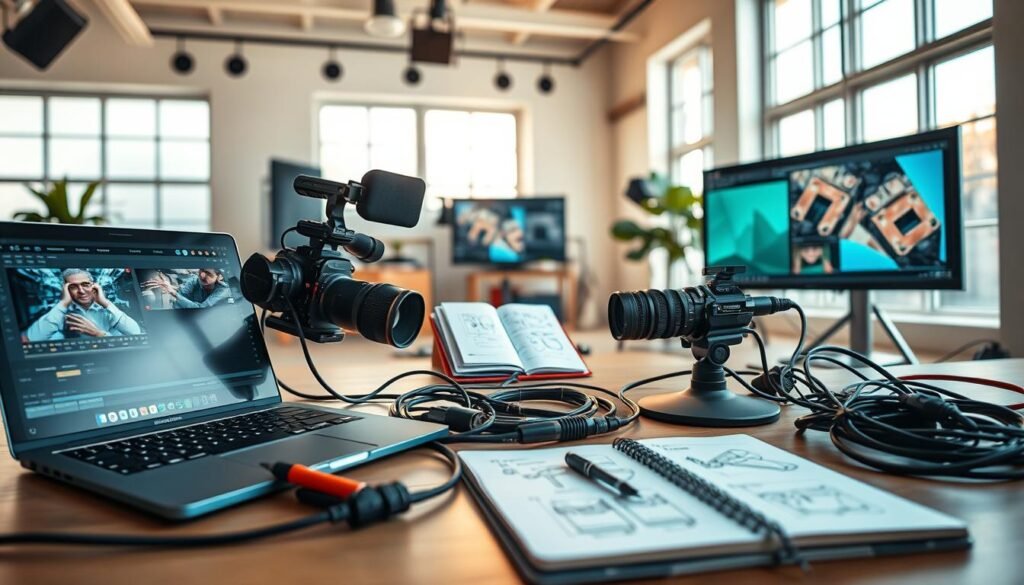
We use machine assistance to remove grunt work so creativity and judgment get more time. That approach speeds up storyboarding, editing, caption generation, and audio cleanup while keeping real people in charge of ideas and outcomes.
Speed up storyboarding, editing, captions, and audio cleanup
AI tools help immediately: faster storyboards, tighter rough cuts, near-instant captions, and cleaner audio that reduce manual time. This shortens production cycles and lowers cost per asset.
Use audience insights and testing data to personalize content
Machine learning surfaces audience patterns so we tailor hooks, examples, and CTAs for different segments without remaking each asset. We run A/B tests on hooks, thumbnails, and captions to learn quickly and refine future work.
Protect originality by keeping human ideation central
Tools should support—not replace—creative judgment. Real customer stories, lived experiences, and category expertise remain core to believability. We avoid templated scripts that feel generic and harm engagement.
- Let AI handle repetitive tasks so we focus on strategy and messaging.
- Document ethical and brand rules for claims, disclosure, and voice consistency.
- Test multiple creative variants and use data to scale winners across platforms.
When used wisely, AI is a capacity multiplier. It helps teams produce more videos and better content while preserving the human touch that drives results and trust.
Publish beyond social: embed video on our website for UX and visibility
Embedding on-site content keeps viewers focused and helps us turn attention into action.
Our website is where we control the experience, capture intent, and support conversion. Placing a clip near product details, pricing, or a signup form speeds understanding and builds trust through human presence.
Use embedded content to build trust and increase time on site
Embedded assets help people learn faster and feel confident about decisions. When a visitor watches on our domain, they are less likely to click away to unrelated views.
Prominent placement often raises time on site and improves play rate when page copy matches the clip’s promise.
Choose hosting based on goals
We pick YouTube when discoverability and external search are primary. For conversion-focused pages we choose lead-capture hosts that remove related links and support gated capture.
Be aware: YouTube embeds can divert attention to ads or related content. For decision pages, uninterrupted viewing and simple CTAs matter more than broad reach.
Make video SEO easier with structured data and clean embeds
We add JSON-LD for embedded content so search engines can read thumbnails, duration, and description. Avoid heavy JavaScript wrappers that block crawlers.
As a verification step, check Google’s video results for the page URL to confirm eligibility for a thumbnail in search.
- Match page copy to the clip so play rate rises.
- Prefer hosts that inject schema for better discoverability.
- Keep embeds lightweight to preserve page speed and UX.
| Hosting Option | Best For | On-site Experience |
|---|---|---|
| YouTube | Discoverability & external views | High reach but potential distractions from related links |
| Wistia / Lead-focused hosts | Conversion, lead capture, analytics | Controlled UX, no external links, schema support |
| Self-hosted | Full control, branding, privacy | Requires CDN and light embeds for good experience |
Distribute every video with a plan for reach, engagement, and results
A plan for distribution turns a single asset into a multi-channel campaign that drives measurable outcomes. Distribution is not optional: even strong clips underperform when we publish without a clear path to viewers and conversion.
Map each clip to the channels where it will perform best
We match intent to platform. For discovery, we prioritize Shorts, Reels, and TikTok. For depth and search, we use YouTube. For trust and B2B reach, LinkedIn performs best. For niche conversations and feedback, Reddit and community forums win.
Repurpose into shorts, clips, and episodic content
One long recording becomes many posts: 15–30s cutdowns, captioned soundbites, and episodic installments. Episodic formats reduce creative friction and train audiences to return, which lifts retention and engagement over time.
Support launches with paid boosts and creator partnerships
We add paid when launches need scale, or when a high-performing organic post merits amplification. Creator partnerships accelerate credibility when creators bring category expertise and a trusting audience.
Use social listening to surface UGC and advocacy
We monitor mentions and find customers who already talk about our brand. When we spot authentic clips, we ask permission to repost. This creates advocacy assets and fuels ongoing community engagement.
| Channel | Primary Role | Best Asset Type | When to Boost |
|---|---|---|---|
| Short-form platforms (TikTok / Reels / Shorts) | Discovery & reach | 15–30s hooks, trends | Launch hooks, top-performing clips |
| YouTube | Search & depth | Long explainers, episodic uploads | Evergreen series, high-intent funnels |
| Trust & B2B pipeline | Case studies, testimonials | Product launches, thought pieces | |
| Community (Reddit / Forums) | Conversation & feedback | Demos, AMAs, help clips | Support-driven campaigns, product Q&A |
Tying distribution back to results is simple: plan channels, repurpose assets, and amplify smartly. That process turns each piece of content into a measurable campaign that grows brands, reaches customers, and improves engagement and results.
Measure video marketing success with the metrics that matter
Our measurement starts with the outcome we want, then we pick the metrics that prove it. Choosing goals first prevents us from mistaking raw views for real business impact.
Track the right diagnostic metrics
We monitor reach for distribution, play rate for relevance, engagement for resonance, retention for content quality, and sentiment for brand impact.
Tie assets to conversions and lead quality
We map analytics events and push conversions into CRM so we can assess lead quality, not just top‑of‑funnel signals. That matters: 85% of marketers report that videos helped them generate leads.
Test rapidly and report by cohort
Our A/B plan tests hooks, first on-screen lines, thumbnail text, CTAs, and lengths. We report by cohort—new vs. returning viewers, paid vs. organic, platform-by-platform—to spot where to double down.
- Publish fast, measure quickly, iterate in short learn-and-ship cycles.
- Use analytics and CRM integrations to link content to conversion and pipeline.
- Choose the metric that proves progress toward your goals, not the one that looks best on a dashboard.
Common video marketing mistakes we avoid to protect performance
Small process errors often explain big drops in engagement more than camera quality ever will. We list the common failures we stop before they cost reach, conversions, and team momentum.

Making content without a defined audience or funnel stage
When we create videos without a clear audience and funnel goal, relevance suffers. Views may rise, but retention and conversion fall.
We always name the audience and pick awareness, consideration, or decision as the primary stage before scripting.
Over-investing in polish when lo-fi native formats win
Lo-fi native content is the norm on many platforms. Excessive production can slow cadence and reduce perceived authenticity.
We reserve high polish for hero assets and keep social-native pieces fast, frequent, and genuine.
Publishing with no distribution plan and then blaming the content
Publishing once and expecting organic reach is a common failure pattern. No amplification, no repurposing, no testing equals missed potential.
We map channels, schedule repurposed edits, and plan paid boosts when scale matters.
Chasing views instead of measuring outcomes tied to goals
Optimizing for raw views can distort priorities. We measure play rate, retention, CTA performance, and conversion by cohort.
If a clip gets many views but few next actions, we treat it as a learning signal, not a win.
Corrective checklist to diagnose and fix underperformance
- Define funnel stage and the target audience.
- Rewrite the hook to match intent and platform norms.
- Clarify the CTA so the next action is obvious.
- Adjust format and length to fit the channel.
- Add a distribution and A/B testing plan before publishing.
Avoiding these mistakes protects results and keeps our teams moving. Small fixes in strategy and distribution often unlock much larger gains than chasing a better camera or longer edit.
Turn these tips into a repeatable video engine that drives growth
Here we describe how to build a repeatable process that turns creative work into measurable business momentum.
Start with one goal, name the audience, choose the story, pick a format, plan production, publish across social media and your site, distribute intentionally, and measure outcomes. This workflow makes each asset purposeful and testable.
Build a small content flywheel so one video creates multiple clips for different platforms. Repeatability protects quality: stable processes free creative time for stronger ideas and clearer messaging.
Governance is simple: a content calendar, reusable templates, and standardized reports that tie work to company results. Invest in a lightweight in-house studio to ship faster and keep institutional knowledge.
Action: pick one funnel stage to improve this quarter, produce a short series, track outcomes, and scale what works.